

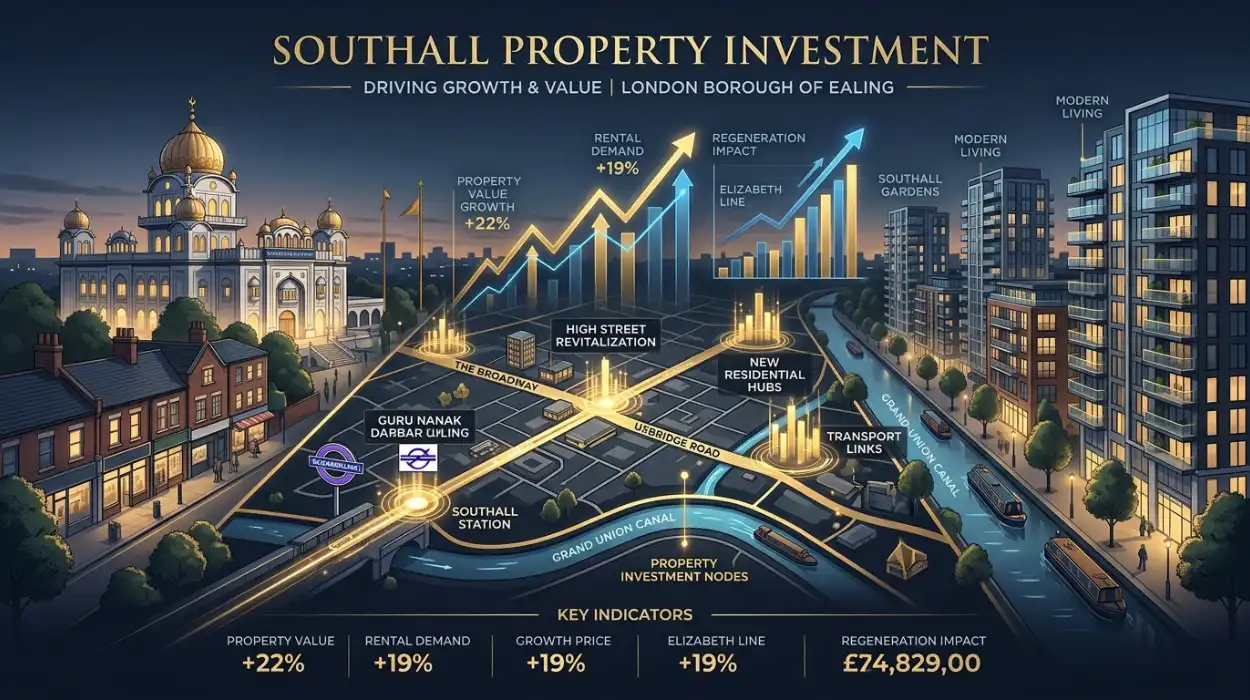
Southall has spent years attracting attention from property investors looking beyond the most expensive parts of London. Located in the London Borough of Ealing, the area combines relatively accessible property prices with strong transport connections, a large established community, major regeneration projects and proximity to Heathrow. The arrival of the Elizabeth line has further strengthened Southall’s position within west London, making journeys towards central London and Heathrow considerably more convenient.
But does that automatically make Southall one of London’s best property investment areas today? Not necessarily. Property investment depends on more than transport improvements or regeneration announcements. Investors need to consider purchase prices, rental demand, tenant profiles, future supply, local amenities, infrastructure, financing costs and the potential for capital growth. Southall still has many of the characteristics investors look for, but its opportunities need to be assessed carefully rather than treated as a guaranteed growth story.
Why Southall Has Attracted Property Investors
Southall’s investment appeal has traditionally come from its combination of affordability, connectivity and population growth. Compared with many established west London locations, the area has offered opportunities to purchase residential property without entering the highest price brackets found closer to central London.
Its location is particularly important. Southall sits on the Elizabeth line between Hayes & Harlington and Hanwell, giving residents direct rail access towards Paddington and central London. It is also relatively close to Heathrow Airport, while road connections provide access to other parts of west London.
The area is also an established commercial and cultural centre rather than simply a commuter suburb. Southall Broadway is well known for its independent shops, restaurants, food businesses and services, creating a local economy that supports both residents and visitors. This combination of residential and commercial activity can be useful for landlords because tenants are not solely dependent on commuting into central London.
Southall has also been formally recognised as an area with significant development potential. The Mayor of London identifies Southall as an Opportunity Area with potential for around 9,000 new homes and 3,000 new jobs by 2041.
How the Elizabeth Line Has Changed Southall
Transport infrastructure is one of the strongest arguments behind the Southall property investment case.
Southall station is now part of the Elizabeth line network and has benefited from improvements including a new ticket hall, extended platforms, step-free access and better passenger information.
For homeowners and tenants, connectivity can influence how attractive a neighbourhood feels. A professional working in central London may be more willing to consider Southall when travelling into the city is straightforward. Likewise, airport workers and people employed around Heathrow can benefit from Southall’s position in west London.
For investors, the important point is not simply that the Elizabeth line exists. The bigger question is whether improved connectivity continues to support demand for homes over the long term.
Transport improvements can increase the attractiveness of areas that were previously overlooked, but investors should avoid assuming that all of the potential price growth has yet to happen. Some of the Elizabeth line effect was anticipated before the railway opened, meaning current prices already reflect part of the area’s improved connectivity.
Regeneration Remains a Major Part of the Investment Story
Southall is not simply benefiting from transport investment. It is undergoing wider regeneration involving housing, public spaces, commercial areas and infrastructure.
The Southall Opportunity Area has been planned as a major growth location, with development focused around former industrial land and new neighbourhoods. Earlier planning frameworks targeted at least 6,000 new homes and 3,000 jobs, while the current London Plan identifies potential for approximately 9,000 homes and 3,000 jobs by 2041.
One of the most significant developments is The Green Quarter, a large regeneration project on the former Southall Gasworks site. The project is introducing new homes alongside green space, community facilities and other infrastructure.
Ealing Council documents show that later phases of The Green Quarter have included proposals for additional homes, commercial uses, education facilities, sports facilities, public spaces and healthcare provision. A 2024 planning proposal also included a commitment to 35% affordable housing and significant financial contributions towards infrastructure in Southall.
For investors, regeneration can create opportunities but also introduces a crucial consideration: supply.
Does New Housing Help or Hurt Investors?
Large-scale development can make an area more attractive, but it can also increase competition between properties.
If thousands of new homes are delivered, landlords may face more competition when marketing similar flats. This can affect rental growth, particularly where new-build apartments have similar layouts, amenities and target tenant groups.
On the other hand, successful regeneration can increase the overall appeal of a neighbourhood. New parks, improved streets, healthcare facilities, schools, shops and public spaces can strengthen the local environment and encourage more people to live in the area.
The Green Quarter illustrates this balance. Development is bringing substantial new housing and infrastructure, while the wider Southall regeneration strategy aims to create a more diverse economy and improve the town centre. Ealing Council describes Southall as a growing neighbourhood with potential for new employment and further investment.
Therefore, investors should not simply ask how many homes are being built. They should ask what type of homes are being built, where they are located, who will live in them and whether local infrastructure is keeping pace with population growth.
Rental Demand Is an Important Consideration
For buy-to-let investors, rental demand can be just as important as potential capital appreciation.
Southall has a diverse population and a broad employment catchment. Its location makes it relevant to commuters travelling towards central London, Heathrow and other employment centres across west London.
A typical tenant might be a professional who wants access to London but does not want to pay the premium associated with more central neighbourhoods. Another potential tenant could work around Heathrow or in the wider west London economy and prioritise convenient transport.
Families may also be attracted by access to local schools, shops, restaurants, healthcare services and community facilities.
However, rental demand should be assessed at property level rather than assumed from the neighbourhood’s reputation. A well-located two-bedroom flat close to Southall station may appeal to a different tenant group from a larger family house several streets away.
Investors should therefore research local rents, comparable properties, vacancy periods, service charges and tenant demand before purchasing.
Southall Versus Other West London Investment Locations
One reason Southall continues to attract attention is its position within the wider west London property market.
Neighbouring locations such as Hanwell, Ealing, Greenford and Hayes each offer different combinations of price, transport, housing stock and rental demand. More established areas of Ealing can command higher prices, while Hayes benefits from its position on the Elizabeth line and proximity to Heathrow.
Southall sits somewhere between these different investment propositions. It has an established town centre and community, while significant regeneration means parts of the neighbourhood are still evolving.
This can create an interesting opportunity for investors who are comfortable with a longer investment horizon. However, comparing properties purely by price can be misleading. Two homes at similar prices may have very different rental yields, maintenance requirements, lease terms, service charges and prospects for resale.
What Are the Main Risks?
Southall is not a risk-free investment area.
The first consideration is property supply. Continued development could increase competition between landlords, particularly in the new-build apartment market.
The second is affordability. Rising mortgage rates and other ownership costs can reduce an investor’s cash flow even when rental demand remains healthy. Service charges can also make some leasehold flats less attractive from a yield perspective.
There are also infrastructure pressures. Planning discussions around major developments have included concerns about traffic, healthcare, affordability and pressure on local services. These issues matter because successful property investment depends partly on whether infrastructure grows alongside housing.
Another consideration is that regeneration takes time. Investors buying on the expectation of rapid capital growth may be disappointed if projects are delayed or market conditions change.
Southall should therefore be viewed as a long-term investment proposition rather than a guaranteed short-term property flip.
Is Southall Better for Capital Growth or Rental Income?
The answer depends on the individual property.
An investor seeking rental income might prioritise a property with a strong tenant market, manageable service charges and a purchase price that produces an acceptable rental yield.
An investor focused on capital growth may be more interested in properties positioned near transport improvements, regeneration areas and established amenities.
The strongest strategy may involve balancing both objectives. A property that has reasonable rental demand while benefiting from the area’s long-term regeneration can provide more flexibility than one purchased solely because it appears cheap.
Investors should calculate the expected gross and net yield rather than relying on advertised rental figures. Mortgage costs, management fees, maintenance, insurance, service charges, ground rent where applicable and periods without tenants can materially change the final return.
Who Should Consider Investing in Southall?
Southall may suit investors who have a medium- to long-term outlook and are comfortable researching individual properties carefully.
It could appeal to landlords seeking access to west London’s rental market without necessarily paying the prices associated with prime central locations. It may also interest investors who believe transport connectivity and regeneration will continue strengthening the area.
However, it may be less suitable for someone looking for immediate and guaranteed capital appreciation. The scale of new development means investors need to understand the local supply pipeline rather than relying on a simple regeneration narrative.
First-time investors should also consider whether they understand leasehold obligations, mortgage affordability, taxation, landlord responsibilities and the costs associated with maintaining a property.
So, Is Southall Still One of London’s Best Property Investment Areas?
Southall remains one of the more interesting property investment locations in west London, but calling it one of the “best” areas depends on an investor’s strategy.
Its strongest advantages are clear: the Elizabeth line, proximity to Heathrow, an established town centre, strong community identity, regeneration activity and substantial planned growth. Southall’s designation as an Opportunity Area reinforces the long-term development story.
At the same time, investors need to account for increasing housing supply, infrastructure pressure, financing costs and differences between individual properties.
The most sensible conclusion is that Southall still deserves serious consideration, particularly for investors with a long-term horizon. Rather than asking whether Southall is universally the best place to invest, prospective buyers should ask whether a specific property offers the right combination of price, rental demand, location, condition, costs and future potential.
For tourists and local residents, the same regeneration that interests investors is also reshaping Southall as a place to live, work, shop and visit. For property investors, that ongoing transformation is the central opportunity — and the main factor that needs careful evaluation.
Frequently Asked Questions
Is Southall a good area for property investment?
Southall can be a strong property investment option because of its Elizabeth line connectivity, proximity to Heathrow, established amenities and long-term regeneration. However, investment performance depends on the individual property’s price, rental demand, costs and location.
Will Southall property prices increase?
Southall has several factors that could support long-term property demand, including transport connectivity and regeneration. However, no property market can guarantee future price growth, so investors should consider local supply, economic conditions and affordability.
Is Southall good for buy-to-let investment?
Southall can appeal to buy-to-let investors because it serves commuters, Heathrow workers, families and professionals seeking west London accommodation. Investors should calculate net rental yield after mortgage, maintenance, management and service costs.
How has the Elizabeth line affected Southall?
The Elizabeth line has improved Southall’s connection with central London and Heathrow. Southall station has also received infrastructure improvements, strengthening the area’s appeal to residents and commuters.
Is Southall still affordable compared with other London areas?
Southall has historically been considered relatively accessible compared with many established west and central London locations. However, affordability varies considerably by property type, development, condition and proximity to the station.
Is The Green Quarter good for property investment?
The Green Quarter is one of Southall’s major regeneration projects and is introducing new homes, green spaces and community infrastructure. Investors should compare individual properties carefully, particularly service charges, rental demand, lease terms and competing new-build supply.
What should I check before buying an investment property in Southall?
Check the purchase price against comparable properties, realistic rental income, net yield, lease length, service charges, maintenance costs, transport access, development plans and potential competing housing supply. Professional legal, mortgage and property advice can also help before committing to a purchase.