
For residents who want to cycle but do not have a garage, shed or suitable indoor storage, finding somewhere secure to leave a bicycle can be one of the biggest practical barriers. In Ealing, this is particularly relevant on residential streets where homes may have limited private outdoor space.
So, are there any new bicycle hangars in Ealing being installed on residential streets? Yes. Ealing Council has continued expanding secure on-street cycle storage, with further installations planned and approved as part of its 2025/26 programme. The council has also confirmed that demand remains high and that locations are selected according to resident requests, cycle theft levels, community support and the distribution of existing facilities.
This means residents in areas such as Ealing Common, North Acton, Northfield, Pitshanger, South Acton, Southfield and other parts of the borough may see new or recently approved bicycle hangars appearing on residential roads.
What Is A Bicycle Hangar?
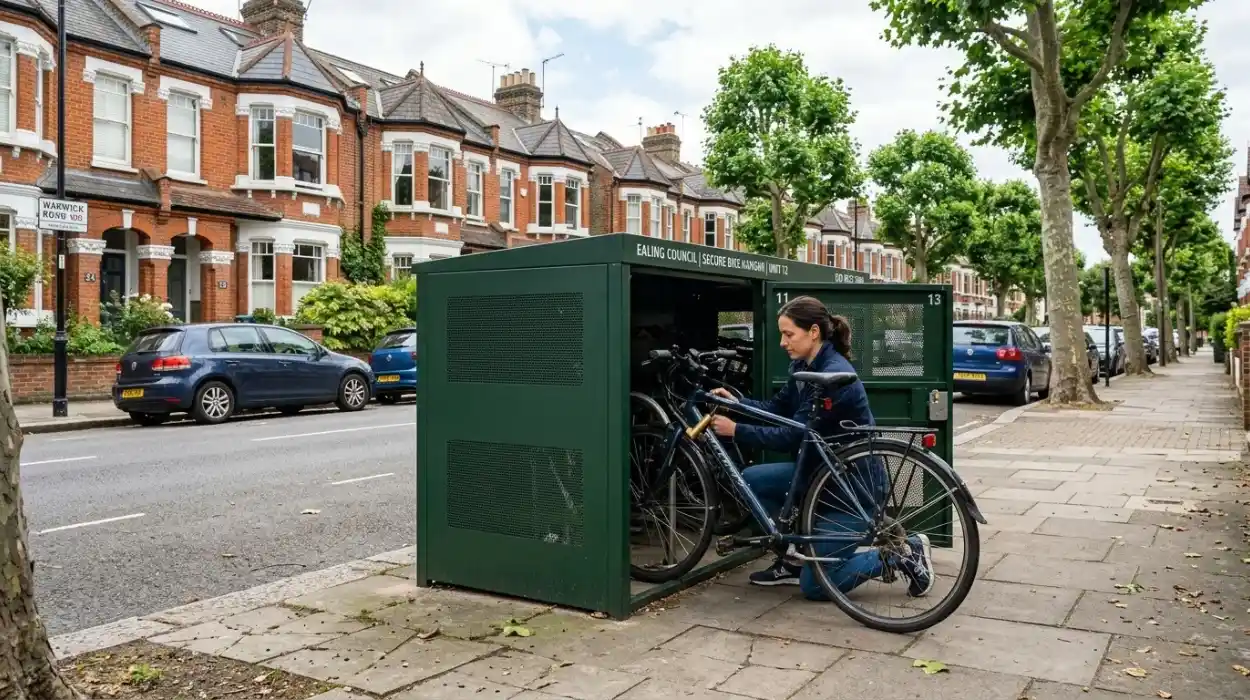
A bicycle hangar is a secure, enclosed storage unit installed on the street for residents who need somewhere safer to keep their bicycles. Rather than leaving a bike against a wall, railing or outside a home, residents can rent an individual space inside a locked communal unit.
Ealing Council says its hangars provide secure and dry storage and are designed to accommodate up to six bicycles while taking up roughly half the space of a traditional parking bay. Access is restricted to members with the appropriate key or access arrangement.
This makes the facilities particularly useful for flats, terraced houses and other properties where storing a full-size bicycle indoors is difficult.
For example, someone living in a first-floor flat in South Acton might cycle to work every day but have no lift-accessible storage area. A nearby hangar can provide a practical alternative to carrying the bicycle through the property or leaving it exposed outdoors.
Where Are New Bicycle Hangars Being Installed In Ealing?
The council’s 2025/26 programme has included several batches of proposed bicycle hangars.
The third batch, for example, went through a formal consultation process in February and March 2026. Proposed locations included Agnes Road, Armstrong Road, Balfour Road, Bedford Road, Burlington Gardens, Burns Road, Manton Avenue, Norwood Gardens, Olive Road, Park Hill, Lancaster Road and Parkfield Drive. The council received eight responses concerning six of the twelve locations and decided to proceed with installation at the locations covered by the officer decision.
These locations demonstrate that the programme is not restricted to major town centres. Residential roads are an important part of Ealing’s approach to cycle storage.
Earlier 2025 installations also covered areas including Ealing Common, Hanwell Broadway, North Acton, Northfield, Pitshanger, South Acton, Southfield and Walpole. A second batch included further locations in Ealing Common, North Acton, South Acton and Southfield.
The council has therefore been installing hangars across different parts of the borough rather than concentrating them in a single neighbourhood.
Is Ealing Council Still Expanding Cycle Hangars?
The wider programme indicates that this is not simply a one-off installation project.
Ealing Council originally committed to delivering at least 150 bike hangars across the borough by 2026. According to the council’s progress report, that target had already been reached by October 2025, providing 900 bicycle spaces, with another batch planned for early 2026.
The council’s current transport information also explicitly identifies installing more cycle hangars on residential streets as part of its efforts to make cycling easier and safer.
For local residents, this is significant because reaching the original 150-hangar target does not necessarily mean that every area with demand has received a facility. The council continues to receive requests and assess possible locations.
How Does Ealing Decide Where A New Hangar Goes?
A common question from residents is why one street receives a hangar while another nearby street does not.
Ealing Council uses several factors when assessing locations. These include the number of requests from residents, the ability to provide bicycle parking close to people’s homes, bicycle theft rates, community support and the distribution of hangars throughout the borough.
This approach means that simply having one person request a hangar does not automatically guarantee installation.
The council also considers whether a proposed location is suitable from a highway and parking perspective. A hangar normally occupies part of the road space associated with a parking bay, so the impact on existing parking can become an important issue during consultation.
This explains why some residents may support a new facility because it provides storage for several cyclists, while others may be concerned about losing car parking capacity.
Why Are Some Residents Concerned About Losing Parking?
Parking pressure is one of the most frequently raised issues surrounding on-street bicycle hangars.
A typical hangar can provide storage for several bicycles while occupying considerably less space than the number of separate parking positions that might otherwise be required for those bicycles. However, installing it on a residential road can still mean changing how kerbside space is allocated.
Ealing Council has acknowledged parking concerns in its consultation decisions. Its stated approach is that providing cycle storage for several residents can offer a greater community benefit than retaining the same space for one car, particularly where there is strong demand for secure bicycle storage.
This does not mean parking concerns are ignored. Proposed sites are subject to consultation, objections are considered and formal Traffic Management Orders may be required before installation.
For someone who relies on a car, the change can therefore feel significant. For a resident who owns a bicycle but has nowhere safe to store it, the same space can represent a major improvement to everyday mobility.
How Does The Consultation Process Work?
Residents should not assume that seeing a proposed hangar means installation is already guaranteed.
Ealing’s process involves local consultation. Residents living close to a proposed site can receive a letter explaining the proposal and giving them an opportunity to comment. Responses are then considered before the council decides whether to proceed.
If a location remains suitable, a Traffic Management Order can follow. This introduces a statutory consultation period, during which objections can be submitted.
The 2025/26 Batch 3 proposals, for example, were subject to a formal objection period from 18 February to 11 March 2026.
This staged process is useful because it gives residents an opportunity to raise practical issues such as parking pressure, access, location suitability and potential effects on the street.
Who Can Use A New Bicycle Hangar?
A hangar is primarily intended for residents who need secure bicycle storage close to home.
Ealing Council explains that the facilities are particularly valuable for people who do not have adequate space at home for their bicycles. The compact design allows several residents to share secure storage rather than each person requiring a separate storage structure.
A resident therefore does not generally treat the hangar like ordinary unrestricted public cycle parking. Spaces are allocated to users, and access is controlled.
This can be particularly useful for commuters, families with bicycles, residents of flats and people who cycle regularly but cannot safely store their bicycle inside their property.
What About Bicycle Theft?
Security is one of the strongest reasons residents request bicycle hangars.
Leaving a bicycle locked outdoors for long periods exposes it to weather and potential theft. A secure communal hangar creates an additional physical barrier and limits access to authorised users.
However, a hangar should not be viewed as a reason to ignore basic bicycle security. Ealing Council advises residents to use two locks, register bicycles with BikeRegister and check that the hangar is properly secured after use.
The council has also previously considered security concerns raised during consultations and reported that its Community Safety Team found no correlation between installed hangars and increased crime at those locations.
What Should You Do If Your Ealing Street Does Not Have A Hangar?
Residents do not have to wait for the council to identify their street independently.
Ealing Council allows people to request a new bike hangar for their area. Requests are then considered alongside wider demand and the council’s location criteria.
If several households on the same residential road need secure bicycle storage, making the demand clear can be useful. The council’s criteria specifically include the volume of resident requests, so local interest forms part of the assessment process.
It is also worth checking whether an existing hangar nearby has available capacity before requesting a completely new one.
What Happens After A Hangar Is Installed?
Once a hangar is approved and installed, residents can apply for a secure parking space through the relevant management system.
Ealing Council’s current information states that Falco manages the borough’s bike hangars, with applications for spaces in new hangars handled through Falco and existing locations handled through Hooplr.
This management arrangement is important for residents because the installation of the physical structure is only one part of the process. Availability, membership and access are managed separately.
The council’s current system also means residents should check the latest official information rather than relying on older references to previous operators.
What Does The Expansion Mean For Ealing’s Residential Streets?
The continuing rollout reflects a wider change in how residential kerbside space is being used.
Ealing is trying to make cycling a more practical transport option alongside walking, public transport and car travel. Secure storage matters because cycling infrastructure is less useful if people cannot safely keep a bicycle near their home.
A commuter in Northfield, for example, might be willing to cycle to Ealing Broadway station but could be discouraged if there is nowhere secure to leave the bicycle overnight. Similarly, a family in North Acton may use bicycles for local journeys but struggle to store several bikes inside a small property.
A hangar does not solve every cycling problem, but it removes one important barrier.
Are More Bicycle Hangars Likely To Appear?
The evidence suggests that Ealing’s cycle-storage programme is continuing beyond the original target. The council has already reached its commitment to install at least 150 hangars, while reporting that demand remains high and that additional locations were planned.
Residents should therefore expect the programme to remain relevant, although the exact timing and location of future installations can change following consultation, objections, technical assessments and available funding.
The best indication for a particular street is the council’s current bike-hangar consultation information rather than assumptions based on installations elsewhere in the borough.
For residents who want a hangar nearby, submitting a location request and watching local consultation notices are the most practical steps.
Frequently Asked Questions About New Bicycle Hangars In Ealing
Are new bicycle hangars being installed in Ealing?
Yes. Ealing has continued installing and approving new bicycle hangars as part of its borough-wide cycle-storage programme, including residential-road locations during the 2025/26 programme.
Which Ealing areas have recently received or been considered for new hangars?
Recent programmes have included areas such as Ealing Common, North Acton, Northfield, Pitshanger, South Acton, Southfield, Walpole and several individual residential roads included in the 2025/26 batches.
Can I request a bicycle hangar on my residential street?
Yes. Ealing Council allows residents to suggest locations for new bike hangars. Requests are assessed alongside factors such as local demand, bicycle theft rates, community support and borough-wide distribution.
Will a bicycle hangar take away a car parking space?
Usually, a street hangar uses kerbside space associated with a parking bay. Parking impact is therefore considered during the consultation and decision-making process.
How many bicycles can an Ealing bike hangar store?
The council states that its compact hangar design can accommodate up to six bicycles while using roughly half the space of a parking bay.
Are Ealing bicycle hangars secure?
They provide enclosed, key-access storage for authorised users. The council also recommends continuing to use good bicycle-security practices, including suitable locks and bicycle registration.
How can I find out whether a hangar is planned near my home?
Check Ealing Council’s current bike-hangar consultation and cycle-parking information. If your street is under consideration, nearby residents may receive information about the proposal and an opportunity to comment.