
Ealing is one of West London’s best-known residential areas, recognised for its leafy streets, historic buildings, attractive parks and convenient connections to central London. Its nickname, the “Queen of the Suburbs”, reflects a reputation that developed during the nineteenth and early twentieth centuries, when Ealing became an increasingly desirable place to live outside the crowded capital.
But why is Ealing called the Queen of the Suburbs, and what makes the title meaningful today? The answer lies in a combination of history, architecture, transport, green spaces and the growth of suburban life. Ealing offered residents a balance between access to London’s employment and cultural opportunities and the appeal of a greener, more spacious residential environment.
The phrase is also connected with the people who shaped the area. Charles Jones, Ealing’s borough surveyor for many years, played an important role in its civic development. Meanwhile, railway expansion helped turn a largely rural settlement into a thriving suburb.
Today, Ealing is a diverse urban area with busy shopping streets, independent businesses, cultural attractions and established residential neighbourhoods. Its historic nickname remains an important part of local identity, even as the borough continues to change.
What Does the Queen of the Suburbs Mean?
The expression “Queen of the Suburbs” describes Ealing’s historical reputation as an attractive, well-planned and desirable residential district on the outskirts of London. Rather than referring to an official royal title, it is a promotional nickname that captured the area’s appeal during a period of rapid suburban expansion.
During the Victorian and Edwardian eras, London’s population grew substantially. Many people wanted homes that offered more space, quieter streets and access to gardens while remaining within reach of employment in the capital. Railway services made this lifestyle increasingly practical.
Ealing suited these preferences. Developers built houses on land that had previously been used for farming, while new roads, shops, schools and public amenities supported the growing population. Green spaces and tree-lined streets helped distinguish the area from more densely built parts of London.
The word “queen” suggested quality, attractiveness and a leading position among London’s suburbs. It was a memorable way to communicate Ealing’s appeal to prospective residents.
However, the nickname should not be interpreted as meaning that Ealing was always wealthy or that every neighbourhood developed in the same way. The wider borough contains communities with different histories, housing types and economic circumstances. The phrase mainly reflects the image associated with Ealing’s established residential districts during its period of suburban growth.
How Ealing Changed from a Rural Settlement into a Suburb
To understand the nickname, it helps to look at Ealing before the expansion of modern London.
For much of its early history, Ealing was a rural settlement surrounded by fields, farms and open land. Agriculture shaped local life, and the parish community centred on institutions such as St Mary’s Church. Travel to London was possible, but it was slower and less convenient than it would become after the introduction of railway services.
The arrival of the Great Western Railway at Ealing in 1838 marked a major turning point. Rail travel made it easier for residents to reach London and encouraged developers to build housing for people who wanted to live outside the capital’s busiest districts.
As transport improved, more land was developed for homes. Residential streets expanded, shops appeared to serve local households, and the area gradually acquired the infrastructure of a growing town.
This transformation was part of a wider change across London. Railway companies and property developers helped create suburbs where people could commute to work while enjoying a different residential environment. Ealing became particularly associated with the attractive, green and spacious side of this suburban movement.
The result was not an overnight transformation. It was a gradual process involving transport investment, new housing, public services and changing expectations about where people wanted to live.
Charles Jones and the Origin of Ealing’s Nickname
One of the most important figures in Ealing’s suburban development was Charles Jones, who served as the borough surveyor from 1863 to 1913. His work helped shape the streets, public buildings and civic infrastructure that supported the growing town.
Jones popularised the phrase “Queen of Suburbs” in his 1902 book, Ealing from Village to Corporate Town. The wording was initially used without the word “the”, which became part of the familiar expression in later years. The nickname presented Ealing as a place that offered the advantages of town life alongside the attractions of the countryside.
Jones’s influence can also be seen in Ealing Town Hall, a distinctive Victorian Gothic building on New Broadway. Designed by Jones in 1888, the town hall reflected the confidence of a community that had grown substantially and wanted civic buildings to match its increasing importance. It remains one of the area’s notable historic landmarks.
The nickname was also a form of promotion. Estate agents, property developers and local businesses had an interest in presenting Ealing as a desirable place to live. Descriptions of its pleasant streets, good schools, transport links and public amenities helped attract prospective residents.
It is worth remembering that the slogan represented an ideal rather than a complete picture of everyday life. Like other growing towns, Ealing experienced social problems and differences in wealth. Nevertheless, the phrase proved memorable and became firmly associated with the area.
Green Spaces That Helped Define Ealing
Ealing’s parks and tree-lined streets were central to its suburban reputation. They offered residents opportunities for recreation and relaxation while distinguishing residential neighbourhoods from the more densely built parts of London.
Walpole Park and Pitzhanger Manor
Walpole Park is one of Ealing’s most recognisable green spaces. It was opened as a public park in 1901, providing residents with an accessible place to walk, relax and spend time outdoors. Its grounds are closely connected with Pitzhanger Manor, the former country residence of architect Sir John Soane.
The park remains relevant to the Queen of the Suburbs identity because it demonstrates how public green space became part of suburban life. Today, visitors can enjoy the lawns, mature trees, ponds and cultural activities while exploring the historic manor and gallery.
Ealing Common
Ealing Common also contributes to the area’s distinctive landscape. Its open space and established trees provide a contrast with the surrounding roads and buildings. The tree-lined avenues developed during the nineteenth century helped reinforce Ealing’s image as a greener residential destination.
Mount Park and Residential Architecture
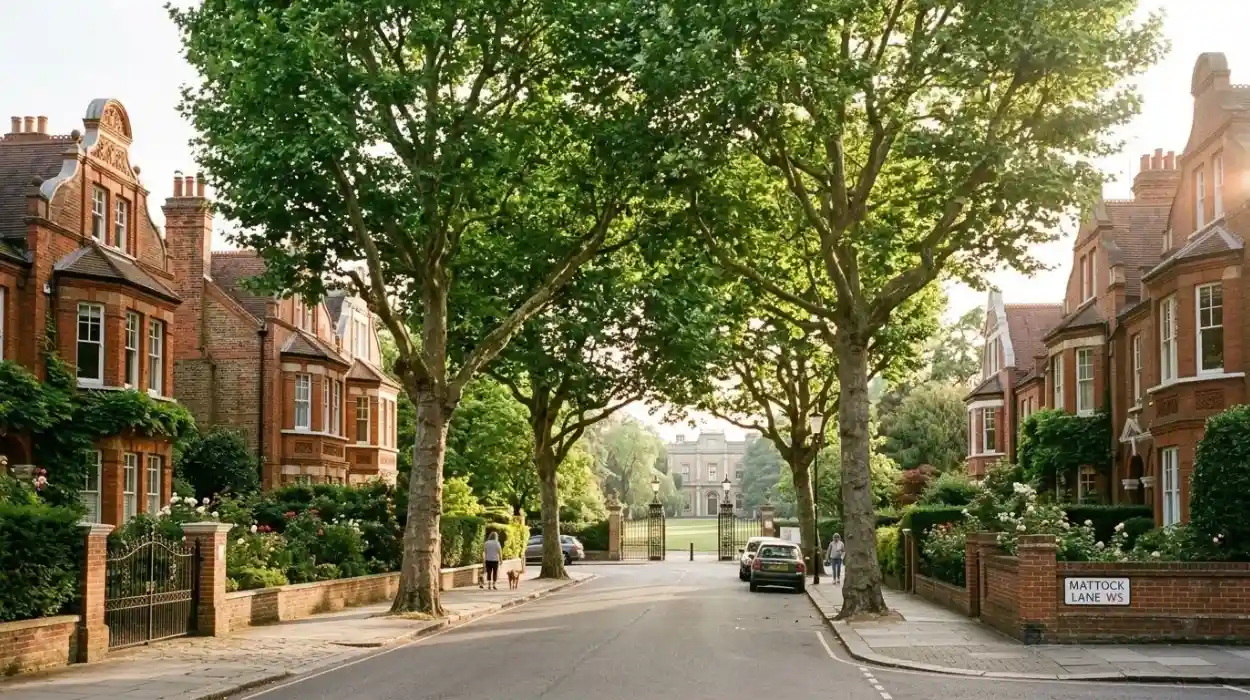
The Mount Park area illustrates another element of Ealing’s appeal: spacious housing and carefully planned residential streets. Victorian and Edwardian homes, mature gardens and architectural variety remain visible in parts of the neighbourhood.
For someone considering moving to Ealing, these features can make a practical difference to everyday life. Parks provide places for exercise and family outings, while established residential streets offer a sense of continuity amid ongoing development.
How Railways and Trams Made Ealing Desirable
Green surroundings alone could not have made Ealing a successful suburb. Transport was equally important.
The Great Western Railway arrived in 1838, followed by further railway and Underground connections that improved access to London. The District Railway reached Ealing in 1879, while electric trams began running along the Uxbridge Road in 1901. These developments made commuting and local travel easier as the town expanded.
Better transport allowed people to live in Ealing while working in central London. It also helped local shops and services reach a larger customer base. Over time, Ealing Broadway developed into a commercial centre serving both residents and travellers.
The same principle remains important today. Ealing Broadway station connects the area with National Rail, the District and Central Underground lines, and the Elizabeth line. Modern connections continue the long-standing relationship between Ealing’s residential appeal and access to the capital.
For visitors, these links make it relatively straightforward to combine a day in Ealing with sightseeing elsewhere in London. For residents, they offer access to employment, education and cultural activities across the city.
Is Ealing Still the Queen of the Suburbs Today?
Ealing’s nickname remains widely recognised, but the area has changed considerably since the early twentieth century. It is no longer simply a leafy residential retreat. It is a busy urban centre with shopping facilities, restaurants, cultural venues, modern housing and communities from many backgrounds.
Ealing Broadway combines historic streets with contemporary retail and transport infrastructure. Southall is well known for its South Asian businesses, food and cultural life, while Acton, Greenford, Hanwell, Northolt and Perivale each have their own identities within the wider borough.
The borough’s film heritage adds another dimension. Ealing Studios, established in the early twentieth century, became famous for classic British comedies and remains part of the area’s cultural story. This creative history broadens Ealing’s identity beyond its reputation for parks and suburban housing.
Some residents may feel that the traditional nickname no longer fully describes a borough with diverse neighbourhoods, industrial areas, busy high streets and modern developments. Others value it as a reminder of the area’s heritage and its long-standing appeal as a place to live.
Both views can be understood. The nickname is most useful when treated as a historical description of Ealing’s development rather than a claim that every part of the borough looks or feels the same.
How to Explore Ealing’s Suburban Heritage
Visitors who want to understand why Ealing became known as the Queen of the Suburbs can explore several places on foot.
Start around Ealing Broadway and Haven Green to see how transport continues to shape the town centre. From there, walk towards Ealing Green and St Mary’s Church to discover older elements of the settlement.
Continue to Walpole Park and Pitzhanger Manor to experience the green spaces and architecture associated with Ealing’s history. If time allows, explore the streets around Mount Park and Ealing Common, where historic housing and mature trees help explain the suburb’s reputation.
This route offers a practical way to connect the main themes of Ealing’s development: its rural origins, the growth of transport, the construction of residential neighbourhoods and the preservation of public spaces.
Visitors should check opening times for indoor attractions before travelling. Parks and public streets can be enjoyed independently, while access to particular buildings or facilities may depend on scheduled opening hours.
Ealing is called the Queen of the Suburbs because it developed a reputation for combining attractive residential streets, green spaces and civic amenities with convenient transport connections to London. The phrase was popularised by borough surveyor Charles Jones in 1902, during a period when Ealing was becoming an established and desirable suburb.
Its parks, Victorian architecture, railway history and cultural landmarks help explain why the nickname has endured. Although modern Ealing is more diverse and urban than the idealised suburb described over a century ago, its historic identity remains visible throughout the area.
For residents, the title connects everyday surroundings with a significant period of local history. For visitors, it provides a useful starting point for exploring the parks, buildings and transport links that helped shape one of West London’s best-known neighbourhoods.
Frequently Asked Questions About Why Ealing Is Called the Queen of the Suburbs
Who first called Ealing the Queen of the Suburbs?
Ealing borough surveyor Charles Jones popularised the phrase “Queen of Suburbs” in his 1902 book, Ealing from Village to Corporate Town. The familiar version, “Queen of the Suburbs”, became established later.
Why was Ealing considered a desirable suburb?
Ealing offered a combination of green spaces, attractive residential streets, schools, shops and improved transport links to central London. These features appealed to people seeking more space outside the capital’s busiest areas.
When did Ealing become a suburb?
Ealing’s suburban transformation accelerated during the nineteenth century, particularly after the Great Western Railway arrived in 1838. Housing, roads and public amenities expanded as transport made commuting easier.
What role did Charles Jones play in Ealing’s history?
Charles Jones served as borough surveyor from 1863 to 1913. He helped shape Ealing’s infrastructure and designed its distinctive Town Hall, contributing to the civic identity associated with the Queen of the Suburbs nickname.
Which parks help explain Ealing’s nickname?
Walpole Park and Ealing Common are important examples of the green spaces that contributed to Ealing’s reputation. Their trees and open areas provide a contrast with the built-up streets of London.
Is Ealing still known as the Queen of the Suburbs?
Yes. The nickname remains widely used to describe Ealing’s historic suburban character, green spaces and residential appeal, although the modern borough also includes busy commercial centres and diverse neighbourhoods.
What can visitors see to learn about Ealing’s history?
Visitors can explore Ealing Green, St Mary’s Church, Walpole Park, Pitzhanger Manor, Ealing Town Hall and the residential streets around Mount Park. Together, these places illustrate the area’s transformation from rural settlement to modern suburb.