
Potholes, damaged pavements and broken streetlights can create genuine problems for people travelling around Ealing. A pothole can affect drivers, cyclists and motorcyclists, while a damaged pavement may create difficulties for pedestrians, wheelchair users and people pushing prams. A faulty streetlight can also make a road, footpath or crossing feel less safe after dark.
If you notice one of these problems, reporting it to the right authority is important. Ealing Council provides separate online reporting routes for road and pavement problems and faulty street lighting. The council also uses routine inspections to identify defects, but residents can report issues that appear between inspections.
Understanding which form to use, what information to provide and when a problem should be treated as urgent can make the reporting process much easier.
How Do I Report a Pothole in Ealing?
For a pothole or other road-surface problem on a council-maintained road, you should use Ealing Council’s road or pavement problem reporting service. The council’s online form covers potholes and road damage alongside problems such as blocked drains, damaged kerbs, road markings, manhole covers and damaged street furniture.
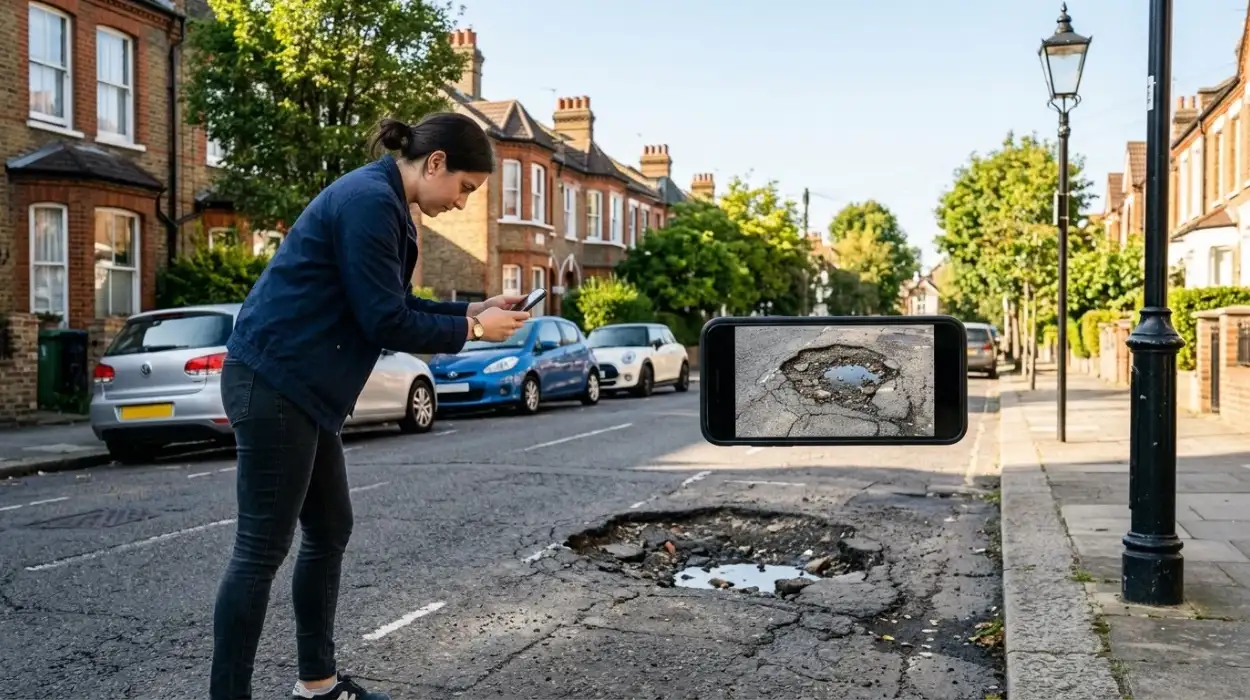
You will need to provide the location and a description of the defect. The form also allows supporting documents and photographs to be uploaded. A clear photograph can help the council understand the size, position and potential seriousness of the pothole.
The council says the online form takes approximately three minutes to complete. After submitting a report, you can check My Account for updates.
For example, if you notice a deep pothole on a residential road in Northolt while walking or driving, record the road name and identify a nearby house number, junction or landmark. A precise location is much more useful than simply saying that there is a pothole somewhere on the road.
What Information Should I Include When Reporting a Pothole?
The more accurately you describe the problem, the easier it is for the council to identify the location and understand the issue.
Start with the exact location. Include the road name, nearby house number, junction, landmark or another recognisable reference point. If the pothole is close to a bus stop, pedestrian crossing or junction, mention this as well.
Then describe the defect. You might explain that the pothole is deep, wide, positioned close to the kerb, located in a cycle lane or affecting a section of road frequently used by vehicles.
A photograph can provide additional context. If you can take one safely, a wider image can show where the pothole sits within the road, while a closer image can show its condition.
Do not put yourself in danger to take a photograph. If traffic conditions make it unsafe to stop, cross the road or approach the defect, prioritise your safety and report the location using the information you already have.
How Does Ealing Council Deal With Potholes?
Ealing Council regularly inspects roads and pavements. According to its published information, major roads are inspected monthly, while residential roads are inspected every three or six months. Defects identified during inspections are prioritised according to their level of danger.
The council also carries out yearly condition surveys of council-maintained roads and pavements. These assessments help inform longer-term resurfacing decisions.
This means that reporting a pothole is useful even if you assume council inspectors will eventually notice it. Residents can identify defects between scheduled inspections, potentially bringing attention to a problem sooner.
The council’s highways maintenance work covers everything from individual pothole repairs to larger resurfacing programmes. Its highways transparency information also describes preventative maintenance, routine inspections, minor repairs and resurfacing as part of maintaining the borough’s road network.
How Do I Report a Broken Streetlight in Ealing?
A faulty streetlight should be reported through Ealing Council’s faulty street light reporting service rather than the pothole or road-defect form. The service covers faulty streetlights, zebra crossing lights, lit road signs, bollards and concerns about lighting levels.
When completing the report, you should provide the location, including the nearest door number, road or landmark. You can describe what is wrong and upload photographs if you have them.
If available, provide the lamp post or bollard number. This can help identify the exact item that requires attention.
For example, if a streetlight outside a local park in Ealing Broadway is not working, mentioning the park entrance, nearby road and lamp-post number can make the location much clearer than simply reporting “a broken light near the park”.
What Counts as a Streetlight Fault?
A streetlight fault does not necessarily mean that the entire lamp has stopped working. Problems can include a light that is flickering, a lamp that remains permanently on, a damaged post, exposed wiring or a lighting unit that has been knocked out of position.
Ealing Council specifically asks residents to use its street-lighting service for concerns about faulty lighting and lighting levels.
The council also distinguishes between ordinary faults and dangerous defects. This distinction matters because some situations require a faster response or telephone contact rather than the standard online form.
If the light is simply not working, the normal online reporting route is appropriate. If the equipment has been seriously damaged or presents an immediate hazard, use the emergency route described by the council.
What Should I Do If a Streetlight Is Dangerous?
Ealing Council says emergency street-lighting defects should be reported by telephone on 0800 015 8785. Examples include exposed wires caused by a missing door, a post knocked down in a road traffic accident, a heavily leaning unit, a hanging lantern, sign plate or bracket, three or more lights being out, or a missing or knocked-over bollard.
These situations should not simply be submitted through the ordinary online form and left unattended if there is an immediate danger.
For instance, imagine a vehicle has hit a lighting column and exposed electrical wiring onto a pavement. That is fundamentally different from noticing that one ordinary streetlight has stopped working. The first situation requires urgent attention because of the potential safety risk.
If there is an immediate danger to life or a wider emergency, use the appropriate emergency services rather than relying solely on a council service request.
How Quickly Will Ealing Council Repair a Streetlight?
Ealing Council publishes different response targets depending on the type of lighting fault. It states that dangerous faults should, where possible, be made safe within one hour. Its published targets include five working days for flickering lights or lights that remain permanently on, 15 working days for complete replacement such as a post or light unit, and 25 working days for lights that are out.
The council also notes that a further 10 working days may sometimes be required for electrical disconnection and reconnection when dealing with a light that is out.
These are useful targets, but residents should not assume that every repair will be completed in exactly the same timeframe. The nature of the defect, access requirements and safety considerations can affect the work.
You can check your My Account for updates after making a report.
What If the Pothole or Streetlight Is on a Major Road?
One of the most important parts of reporting a highway problem is identifying who is responsible for the road.
Ealing Council specifically states that its road and pavement reporting form should not be used for problems on Transport for London red routes, including the A40 and A406. Those routes are maintained by TfL rather than the council.
The same distinction applies to street lighting. Ealing Council says its street-light reporting form should not be used for streetlight faults on roads maintained by Transport for London, including red routes and the A40 and A406.
Traffic-light faults are also handled by TfL, rather than being treated as ordinary Ealing Council street-light problems.
This is particularly useful for commuters and visitors because a road can physically be inside the London Borough of Ealing while responsibility for a particular highway asset sits elsewhere.
Can I Report a Pothole Through an App?
Ealing Council also promotes Love Clean Streets as a way to report environmental issues, including potholes. The council says the app allows residents to log an issue quickly and receive an email notification when the report is made and again when it is closed.
The council also directs residents towards its Ealing Report It service for local problems.
For people who regularly notice road or street problems while walking around Ealing, an app-based reporting option can be convenient. It can also make it easier to submit a photograph and location while the issue is fresh in your mind.
However, residents should still use the correct reporting category and follow any instructions provided by the relevant service.
What Happens After You Report the Problem?
Once a road or pavement problem has been submitted, Ealing Council says it will investigate it and may contact the person reporting the issue if more information is required. Residents can check My Account for updates.
The council’s approach to road defects is based partly on the level of danger. This means not every pothole will necessarily receive the same priority.
For example, a relatively minor defect on a quiet residential street may be treated differently from a large pothole positioned where cyclists regularly travel or where vehicles have to swerve to avoid it.
The same principle applies to street lighting. A standard lamp outage has a different response target from exposed wiring or a knocked-down lighting column.
What If the Problem Has Already Been Reported?
If you notice a pothole or broken streetlight that appears to have already been reported, there is still value in checking its status rather than repeatedly submitting identical reports without additional information.
Ealing Council provides online account facilities for checking reports and updates.
If the condition has become significantly worse, however, a new or additional report may be useful. For example, a shallow pothole that has developed into a much deeper road defect represents a changed situation.
When following up, provide new information such as worsening damage, increased danger, flooding or changes affecting pedestrians, cyclists or vehicles.
Practical Examples of When to Report
Consider a resident walking along a residential road in Northolt who notices a pothole large enough to affect vehicles. They can record the road name, nearest property or junction, take a safe photograph and submit the issue through Ealing Council’s road and pavement reporting service.
A cyclist travelling through Ealing Broadway might notice a damaged section of road near a junction. If it creates a particular risk for cyclists, that detail should be included in the report.
Someone walking home in Southall might notice a streetlight that has stopped working. They can report the location and lamp-post number if available.
If another resident finds that a lighting column has been knocked down following a collision, that is a different situation. The council specifically identifies knocked-down posts and exposed wires as emergency street-light defects.
These examples show why accurate descriptions matter. The same general category—“road problem” or “streetlight problem”—can contain issues with very different levels of urgency.
Why Reporting Local Highway Problems Matters
Reporting a pothole or faulty streetlight is not only about getting one individual problem fixed. Reports help the council understand where defects are appearing between routine inspections.
Road conditions can change quickly because of weather, traffic, utility works, drainage problems and general wear. A small defect can develop into a larger one if deterioration continues.
Street lighting also contributes to the usability of public spaces after dark. Ealing Council has been upgrading lighting through a borough-wide LED programme and says its newer central management system supports remote monitoring and quicker fault detection.
Residents therefore remain an important source of information even as technology and planned maintenance improve.
If you are wondering how to report a pothole or broken streetlight to Ealing Council, the key is to use the correct service and provide a precise location.
Potholes and other road or pavement defects should be reported through Ealing Council’s road and pavement problem service, while faulty streetlights have a separate reporting form.
Photos, nearby landmarks, road names, house numbers and lamp-post numbers can make reports more useful. It is also important to distinguish ordinary faults from dangerous street-light defects that require urgent telephone reporting.
Finally, check whether the road is actually maintained by Ealing Council. Problems on TfL red routes such as the A40 and A406 need to be directed to Transport for London instead.
Whether you live in Northolt, Ealing Broadway, Southall, Acton, Hanwell or another part of the borough, reporting highway problems promptly can help the relevant authority identify defects and decide how they should be prioritised.
Frequently Asked Questions About Reporting Potholes and Streetlights in Ealing
How do I report a pothole to Ealing Council?
Use Ealing Council’s online road or pavement problem service. Select the relevant road defect category, provide the location and description, and upload a photograph if you have one.
How do I report a broken streetlight in Ealing?
Use Ealing Council’s separate faulty street-light reporting form. You should provide the location, describe the fault and include the lamp-post or bollard number if you have it.
Can I report a pothole using an app?
Yes. Ealing Council promotes the Love Clean Streets app for reporting environmental problems, including potholes. The council says users receive email notifications when an issue is reported and when it is closed.
How long does Ealing Council take to fix a broken streetlight?
The published target depends on the fault. Ealing Council states that dangerous faults should, where possible, be made safe within one hour, while ordinary faults have longer response targets depending on their type.
Can I report a pothole on the A40 or A406 to Ealing Council?
No. Ealing Council says the A40 and A406 are among the Transport for London red routes and should not be reported through the council’s road or pavement problem form.
What should I do if a streetlight has exposed wires?
Treat exposed electrical wiring as an emergency street-light defect. Ealing Council specifically instructs residents to report exposed wires and certain other dangerous lighting defects by telephone on 0800 015 8785.
Can I check the progress of my report?
Yes. Ealing Council says you can check My Account for updates on submitted road and street-light reports.