
If you are renting or buying a home in Ealing, one of the regular household costs you need to understand is council tax. Council Tax in Ealing varies according to the valuation band of your property, with the amount also including charges set by Ealing Council and the Greater London Authority (GLA).
For the 2026/27 financial year, running from 1 April 2026 to 31 March 2027, Ealing Council has published charges for all eight council tax bands. A Band D property, often used as the standard reference point when comparing council tax, has a total annual charge of £2,138.53 in Ealing for 2026/27. This includes £1,628.02 for Ealing Council and £510.51 for the GLA.
However, your actual bill may be higher or lower depending on your property’s band, whether you qualify for a discount or exemption, and your personal circumstances. Understanding how the system works can make it easier to budget before moving to Ealing or when reviewing your current household expenses.
What Is Council Tax?
Council tax is a local tax charged on most residential properties in England. It helps fund services provided by local authorities and contributes towards wider public services.
In Ealing, the money supports services delivered by Ealing Council, while part of the bill is collected on behalf of the Greater London Authority. The GLA element contributes towards services and responsibilities across London.
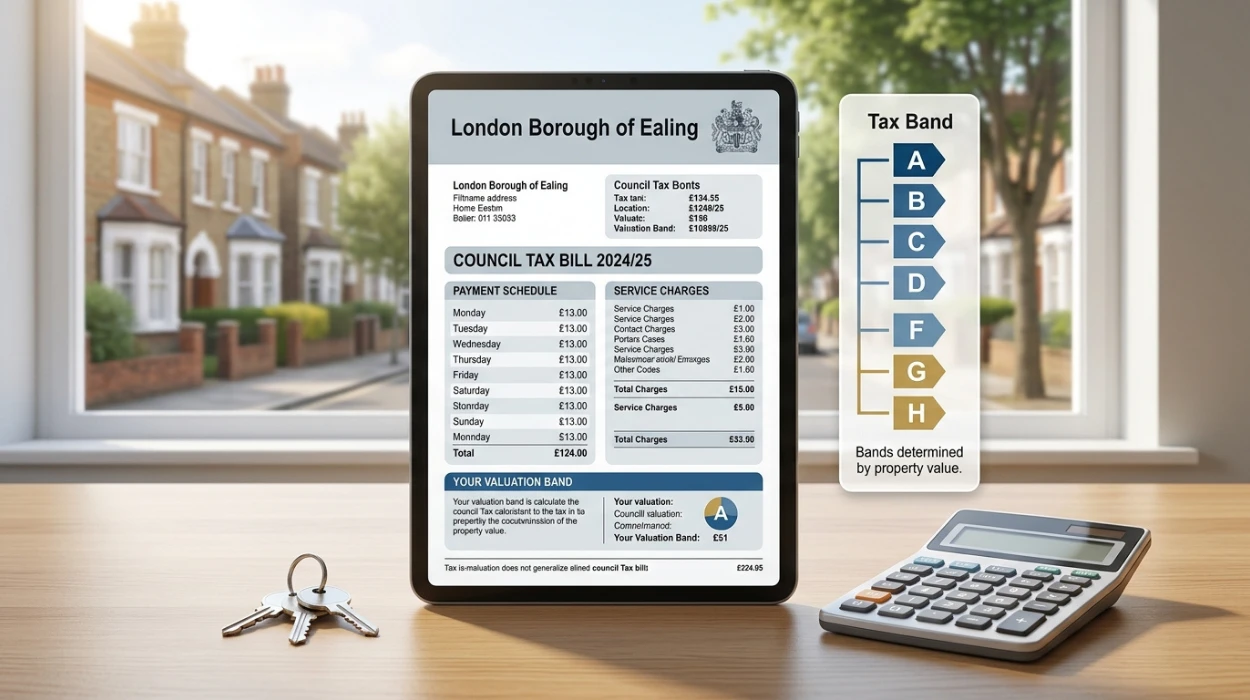
Council tax is normally charged on a property rather than being calculated directly from the owner’s or tenant’s income. The property is placed into one of eight valuation bands, from Band A to Band H.
The valuation system can initially seem unusual because the bands are based on what a property would have been worth on 1 April 1991, rather than its current market value. The Valuation Office Agency (VOA) is responsible for determining the band.
This means that a modern property in Ealing is still assessed using the historical valuation framework rather than today’s estate agent valuation.
How Much Is Council Tax in Ealing in 2026/27?
The amount depends on your council tax band. Ealing Council’s official figures for 1 April 2026 to 31 March 2027 are:
| Council Tax Band | 1991 Property Value | Total 2026/27 |
|---|---|---|
| Band A | Up to £40,000 | £1,425.69 |
| Band B | £40,000–£52,000 | £1,663.29 |
| Band C | £52,000–£68,000 | £1,900.92 |
| Band D | £68,000–£88,000 | £2,138.53 |
| Band E | £88,000–£120,000 | £2,613.77 |
| Band F | £120,000–£160,000 | £3,088.98 |
| Band G | £160,000–£320,000 | £3,564.22 |
| Band H | More than £320,000 | £4,277.06 |
These are the standard annual charges before any applicable discounts, reductions or exemptions.
For example, someone moving into a Band C flat in Ealing would have a standard annual charge of £1,900.92, while a Band E property would have a charge of £2,613.77.
The difference can therefore be significant when comparing properties. Two homes with similar rent or purchase prices can still have different council tax bills if they fall into different bands.
What Is the Average Council Tax Band in Ealing?
Band D is commonly used as a benchmark when comparing council tax charges, although it does not mean that every Ealing property is Band D.
For 2026/27, the total Band D charge in Ealing is £2,138.53 per year. This works out at roughly £178.21 per month if the annual cost is simply divided by 12.
However, council tax bills are generally issued with instalment arrangements rather than requiring residents to make one monthly payment based on a simple annual division. Your actual instalment schedule will depend on the payment arrangement shown on your bill.
The Band D figure is particularly useful when comparing council tax between different London boroughs, but prospective residents should always check the specific band of the property they are considering.
Why Does Council Tax Differ Between Ealing Properties?
The main reason is the property’s valuation band.
Ealing properties range from Band A to Band H, and each band has its own charge. A larger family house may fall into a higher band than a smaller flat, although the exact band cannot be predicted simply from the property’s current selling price.
The valuation bands are based on the property’s estimated value as at 1 April 1991. The VOA, rather than Ealing Council, is responsible for the valuation.
This is important if you are moving into a newly built apartment or a property that appears expensive by today’s standards. Its council tax band is not simply calculated from the price you pay for it.
Who Has to Pay Council Tax in Ealing?
Usually, the person living in the property is responsible for council tax.
This can include an owner-occupier, a tenant or another adult resident depending on the circumstances. Ealing Council explains that there is normally one council tax bill for each property, although certain types of accommodation have different rules about who is liable.
For example, a person renting a flat in Ealing would generally be responsible for paying the council tax rather than the landlord.
There are exceptions. Certain houses in multiple occupation, residential homes and other specified properties can have different liability arrangements. Ealing Council also notes that, since December 2023, HMOs are generally valued as a single property for council tax purposes rather than individual rooms automatically receiving separate bands.
If you are renting, check your tenancy agreement and council tax arrangements before assuming that the landlord is responsible.
Can You Get a Council Tax Discount in Ealing?
Yes. Some residents may qualify for a discount depending on who lives in the property and their circumstances.
One of the most familiar situations is when a property has only one adult resident who is liable for council tax. A single-person discount may apply, although eligibility depends on the rules and circumstances.
Students can also have different council tax treatment, while some properties and residents may qualify for exemptions or reductions.
The important point is that you should not assume your bill is automatically reduced. If you believe you qualify, check the relevant Ealing Council scheme and submit the required information or evidence.
What Is Council Tax Reduction?
Council Tax Reduction is designed to help eligible residents who have difficulty meeting their council tax liability because of their income and circumstances.
Ealing Council operates a Council Tax Reduction Scheme for eligible working-age residents. The amount of support depends on factors including income, household circumstances and whether someone falls into a protected category.
For 2026/27, Ealing’s scheme includes different contribution levels depending on household circumstances and income. In some cases, eligible residents can receive a substantial reduction in their council tax liability.
For example, Ealing Council provides an example involving a Band E household where an eligible applicant receives a 50% reduction before other relevant adjustments are considered.
If your income has changed, you are struggling to pay your bill or you think your circumstances may qualify you for support, it is worth checking the council’s current reduction scheme rather than simply missing payments.
When Do You Receive Your Ealing Council Tax Bill?
Council tax bills for the next financial year are generally sent out every March. Ealing Council also provides online account access through My Account, allowing residents to view and download their bills.
Residents can choose paperless billing and can also set up Direct Debit. Ealing Council states that different payment dates can be selected for Direct Debit arrangements.
If you move during the year, your bill can change. Other circumstances, such as someone moving into or out of your home or receiving a discount, can also result in a new bill being issued.
This is particularly relevant for renters and homeowners moving between areas such as Ealing Broadway, Northfields, Hanwell, South Ealing, West Ealing and Ealing Common.
What Happens If You Move to Ealing?
If you move into an Ealing property, you should make sure the council has the correct information about your address and occupancy.
Your council tax liability normally begins according to the date you become responsible for the property. If you move out, you should also report the change so that your account can be updated.
This is an easy detail to overlook when moving home because there are usually many other tasks involved, including changing your address, arranging utilities and updating insurance.
Keeping your council tax account accurate can prevent unexpected bills or problems later.
Can You Challenge Your Council Tax Band?
If you believe your property has been placed in the wrong council tax band, you may be able to challenge it.
The important distinction is that Ealing Council does not decide the property’s valuation band. The VOA is responsible for council tax banding. Ealing Council advises residents who believe their band is incorrect to contact the VOA and provide evidence supporting their case.
Before making a challenge, research comparable properties and understand the relevant valuation rules. A disagreement simply based on the property’s current market price is not necessarily enough because council tax bands use the historical 1991 valuation basis.
How Can You Budget for Council Tax in Ealing?
The easiest approach is to treat council tax as a fixed household expense alongside rent or mortgage payments, energy, water, broadband and transport.
For example, a household in a Band D property has a 2026/27 annual charge of £2,138.53 before discounts or reductions. Dividing that amount across 12 months gives an approximate budgeting figure of £178.21 per month.
A Band E household would need to budget for a higher annual amount of £2,613.77, while a Band B property has a considerably lower standard charge of £1,663.29.
When comparing rental properties in Ealing, therefore, do not look only at the advertised rent. Add council tax and other household costs to understand the true monthly cost of living.
What Does Your Council Tax Pay For?
Council tax contributes towards local services and the wider public services associated with local and London government.
Residents may therefore see their council tax as contributing to areas such as local services, community facilities, social care and other council responsibilities. The exact allocation of council spending changes over time according to the council’s budget and priorities.
For 2026/27, Ealing’s council tax guide sets out the council’s budget and the relationship between council tax income and the wider funding of local services.
The GLA element is also included in the total shown on your council tax bill, meaning residents are not paying an Ealing Council-only charge.
Is Council Tax Expensive in Ealing?
Whether Council Tax in Ealing feels expensive depends on the property’s band, household income and the cost of other living expenses.
The Band D charge of £2,138.53 for 2026/27 gives a useful benchmark, but many households will pay a different amount because their property falls into another band or because they receive a discount or reduction.
For someone choosing between properties, council tax should be considered alongside rent, mortgage costs, commuting expenses and household bills.
A slightly cheaper property with a higher council tax band may not actually be cheaper overall, while a home further from a station could introduce additional transport costs.
Understanding Council Tax in Ealing is an important part of planning the cost of living in the borough. For 2026/27, annual charges range from £1,425.69 for Band A to £4,277.06 for Band H, with Band D standing at £2,138.53.
The amount you actually pay can depend on your property’s band, household circumstances, discounts, exemptions and eligibility for Council Tax Reduction.
If you are moving to Ealing, check the property’s council tax band before signing a tenancy or completing a purchase. If you already live in the borough, make sure your council tax account reflects your current circumstances and investigate available support if your financial situation has changed.
For the most accurate information, always use the latest figures and guidance published by Ealing Council and the Valuation Office Agency.
Frequently Asked Questions
How much is Council Tax in Ealing in 2026/27?
The 2026/27 total ranges from £1,425.69 for Band A to £4,277.06 for Band H. Band D is £2,138.53 for the year before any applicable reductions or discounts.
What is Band D Council Tax in Ealing?
Band D Council Tax in Ealing is £2,138.53 for 2026/27. This includes £1,628.02 for Ealing Council and £510.51 for the Greater London Authority.
How do I find my council tax band in Ealing?
Your property is assigned a council tax band by the Valuation Office Agency. You can check your band using the official council tax banding service and Ealing Council’s council tax information.
Do tenants pay Council Tax in Ealing?
Usually, yes. A tenant who occupies a property will generally be responsible for the council tax, although certain property types and living arrangements have different rules.
Can I get a Council Tax discount in Ealing?
Some residents can qualify for discounts, exemptions or Council Tax Reduction depending on their household and financial circumstances. Eligibility should be checked with Ealing Council rather than assumed.
Can I challenge my Council Tax band in Ealing?
Potentially. Council tax bands are determined by the Valuation Office Agency, and residents who believe their property has been incorrectly banded can investigate the challenge process.
What happens if I cannot afford my Ealing Council Tax?
If you are struggling financially, check whether you qualify for Council Tax Reduction or another form of support. Ealing’s 2026/27 reduction scheme takes household income and circumstances into account.