
Ealing is often described as one of west London’s most attractive residential areas, known for its green spaces, independent businesses, restaurants and excellent transport connections. Yet behind its modern town centres and busy streets is a surprisingly rich history.
From its early days as a small village to its role in British cinema, music and multicultural London, Ealing has developed in ways that are easy to overlook when you are simply travelling through the borough or living locally.
There are historic buildings hidden among modern streets, famous cultural connections that began in unexpected places and green spaces with stories stretching back centuries. Here are ten things you may not know about Ealing and the reasons they make the area worth exploring.
Ealing Was Once a Small Rural Village
It can be difficult to imagine modern Ealing as a rural settlement, but much of the area was once made up of villages, farmland, houses and country estates.
Ealing’s history can be traced back to Anglo-Saxon times, while the name is associated with the Gillingas, or Gilla’s people. The Domesday Book also recorded manors in parts of the modern borough, including Greenford and Hanwell.
For centuries, agriculture was an important part of local life. Ealing, Hanwell, Acton and Southall developed along the main route between London and Oxford, while places such as Greenford, Perivale and Northolt remained comparatively rural for much longer.
The arrival and expansion of transport during the nineteenth century gradually transformed this landscape. Railways, trams and buses made travelling between Ealing and central London easier, encouraging residential growth and turning Ealing into a desirable suburban location.
Ealing Has Been a Film Location for More Than a Century
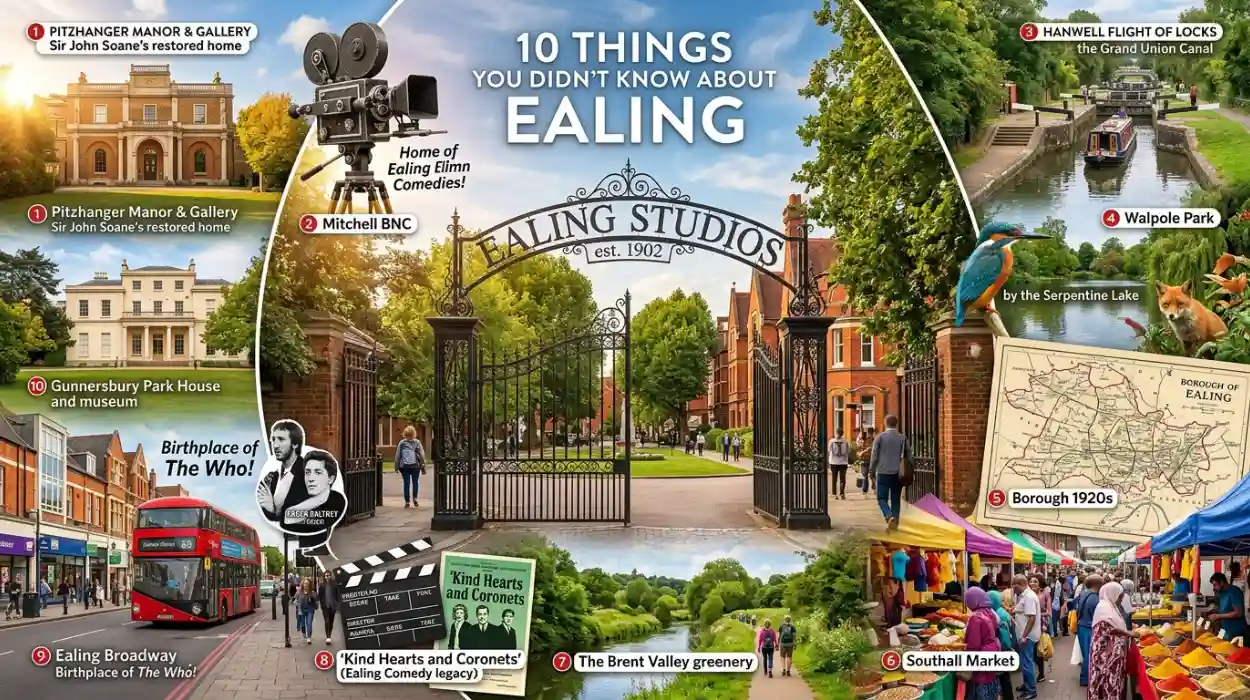
One of the most interesting things about Ealing is its connection with the film industry. Ealing Studios has been associated with the area since 1910, making the borough an important part of Britain’s cinematic history.
The connection is not limited to films made inside the studios. Locations across Ealing and neighbouring parts of west London have appeared on screen, meaning that ordinary streets and historic buildings can sometimes look familiar to film fans.
Pitzhanger Manor, for example, appeared as a location in The Importance of Being Earnest. Other films connected with Ealing locations include About a Boy, Love Actually and Calendar Girls.
This has helped create a form of film tourism in which visitors explore places they recognise from movies. For tourists, Ealing can therefore be experienced not only as a London neighbourhood but also as part of Britain’s screen history.
Pitzhanger Manor Was Designed by Sir John Soane
Pitzhanger Manor is one of Ealing’s most significant architectural landmarks, but many people passing through Walpole Park may not realise how important its designer was.
The manor was designed by Sir John Soane, one of Britain’s most influential architects. Soane is particularly associated with major works including the Bank of England and Dulwich Picture Gallery.
He acquired Pitzhanger in 1800 and transformed it into his country residence and an opportunity to experiment with architectural ideas. The building was designed as both a home and a showcase of his approach to architecture.
Today, Pitzhanger Manor and Gallery combines historic architecture with contemporary exhibitions and cultural events. The building underwent a major conservation project before reopening in 2019, helping restore many elements of Soane’s original vision.
For visitors interested in architecture, history or art, Pitzhanger provides a rare opportunity to experience an important Soane building outside central London.
Walpole Park Was Once Part of a Private Estate
Walpole Park is now one of Ealing’s best-known public green spaces, but its history goes well beyond its role as a place for walks, picnics and festivals.
The park was originally associated with Pitzhanger Manor and its surrounding estate. Sir John Soane’s ownership connected the landscape with the architectural history of the manor.
The grounds eventually became a municipal park, opening to the public in 1901. Today, Walpole Park provides a mixture of open lawns, mature trees, ponds and recreational facilities.
It also hosts major local events, including summer cultural festivals. This makes it an interesting example of how Ealing has converted historic private landscapes into spaces used by the wider community.
Next time you walk through Walpole Park, the landscape can therefore be viewed as part of a much older story rather than simply another London park.
Ealing Played a Role in the Birth of British Rhythm and Blues
Ealing’s cultural influence extends beyond cinema. The Ealing Club is remembered as an important location in the development of British rhythm and blues and is closely associated with the early story of the Rolling Stones.
The club became a meeting point for musicians and music enthusiasts during a period when American blues and rhythm and blues were influencing a new generation of British performers.
This is significant because Ealing is sometimes perceived mainly as a suburban residential district. Its music history reveals another side of the borough: one connected with London’s changing youth culture and the development of modern British popular music.
For music enthusiasts, this adds another layer to the Ealing experience. The streets may appear peaceful today, but some local venues once formed part of a much more energetic musical scene.
Ealing Has Connections to Famous Musicians
The borough’s musical connections do not stop with the Ealing Club. The former Ealing School of Art, now associated with the University of West London, has educated several well-known musicians.
Among its former students are Freddie Mercury, Ronnie Wood and Pete Townshend.
These connections demonstrate how educational and creative institutions can influence cultural history far beyond their immediate surroundings. Students who passed through Ealing went on to become major figures in British music.
For visitors, this provides another reason to look beyond conventional attractions. Ealing’s cultural importance is not always represented by large monuments; sometimes it survives through the people who studied, worked and performed there.
Ealing’s Story Is Also a Story of Migration
Modern Ealing is one of London’s diverse communities, and that diversity has developed through several waves of migration.
Following the Second World War, Caribbean communities became an important part of Ealing’s social history. The borough’s history also includes migration from India, Pakistan, Poland and many other parts of the world.
Southall, within the modern London Borough of Ealing, became particularly important for South Asian communities and later developed a reputation for its food, businesses, cultural organisations and festivals.
The borough’s cultural history therefore cannot be separated from migration. Restaurants, shops, places of worship, community organisations and cultural events all contribute to the identity of contemporary Ealing.
For tourists, exploring neighbourhoods such as Southall alongside central Ealing can provide a much broader understanding of west London’s multicultural character.
Ealing Has One of Europe’s Largest Amateur Theatres
Theatre enthusiasts may be surprised to learn about the importance of The Questors.
Founded in 1929, The Questors is described by Ealing Council as one of the largest amateur theatres in Europe. It has become an established part of Ealing’s cultural life and continues the borough’s long association with performing arts.
Its history illustrates that Ealing’s cultural scene is not dependent entirely on major commercial venues. Community-led organisations have played a significant role in providing opportunities for performers, audiences and local creative groups.
For residents looking for cultural activities close to home, venues such as The Questors offer an alternative to travelling into central London for theatre.
Ealing Has a Remarkably Rich Local Archive
Another fact that is easy to overlook is just how much historical material survives in Ealing.
Ealing Council’s Local History Centre holds more than 45,000 archival items and 20,000 photographs, alongside books, microfilms and other historical resources.
These collections can help researchers investigate everything from local buildings and businesses to family history, community organisations and major events.
This means Ealing’s history is not simply preserved in famous buildings. It is also contained within photographs, documents, diaries, council records and personal collections.
For residents interested in genealogy or local history, these archives provide an opportunity to discover how streets, neighbourhoods and communities changed over generations.
Ealing Has More Green Space Than You Might Expect
Ealing’s reputation for parks is well deserved. Walpole Park is perhaps the best-known example, but it is only part of a much wider network of green spaces.
Pitshanger Park provides riverside walking opportunities alongside the River Brent, while areas such as Perivale Meadows and Pitshanger Riverside form part of the Brent River Park.
Gunnersbury Park, Hanger Hill Park and other open spaces provide additional opportunities for walking, sport, recreation and wildlife watching.
This matters because Ealing’s identity is partly shaped by the relationship between urban development and green space. Residents can live relatively close to central London while still having access to parks, meadows and riverside landscapes.
For visitors, exploring these spaces can provide a slower and more local experience of west London.
Ealing Became a Borough Before the Modern Borough Existed
The administrative history of Ealing is another fascinating part of its story.
Ealing became a borough in 1901 and was the first borough created in Middlesex. However, the modern London Borough of Ealing did not exist at that point.
The present borough was created in 1965 when Ealing, Acton and Southall were brought together. Hanwell, Greenford, Perivale and Northolt had previously developed as separate communities with their own histories and identities.
This explains why the modern borough can feel so diverse from one neighbourhood to another. Ealing Broadway, Southall, Northolt, Greenford, Perivale, Hanwell and Acton each have distinctive historical backgrounds.
Understanding that history makes it easier to appreciate why the borough contains such a variety of architecture, cultures, landscapes and local identities.
Why These Ealing Facts Matter Today
The most interesting thing about Ealing is that its history remains visible in everyday life.
A walk through Walpole Park can lead to Pitzhanger Manor and the architectural legacy of John Soane. A visit to Ealing’s cultural venues can reveal the area’s long connection with theatre and music. Exploring Southall can introduce visitors to communities whose arrival helped shape modern west London.
Meanwhile, Ealing Studios connects the borough to more than a century of British cinema, while the local history archives preserve thousands of records documenting how the area changed.
For tourists, these details can transform an ordinary visit into a deeper exploration of west London. For residents, they provide another reason to look at familiar streets with fresh curiosity.
Ealing is therefore much more than a convenient place to live or a transport interchange. It is a borough shaped by rural origins, suburban expansion, architecture, cinema, music, migration, community culture and green spaces.
Frequently Asked Questions
What is Ealing famous for?
Ealing is particularly known for Ealing Studios, its parks and green spaces, Pitzhanger Manor, cultural venues, restaurants and its diverse communities. It also has important connections with British cinema and music.
What are some unusual facts about Ealing?
Ealing was once largely rural, Pitzhanger Manor was designed by Sir John Soane, Ealing Studios has been associated with the area since 1910, and the Ealing Club played an important role in British rhythm and blues.
Did famous musicians live or study in Ealing?
Yes. Former students of the Ealing School of Art include Freddie Mercury, Ronnie Wood and Pete Townshend. The Ealing Club is also associated with the early development of the Rolling Stones.
Is Ealing good for tourists?
Yes. Visitors can explore historic buildings, parks, museums, theatres, restaurants, cultural areas and film-related locations. Ealing can also provide a quieter alternative to some of central London’s busiest tourist areas.
What is the oldest part of Ealing?
Ealing has a history stretching back to Anglo-Saxon times, while archaeological evidence indicates earlier human activity. Great Ealing developed around the historic parish church and became an important local settlement.
Why is Pitzhanger Manor important?
Pitzhanger Manor was designed by Sir John Soane between 1800 and 1804 as his country residence and architectural showcase. It is now a Grade I listed building and cultural venue.
What makes Ealing different from other parts of London?
Ealing combines suburban character, strong transport connections, historic architecture, cultural diversity and extensive green spaces. Its history also gives it a distinctive identity within west London.