
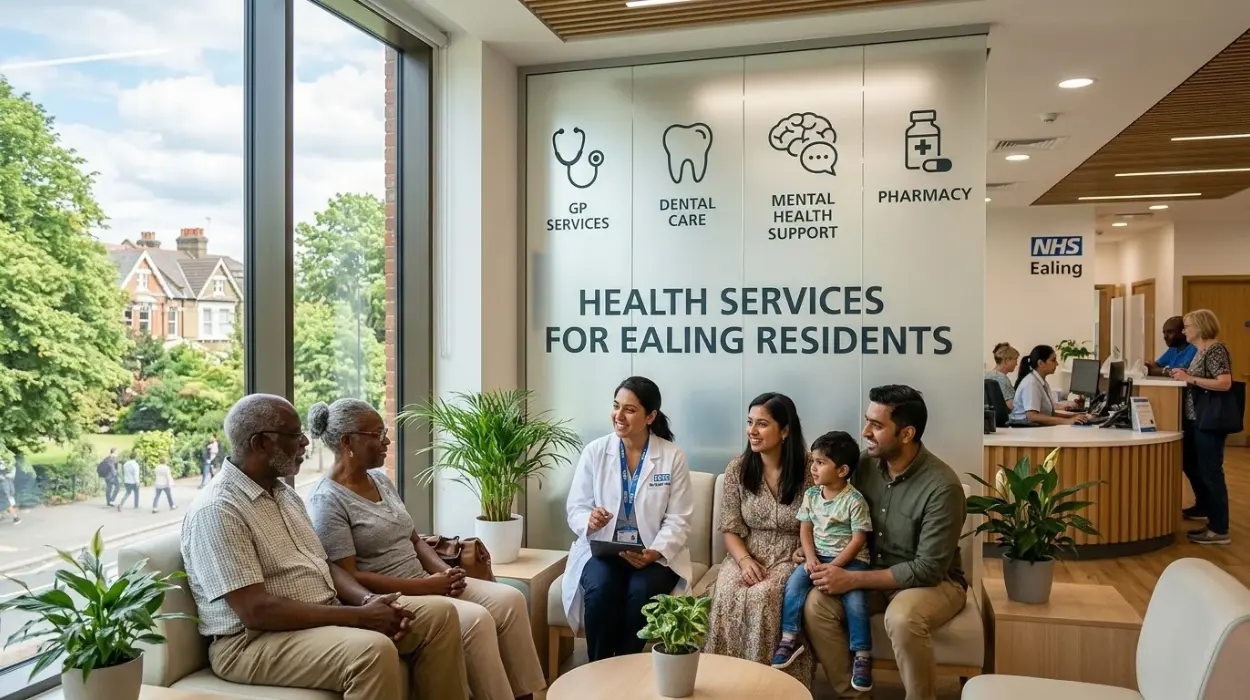
Ealing residents have access to a broad range of health services covering everyday medical needs, urgent treatment, hospital care, mental health, community healthcare, sexual health, pharmacy support and services for people living with long-term conditions. The borough includes neighbourhoods such as Ealing Broadway, Acton, Hanwell, Southall, Greenford, Northolt, Perivale and West Ealing, with healthcare facilities and services spread across the area.
Knowing which service to use can make it easier to get appropriate help without unnecessary delays. A minor illness may be suitable for a pharmacist or GP, while an urgent but non-life-threatening problem may require NHS 111 or an urgent treatment service. More serious emergencies require immediate NHS emergency care.
For residents, families, older people, children and people who have recently moved to Ealing, understanding the local healthcare system is an important part of living in the borough.
GP Services for Everyday Healthcare
A GP practice is usually the starting point for many ongoing health concerns. Ealing residents can register with a local GP surgery and use it for appointments, medical advice, prescriptions, referrals and management of longer-term conditions.
GPs can help with problems ranging from recurring symptoms and infections to blood pressure, diabetes, asthma and other chronic conditions. They can also assess whether a patient needs to see a specialist or use another NHS service.
For someone moving to Ealing, registering with a GP is particularly useful. Rather than waiting until an illness develops, having an established GP practice gives residents a regular point of contact for preventative care and ongoing medical support.
Some healthcare needs can also be handled online. The NHS provides digital services for tasks such as booking GP appointments, viewing certain test results and ordering repeat prescriptions, depending on the services offered by an individual practice.
Pharmacies and Medicines Advice
Local pharmacies are an important part of healthcare in Ealing and can often provide advice without requiring a GP appointment. Pharmacists can advise on common illnesses, medicines and minor health problems and may provide certain NHS services depending on the pharmacy.
Residents can also use pharmacies for prescription collection and advice about taking medicines safely. This can be particularly helpful for people managing several medicines or living with long-term conditions.
The NHS recommends considering a pharmacy for appropriate minor illnesses and medicine-related questions. This helps patients choose a service suited to the seriousness of their symptoms rather than automatically using a GP or hospital.
Ealing also has local health initiatives delivered through pharmacies. For example, the Ealing Smokefree Service works with nominated pharmacies to support people who want to stop smoking and access nicotine replacement therapy. Participating pharmacies include locations in areas such as Acton, Greenford and Perivale.
Hospital and Emergency Healthcare in Ealing
Ealing Hospital on Uxbridge Road in Southall is an important healthcare facility serving the local area. Its NHS service directory includes Accident and Emergency, while other services are delivered through the organisations operating from the hospital site.
Hospital care is different from routine GP treatment. A person with a life-threatening emergency should not wait for a routine appointment. In an emergency, the NHS advises calling 999 or attending the appropriate emergency department. For urgent problems that are not life-threatening, NHS 111 can help determine the most suitable service.
Ealing Hospital also has community-based services connected with wider local healthcare provision. These include intermediate care, discharge support, chronic pain management and musculoskeletal physiotherapy.
This wider network is important because healthcare does not always end when someone leaves hospital. Rehabilitation and community support can help people recover safely and maintain independence at home.
Community Healthcare Across Ealing
One of the most important parts of healthcare in the borough is Ealing Community Partners. This is a collaboration involving NHS organisations, Ealing Council and voluntary-sector organisations to provide community health and care services.
Its services include support for people with long-term conditions, physiotherapy, podiatry, speech and language therapy, occupational therapy, community nursing, learning disability healthcare and end-of-life care.
Community healthcare can be particularly valuable for residents who need support outside a traditional hospital setting. For example, someone recovering from an illness may require physiotherapy, while an older person may need help to remain independent at home.
Services are delivered from different locations around Ealing. Ealing Day Treatment Centre, Clayponds Hospital, Greenford Green Clinic and other community sites provide different forms of treatment and rehabilitation.
This means residents should not assume that all specialist NHS services are located inside one hospital. Local healthcare is distributed across the borough.
Mental Health and Wellbeing Support
Mental health is an important part of healthcare for Ealing residents. Support is available for people experiencing anxiety, depression, emotional distress, severe mental health difficulties and other psychological needs.
A GP can be an appropriate first point of contact when someone is experiencing ongoing mental health concerns. Depending on the circumstances, people may also receive support through community mental health services, psychological therapies or specialist teams.
Ealing Council highlights several routes for people who need mental health support, including GP surgeries, community teams, hospitals and crisis services.
West London NHS Trust also provides mental health services across the borough, including support for older people, people experiencing complex mental health needs and perinatal mental health services for women during pregnancy or after childbirth.
If someone is experiencing a mental health crisis, urgent professional support should be sought rather than waiting for a routine appointment. Ealing Council lists a 24-hour mental health helpline operated through West London Mental Health Trust.
Sexual Health Services
Ealing residents can access specialist sexual health services for testing, treatment, contraception and sexual health advice.
The Ealing GUM Clinic at Mattock Lane Health Centre provides testing and treatment for sexually transmitted infections, contraception and emergency contraception, alongside HIV testing and related support. The current NHS listing states that the clinic operates by booking rather than walk-in attendance, so residents should check the latest arrangements before attending.
Sexual health services can be used for preventative care as well as treatment. Someone who has concerns following a new sexual relationship, for example, may seek testing even when they have no obvious symptoms.
Support for Long-Term Conditions and Rehabilitation
Healthcare for Ealing residents also extends beyond treating immediate illness. Community services support people living with conditions such as diabetes, mobility problems, chronic pain and continence needs.
Physiotherapy, podiatry, occupational therapy, speech and language therapy and specialist rehabilitation can all form part of a person’s care. Ealing Community Partners provides several of these services across community locations.
For example, a resident recovering from a stroke may require neurological rehabilitation, while someone experiencing persistent joint or muscle problems may benefit from musculoskeletal physiotherapy.
The Community Independence Service can also help eligible people remain independent at home. Its approach involves working with patients to establish individual goals and coordinate care with other professionals.
Healthcare for Older People, Children and Families
Different stages of life can require different forms of healthcare. Children may need vaccinations, developmental assessments, speech and language support or specialist therapies. Older residents may require rehabilitation, dementia support, falls services or assistance with managing several long-term conditions.
Ealing’s community healthcare network includes children’s occupational therapy and speech and language therapy, while adult services include dementia support and rehabilitation.
For families, knowing where to seek help can reduce confusion. A GP can help assess many concerns and arrange referrals where specialist treatment is required.
How to Choose the Right Health Service
Choosing the correct service depends largely on how serious and immediate the problem is. For routine healthcare, a GP is generally a suitable starting point. For minor illnesses and medicine-related questions, a pharmacist may be able to help.
NHS 111 is designed for situations where medical advice is needed urgently but the problem is not clearly a life-threatening emergency. It can help direct patients towards an appropriate service. For suspected serious emergencies, 999 is the appropriate route.
This approach can be particularly useful for tourists or people who are unfamiliar with healthcare arrangements in Ealing. Visitors should also check their eligibility and circumstances before assuming that every NHS service will be available to them in the same way as it is to local residents.
Making Better Use of Healthcare in Ealing
Getting familiar with local healthcare before an urgent situation occurs can make accessing support much easier. Residents can identify their GP, locate nearby pharmacies, understand how to contact NHS 111 and learn where relevant community services are provided.
It is also useful to keep important medical information accessible, including regular medicines, allergies and details of existing conditions. People managing long-term health problems may benefit from understanding their care plan and knowing which community services are available to them.
Ealing’s healthcare network combines primary care, hospitals, community services, mental health support, pharmacies and specialist services. The result is a system designed to address different levels of need rather than relying on a single healthcare location.
Health Services Available to Ealing Residents cover far more than GP appointments and hospital treatment. Residents can access pharmacies, community healthcare, rehabilitation, mental health support, sexual health services, long-term condition management and urgent and emergency care.
The most useful approach is to understand which service matches the situation. A GP can support routine and continuing healthcare, pharmacists can help with many minor conditions and medicines, NHS 111 can guide people with urgent concerns, and emergency services are available when a situation is life-threatening.
For people living in Ealing, including communities across Acton, Greenford, Northolt, Perivale, Southall, Hanwell and Ealing Broadway, knowing how the local healthcare network works can make it easier to seek appropriate help when it is needed.
Frequently Asked Questions
What health services are available to Ealing residents?
Ealing residents can access GP practices, pharmacies, hospitals, community healthcare, mental health services, sexual health clinics, rehabilitation, long-term condition support and urgent and emergency NHS services.
How do I find a GP in Ealing?
You can use the NHS service finder to identify GP practices in your area and check registration information. Residents should register with a local GP practice where possible for ongoing healthcare needs.
Is Ealing Hospital available for emergency treatment?
Ealing Hospital has an Accident and Emergency department listed by the NHS. For life-threatening emergencies, call 999. For urgent but non-life-threatening medical problems, NHS 111 can provide guidance.
Where can Ealing residents get mental health support?
Mental health support can be accessed through GPs, community teams, hospitals and specialist services. Ealing Council also provides information about urgent mental health support and crisis services.
Can I get sexual health testing in Ealing?
Yes. The Ealing GUM Clinic provides STI testing and treatment, contraception, emergency contraception and HIV testing. Its current NHS listing says appointments are required rather than walk-in visits.
What community healthcare services are available in Ealing?
Community services include physiotherapy, podiatry, occupational therapy, speech and language therapy, community nursing, long-term condition support, rehabilitation and care for people with learning disabilities.
What should I do if I need urgent medical advice in Ealing?
If you need urgent medical advice and the situation is not a life-threatening emergency, contact NHS 111 online or by telephone. If you believe someone is experiencing a life-threatening emergency, call 999 or attend appropriate emergency care.