
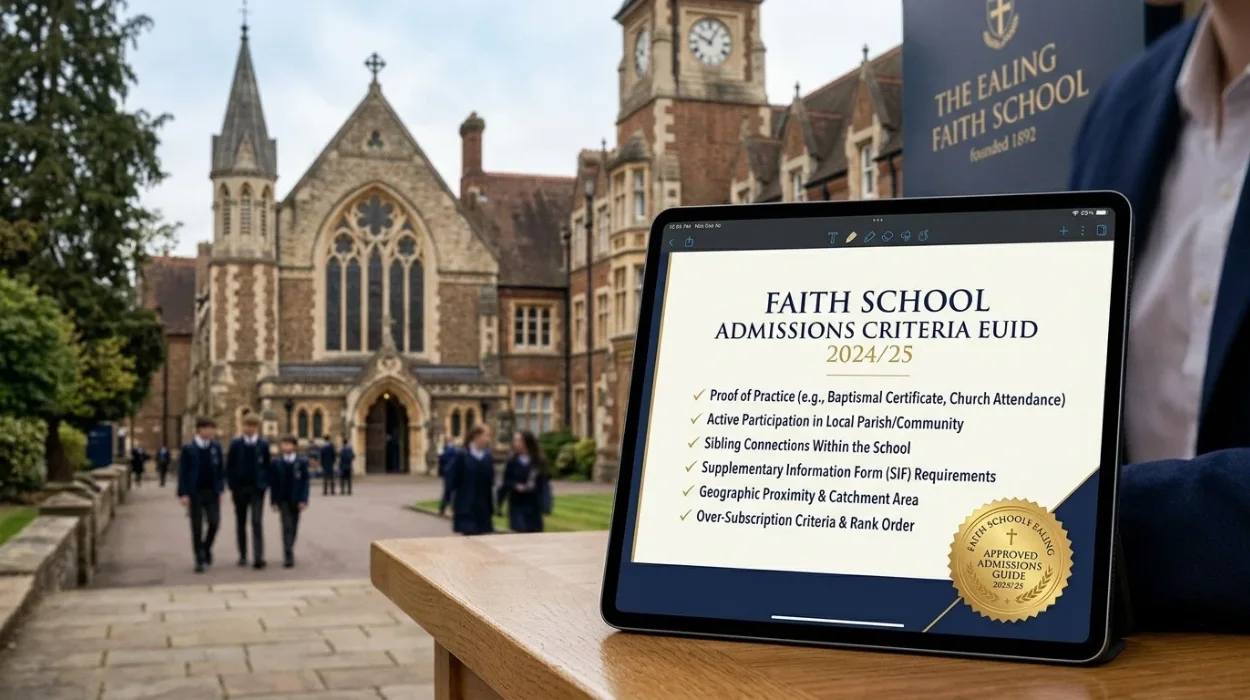
Choosing a school in Ealing involves more than checking Ofsted information, school facilities or the distance from home. For families considering a faith school, understanding the Ealing Faith School Admissions Criteria is particularly important because different schools can use different oversubscription rules. Faith-based schools may consider factors such as religious practice, church or place-of-worship attendance, siblings, looked-after children, distance and other published priorities.
Ealing has a diverse education landscape, including Church of England, Catholic and Sikh schools, alongside community schools and academies. The London Borough of Ealing explains that some faith schools require families to complete a Supplementary Information Form (SIF) in addition to the normal school application.
The important point for parents is that being a faith school does not mean every applicant must belong to that faith. Individual admissions policies determine how priority is allocated and what evidence may be required. Understanding the specific policy for the school and admission year is therefore essential.
What Are Ealing Faith School Admissions Criteria?
Ealing faith school admissions criteria are the rules used to decide which children receive places when more applications are received than there are available spaces.
Every school has a published admission number, commonly called the PAN. If applications remain below that number, oversubscription criteria may not need to be used to the same extent. If applications exceed the available places, the school applies its published criteria in the stated order.
Faith schools may have their own admission arrangements. Ealing Council’s list of high schools with their own admission rules includes faith schools such as The Cardinal Wiseman Catholic School, Ada Lovelace CofE High School, Twyford CofE High School and William Perkin CofE High School.
This means parents should not assume that the admissions rules for one Ealing faith school automatically apply to another.
Why Faith Status Can Affect School Admissions
A faith school’s religious character can form part of its admissions arrangements, particularly when there are more applicants than places.
For example, a Church of England school may have criteria relating to church attendance, while a Catholic school may give priority according to Catholic practice and supporting evidence. Some schools can also include categories for children from other Christian denominations or other faith backgrounds.
The precise wording matters. A requirement such as attending a place of worship regularly is different from simply identifying with a particular religion.
Christ the Saviour Church of England Primary School’s 2026/27 policy, for example, states that parents applying for a place are expected to respect and support the school’s distinctive Christian ethos. It also states that parents who are not of the school’s faith are still entitled to apply and be considered for a place.
This illustrates why families should read the actual admissions policy rather than relying on assumptions about faith schools.
Religious Practice and Faith Priority
One of the biggest questions parents ask is whether attending a church, mosque, temple, gurdwara or other place of worship automatically gives a child priority.
The answer depends entirely on the school’s published admission arrangements.
A school may specify the frequency of worship required, how long the family needs to have attended, whether the child must attend, whether parents’ attendance is considered, and whether a religious leader must verify the information.
For some applications, the school may request details such as the name and address of the place of worship, denomination or faith group, length of attendance and frequency of worship.
The proposed 2027/28 arrangements for Christ the Saviour CE Primary School illustrate how detailed these criteria can become. The proposed changes included different priority for children attending another Christian denomination weekly compared with children attending a Church of England church twice a month. The proposal also introduced deanery-based priority within certain faith categories.
Because those arrangements concern a particular school and admission year, parents should always check the final policy before applying.
Supplementary Information Forms Explained
A Supplementary Information Form, or SIF, is an additional form that some schools use to collect information needed to apply their own admission criteria.
Ealing Council specifically advises that some faith schools require an SIF and that families should obtain it directly from the school when applying.
The SIF can be particularly important when an application involves faith-based criteria. For instance, the school may need evidence of church attendance or confirmation from a priest, minister or another recognised religious leader.
Submitting the main council application without completing a required SIF can therefore create a problem. Parents should check the school’s admissions page early, identify whether a SIF is required and follow the school’s instructions about where and when it must be returned.
Siblings and Family Connections
Faith is not necessarily the only factor considered by a faith school’s admission policy.
Sibling priority is common in school admissions and can be significant when a child already has a brother or sister attending the school. However, the definition of a sibling can vary. Some policies specify which year groups count, whether half-siblings qualify, and whether a sibling must still be attending at the relevant time.
The exact wording should therefore be checked in the school’s current policy.
For example, Drayton Manor High School’s published 2027/28 criteria place children with a sibling attending the school in Years 7 to 11 among its priority categories. The policy then uses other criteria, including whether the school is the child’s nearest publicly funded high school.
This demonstrates why families should examine the complete hierarchy rather than focusing on one criterion in isolation.
Distance and Catchment Areas
Parents often use the term “catchment area” when discussing Ealing school admissions. However, there is an important distinction between a formal catchment area and a distance-based oversubscription criterion.
Some schools may prioritise children according to measured distance from the school or another defined point. Others may use religious geography, such as a parish or deanery, as part of their criteria.
Distance can become especially important when several applicants satisfy higher-priority categories.
Families should not assume that living close to a faith school guarantees a place. If the school gives priority to particular faith categories before applying distance, a family living nearby may still be ranked behind applicants who satisfy those higher categories.
The school’s published admissions arrangements should therefore be checked before treating proximity as a deciding factor.
Looked-After and Previously Looked-After Children
Admissions arrangements also contain statutory priority categories for certain children who are looked after or were previously looked after.
The exact definitions and evidence requirements are set out in the relevant admission arrangements. Ealing’s high-school admissions guidance also explains that supporting evidence may be required for looked-after or previously looked-after children.
These categories generally appear before ordinary oversubscription considerations, although families should read the school’s policy for the precise wording and definitions applicable to that admission year.
Catholic Faith Schools in Ealing
Ealing has several Catholic primary schools with their own admissions policies. Ealing Council’s current primary-school admissions documents include schools such as St Gregory’s Catholic Primary School, St Anselm’s Catholic Primary School, St John Fisher Catholic Primary School, St Joseph’s Catholic Primary School, Mount Carmel Catholic Primary School, Our Lady of the Visitation Catholic Primary School, St Raphael’s Catholic Primary School and St Vincent’s Catholic Primary School.
Their criteria should not be treated as interchangeable.
For example, St Gregory’s Catholic Primary School has a specific 2026/27 admissions policy and SIF published through Ealing Council, with the council noting that the SIF needs to be completed and returned directly to the school.
A Catholic family applying to several schools should therefore read each school’s policy rather than completing one SIF on the assumption that the same evidence requirements apply everywhere.
Church of England Schools in Ealing
Church of England schools also have individual arrangements.
Christ the Saviour CE Primary School is one example. Its 2026/27 policy identifies a Reception admission number of 120 and explains the school’s Christian foundation and distinctive ethos.
Ealing’s secondary-school landscape also includes Church of England schools such as Ada Lovelace CofE High School, Twyford CofE High School and William Perkin CofE High School. Their individual policies should be consulted because the admissions arrangements can differ between schools.
Sikh and Other Faith Schools
Faith-school admissions in Ealing are not limited to Christian schools. Ealing Council identifies Christian, Catholic and Sikh schools within its admissions information.
Khalsa Primary School is included among the primary schools with its own admissions policies, including arrangements for 2026/27 and 2027/28.
For families considering a Sikh faith school, the same principle applies: read the school’s specific policy and check whether additional forms, evidence or faith-related criteria apply.
How the Application Process Works
For a normal primary-school application in Ealing, families apply through the coordinated admissions process. For children starting Reception in September 2027, Ealing Council states that applications open on 1 September 2026 and the on-time deadline is 15 January 2027. National offer day is 16 April 2027.
For secondary school applications for September 2027, the application period also opens on 1 September 2026, with a 31 October 2026 deadline. National offer day is 1 March 2027.
These dates matter because submitting the application late can affect when it is considered.
The main application is not necessarily the only step for a faith school. If the school requires an SIF, parents should complete that additional process according to the school’s instructions.
A Practical Example for an Ealing Family
Imagine a family living in West Ealing who wants to apply to several schools, including a Catholic primary school and a Church of England primary school.
The family should first check each school’s published admission policy for the relevant year. They should then identify whether either school requires a SIF, determine whether religious practice is part of the oversubscription criteria and check what evidence is required.
If one school asks for verification from a priest or religious leader, the family should arrange this well before the application deadline rather than leaving it until the final week.
They should also consider sibling status, distance, admission number and any other priority categories.
Most importantly, they should distinguish between preference and eligibility. Listing a school on an application expresses a preference; it does not guarantee that the child will meet the school’s oversubscription criteria or receive a place.
Common Mistakes Parents Should Avoid
One common mistake is assuming that all Ealing faith schools use identical criteria. They do not.
Another is failing to complete a required SIF. Ealing Council specifically directs families to obtain required SIFs from the relevant school.
Parents can also make the mistake of relying on old admissions information. A school’s criteria for 2025/26 may not be identical to its criteria for 2026/27 or 2027/28.
A further issue is assuming that regular worship automatically guarantees priority. The policy may specify frequency, duration, denomination, verification and other conditions.
Finally, families should avoid treating online discussions as definitive. Parent forums and social media can provide useful experiences, but the school’s current admission policy and Ealing Council’s official guidance are the appropriate sources for the actual rules.
How to Check the Latest Ealing Admissions Criteria
The safest approach is to start with Ealing Council’s school admissions information and then open the individual school’s current admission policy.
Ealing publishes admissions arrangements and individual policy documents for schools with their own admission authorities. Its current document listings include 2026/27 and 2027/28 policies for several faith schools.
Parents should check four things before submitting an application: the admission year, oversubscription criteria, SIF requirements and supporting evidence.
It is also worth checking the school directly if anything is unclear. Admissions teams can explain which form is required and how supporting information should be submitted.
Understanding Ealing Faith School Admissions Criteria is ultimately about reading the rules of the individual school rather than relying on a general assumption about faith education.
Religious practice may be important at some schools, while sibling priority, distance, looked-after status and other categories may also affect how applications are ranked. Some schools require supplementary forms, and the evidence needed can vary.
For families in Ealing, the most reliable strategy is to identify the schools being considered, read the admission arrangements for the correct year, note every criterion that applies to the child and complete both the main application and any required supplementary process on time.
Admission arrangements can change, so parents should always verify the current policy before making an application. Ealing Council’s published 2027/28 materials, for example, include proposed changes affecting several schools, demonstrating why using current information matters.
Frequently Asked Questions
Do Ealing faith schools only accept children from their own religion?
No. This depends on the individual school’s admissions policy. Some faith schools have faith-based priority categories, but that does not necessarily prevent families from other faiths or no faith from applying. Christ the Saviour CE Primary School, for example, explicitly states that parents who are not of its faith can apply and be considered.
Does attending a church guarantee admission to a faith school?
No. Church attendance may form part of an admissions criterion at some schools, but the precise requirements can include frequency, duration and verification. Other applicants may also qualify under higher or separate priority categories.
What is a Supplementary Information Form?
A Supplementary Information Form, or SIF, is an additional form requested by some schools to collect information needed to apply their admissions criteria. Ealing Council says that where a faith school requires a SIF, families should obtain it directly from the school.
Are siblings given priority at Ealing faith schools?
Sibling priority is used by some Ealing schools, but the exact definition and position in the priority order depend on the school’s published admissions arrangements. Parents should check the current policy rather than assume that every school uses the same sibling rule.
Does living near an Ealing faith school guarantee a place?
No. Distance may be one part of the oversubscription criteria, but some schools apply other priorities first. Faith practice, sibling status and other categories can affect an application’s ranking before distance is considered.
When should parents apply for an Ealing school place?
For September 2027 Reception applications, Ealing Council states that the deadline is 15 January 2027. For September 2027 secondary admissions, the deadline is 31 October 2026.
Where can parents find the latest Ealing faith school admissions criteria?
Parents should check Ealing Council’s school admissions pages and the individual school’s current admissions policy. This is especially important because criteria can change between admission years and some schools publish their own arrangements.