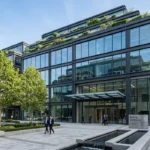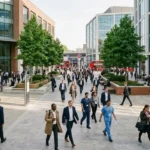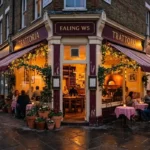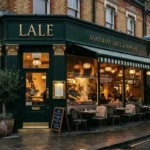
Southall has long been recognised as one of West London’s most distinctive commercial and cultural destinations. Known for its vibrant high street, specialist shops, restaurants, food businesses, markets and strong entrepreneurial culture, the area has developed an economic identity that extends far beyond traditional retail. Today, improved transport connections and major regeneration projects are creating new opportunities for businesses, investors, residents and visitors.
So, is Southall: The Business Capital of West London? The answer depends on how the phrase “business capital” is defined. Central Ealing remains an important metropolitan commercial centre, while Park Royal is a major industrial location. However, Southall has a particularly diverse combination of retail, hospitality, manufacturing, wholesale, services, cultural businesses and emerging employment space.
Its proximity to Heathrow, connection to Central London through the Elizabeth line and ongoing development around the former Southall Gasworks site have strengthened its economic potential. Ealing Council describes Southall as a growing neighbourhood and a cultural destination of national importance, with opportunities to attract new jobs and diversify the local economy.
Why Southall matters to West London’s economy
Southall occupies an important position in the wider West London economy. It sits close to Heathrow Airport, has access to major roads and is connected to Central London through the Elizabeth line. These factors make the area relevant to companies that need access to customers, workers, suppliers and wider markets.
The commercial identity of Southall has also developed over many decades. Its town centre serves a catchment that extends beyond the immediate neighbourhood, particularly for specialist Asian retail, food, clothing, jewellery and cultural products.
The area’s economic importance is therefore based on more than office buildings. Small independent businesses, established companies, industrial operators, restaurants, wholesalers and specialist retailers all contribute to Southall’s commercial character.
This mixture gives the area a different identity from conventional business districts. Instead of being dominated by one industry, Southall operates as a diverse local economy with links to regional and international markets.
Southall Broadway: the heart of local business
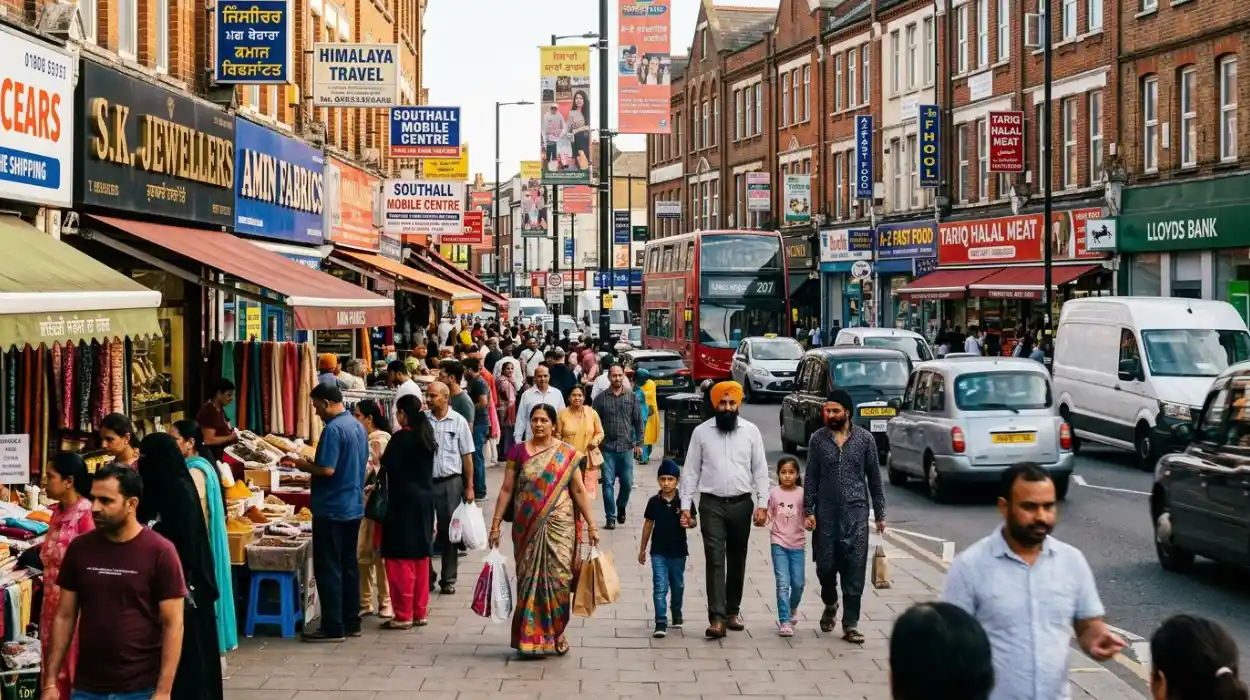
Southall Broadway is perhaps the most recognisable part of the area’s commercial landscape. Running along Uxbridge Road, it contains a dense collection of shops, restaurants, food outlets, specialist retailers and services.
The Broadway attracts both local residents and visitors from further afield. Ealing Council highlights Southall Broadway as the area’s main shopping destination, with specialist Asian goods and services contributing to its wider appeal.
For entrepreneurs, this creates an interesting environment. A business can benefit from an established customer base that already visits the area specifically to shop, eat and access specialist services.
Food is particularly important. Southall is associated with Punjabi, Indian, Pakistani, Sri Lankan and South Indian cuisines, making restaurants, sweet shops, cafés, bakeries and food retailers an important part of the local economy.
Retail is similarly diverse, with clothing, jewellery, groceries, electronics, beauty services and specialist products contributing to the high street.
Southall’s entrepreneurial culture
One of Southall’s strongest economic assets is its entrepreneurial culture. Independent businesses play a major role in shaping the town centre, and many commercial activities are closely connected to family businesses and specialist knowledge.
This environment can be particularly valuable for new entrepreneurs. Instead of entering a completely new market, a business can become part of an existing commercial ecosystem.
For example, a new food business may benefit from Southall’s established reputation as a destination for South Asian cuisine. A clothing retailer can potentially attract customers already visiting the area for specialist fashion. A beauty business can serve both local residents and visitors travelling specifically for services.
This does not mean competition is low. In fact, Southall’s strong business community means that competition can be intense. New businesses need a clear proposition, good customer service, competitive pricing and an understanding of local demand.
How the Elizabeth line changed Southall
Transport is one of the biggest factors behind Southall’s growing commercial importance. The Elizabeth line has improved connections between Southall, Central London and Heathrow.
Ealing Council specifically identifies the Elizabeth line as an important asset for Southall, providing fast and regular connections towards Heathrow and Central London.
Better connectivity matters because businesses depend on people being able to reach them. Employees can travel more easily, customers have greater access and companies can connect with other commercial centres across London.
For visitors, the improved rail connection also makes Southall easier to include in a West London itinerary. Someone staying elsewhere in London can travel to the area for shopping, dining or cultural experiences without necessarily needing a car.
The station therefore functions as more than a transport facility. It strengthens Southall’s position within the wider London economy.
Southall and Heathrow Airport
Heathrow is another major economic factor. Southall’s location provides an opportunity to benefit from airport-related employment, supply chains, logistics and visitor spending.
Ealing’s planning evidence identifies Heathrow as an important economic anchor for Southall and the borough more widely. It also highlights airport-related businesses and employment as an area where stronger local connections and supply chains can create opportunities.
Businesses involved in freight, warehousing, hospitality, transport, catering and other services can potentially benefit from proximity to such a major economic hub.
The relationship works in both directions. Southall provides businesses and workers within West London, while Heathrow creates demand for a wide range of goods and services.
This geographic relationship is one reason why Southall’s future economic development deserves attention.
Industrial and commercial businesses in Southall
Southall is not just a retail destination. Industrial and commercial activities form an important part of the local economy.
The area contains a mixture of industrial sites, warehouses, wholesale operations and smaller business units. Ealing Council’s planning evidence notes that industrial land represents a significant proportion of Southall’s commercial floorspace and that strategic industrial land is being protected as part of future planning.
This matters because industrial space supports businesses that may not fit within traditional high streets. Manufacturers, distributors, trades, wholesalers and logistics companies need premises with different requirements from cafés or professional services.
Protecting suitable employment space can therefore help maintain a diverse economy.
At the same time, industrial areas face pressures from rising land values and competing demands for housing. Finding the right balance between homes, employment space and infrastructure will be important to Southall’s long-term economic success.
The Green Quarter and Southall’s future
One of the most significant changes taking place in Southall is the regeneration of the former gasworks site.
The Green Quarter is a major mixed-use development that includes new homes, shops, community facilities, a cinema, a health centre, a primary school and substantial public open space.
For the local economy, the importance of such a project goes beyond construction. New residents can create demand for shops, restaurants, professional services, childcare, leisure businesses and other everyday services.
The development also creates an opportunity to connect existing Southall with new neighbourhoods. This is important because regeneration is most effective when new investment strengthens the existing town rather than operating separately from it.
Ealing Council’s regeneration framework emphasises the potential for employment-led growth in Southall, including new employment space and a more diverse and resilient economy.
Can Southall compete with Ealing Broadway?
Southall and Ealing Broadway should not necessarily be viewed as direct competitors. They serve different commercial purposes.
Ealing Broadway functions as a metropolitan centre with a strong mix of retail, leisure, professional services and offices. Ealing Council describes central Ealing as an important economic centre with significant commercial and civic amenities.
Southall has a more distinctive specialist retail, cultural and entrepreneurial identity. Its customer base is strongly connected to its diverse community and its reputation as a destination for Asian goods, food and services.
For some businesses, Ealing Broadway may be the stronger location. For others, Southall’s specialist market and established customer demand could be considerably more valuable.
The real question is therefore not whether Southall can replace Ealing Broadway, but whether it can become one of West London’s most important business destinations in its own right.
Why Southall is attractive to small businesses
Small businesses can find several advantages in Southall. The area already has established footfall, a strong community identity and a wide range of commercial activity.
A new restaurant, for example, can benefit from customers who already associate Southall with food. A specialist retailer can potentially attract shoppers who visit specifically to find products that are less readily available elsewhere.
Local services can also benefit from the area’s substantial residential population.
However, entrepreneurs should research the exact location rather than treating the whole of Southall as one market. A business on the main Broadway may have a very different customer profile from one operating within an industrial estate or a quieter neighbourhood centre.
Understanding footfall, nearby competitors, transport access, parking and customer demographics is essential before committing to commercial premises.
The role of food and hospitality
Food is one of Southall’s strongest commercial assets. The area has an extensive range of restaurants, cafés, sweet shops, bakeries, food markets and specialist grocery businesses.
The concentration of South Asian cuisine gives Southall an identity that attracts people from outside the immediate neighbourhood. Visitors may travel specifically for Punjabi food, Indian sweets, Pakistani dishes, South Indian cuisine or specialist ingredients.
This creates opportunities beyond restaurants. Food wholesalers, caterers, delivery services, event suppliers and specialist grocery businesses can all form part of the wider food economy.
Hospitality also supports other local businesses because visitors who come to eat may shop, use local services or spend time exploring the area.
Southall’s cultural identity as an economic asset
Southall’s cultural identity is not separate from its economy; it is one of its key commercial strengths.
The area is widely recognised for its Indian and Pakistani roots and its multicultural community. Ealing Council describes Southall as a lively and diverse destination with strong Indian and Pakistani heritage alongside communities from around the world.
This cultural character supports specialist retail, food, fashion, beauty, entertainment and events.
It also gives Southall a recognisable identity that can be difficult for newly developed commercial areas to reproduce. A successful business location is not simply a collection of buildings; it is a place with a reason for people to visit.
Southall already has that reason.
Challenges facing Southall businesses
Despite its strengths, Southall faces important challenges. Rapid development can put pressure on infrastructure, transport, public spaces and existing businesses.
There are also concerns about inequality and deprivation within the area. Ealing Council’s recent regeneration evidence notes that Southall has strong economic and cultural assets but also faces challenges relating to poverty, deprivation, place perception and retaining its identity during significant development.
This makes inclusive growth particularly important.
Economic development should create opportunities for existing residents and businesses as well as attracting outside investment. Affordable workspace, skills development, improved public spaces and better connections between residents and employers can help ensure that economic growth benefits the wider community.
What could make Southall a business capital?
If Southall is to strengthen its position as a major West London business destination, several priorities matter.
First, transport connectivity needs to remain strong. The Elizabeth line has already improved access, but local walking, cycling, bus and road connections are also important.
Second, existing employment land needs to be protected where it provides valuable business space. Industrial and commercial premises support jobs that cannot simply be relocated into conventional offices.
Third, the town centre needs to remain attractive. Clean streets, good public spaces, accessible pavements, attractive shopfronts and reliable services can encourage visitors to stay longer.
Finally, regeneration should support a mixture of businesses. Southall’s strength comes from diversity, so future development should accommodate independent businesses, established companies, creative enterprises, industrial operators and growing SMEs.
Southall for investors and entrepreneurs
For investors, Southall presents both opportunity and complexity. Major infrastructure investment and regeneration indicate long-term change, while the established town centre already provides an active commercial base.
Entrepreneurs should consider Southall if their business can benefit from a diverse customer base, strong transport connections or proximity to Heathrow and wider West London markets.
But investment decisions should be based on evidence rather than reputation alone. Potential tenants and investors should assess property costs, business rates, footfall, planning restrictions, accessibility, competition and the future development pipeline.
The most successful businesses are likely to be those that understand both the traditional Southall economy and the opportunities emerging from regeneration.
Is Southall really the business capital of West London?
Calling Southall the “business capital of West London” is ultimately a bold claim. The borough contains several powerful commercial centres, including Ealing Broadway, Acton and Park Royal, each with different strengths.
Yet Southall has a credible case for being one of the most significant business destinations in the region.
Its specialist retail economy, food and hospitality sector, industrial businesses, entrepreneurial culture, Heathrow proximity, Elizabeth line connectivity and large-scale regeneration create a particularly strong combination.
The most important development may be the way these assets interact. A thriving existing town centre combined with new homes, employment space, improved transport and investment can create an economic ecosystem that is greater than the sum of its individual parts.
Southall: The Business Capital of West London? may remain a question rather than an established title, but the area’s economic importance is increasingly difficult to overlook.
Southall has something many emerging business districts spend years trying to create: a strong identity. Its Broadway, specialist shops, restaurants, markets, industrial areas and cultural businesses already attract people from across West London and beyond.
The Elizabeth line and Green Quarter are adding another layer of opportunity, while the area’s proximity to Heathrow strengthens its strategic position.
The challenge now is ensuring that growth benefits existing communities as well as new businesses and residents. If Southall can protect its entrepreneurial character while adding high-quality employment space, infrastructure and investment, it has the potential to become an even more influential commercial centre within West London.
Rather than asking whether Southall has already become the business capital, it may be more useful to ask whether it is on the way to becoming one of West London’s defining business destinations. The evidence suggests that its economic story is far from finished.
Frequently Asked Questions
Is Southall the business capital of West London?
Southall is not officially designated as the business capital of West London, but it is an important commercial and cultural centre. Its retail, hospitality, industrial businesses, transport links and regeneration give it significant economic potential.
Why is Southall important for business?
Southall benefits from a diverse economy, strong local demand, specialist retail, restaurants, industrial businesses and proximity to Heathrow. Its Elizabeth line connection also improves access to Central London and other parts of West London.
Is Southall a good place to start a business?
Southall can be attractive for entrepreneurs, particularly those operating in food, retail, hospitality, specialist services and other customer-facing sectors. Businesses should research individual streets, competition, premises costs and their target market before choosing a location.
What businesses are popular in Southall?
Southall is particularly known for food businesses, restaurants, specialist Asian retail, clothing, jewellery, grocery stores, beauty services and wholesale operations. Industrial and logistics businesses also form an important part of the local economy.
How has the Elizabeth line affected Southall?
The Elizabeth line has improved Southall’s connections with Central London and Heathrow. Better connectivity can support businesses by making the area easier to reach for customers, workers and visitors.
What is the Green Quarter in Southall?
The Green Quarter is a major regeneration project on the former Southall Gasworks site. It includes new homes alongside shops, community facilities, leisure uses, education, healthcare and extensive public open space.
Will Southall become more important economically?
Southall has significant potential for further economic growth because of regeneration, improved transport connections, its existing town centre, industrial land and proximity to Heathrow. Future success will depend on balancing development with local employment, infrastructure and community needs.