

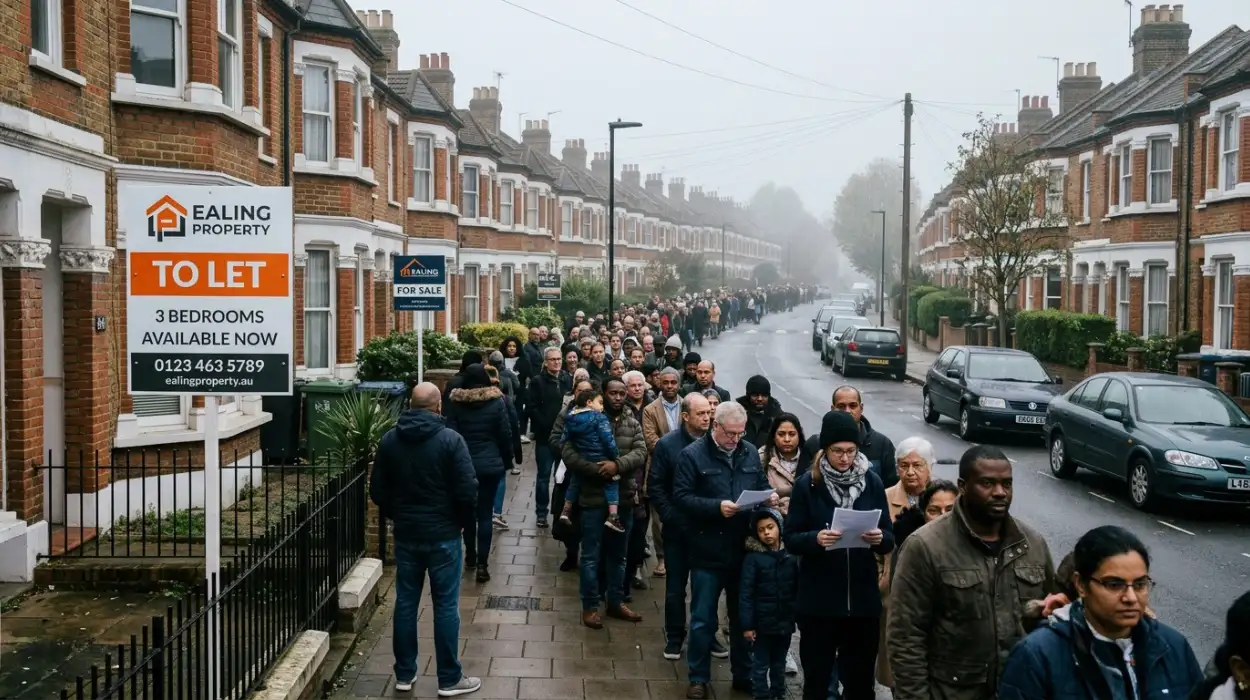
The Ealing housing crisis has become an increasingly important issue for residents, families and people trying to find an affordable home in west London. Ealing is an attractive place to live, with strong transport connections, green spaces, schools, town centres and access to central London. However, demand for housing has grown considerably faster than the supply of homes available to people who need them.
The scale of the problem is particularly visible through Ealing’s council housing register. Ealing Council currently reports more than 13,300 live applications on its housing register, which acts as the waiting list for council housing. The council also receives around 350 new applications each month.
This does not mean that 13,300 homes are immediately required or that every applicant will receive a council property. The housing register includes different types of households with different levels of housing need. Nevertheless, the figure illustrates the substantial gap between demand and the amount of social housing available.
Why Is Ealing Facing a Housing Crisis?
Ealing’s housing shortage is not caused by one single factor. Population growth, rising housing costs, limited land, household formation and pressure on social housing all contribute to the situation.
The borough is an attractive residential location partly because of its transport links and quality of life. Ealing Broadway, South Ealing, Northfields, Hanwell, Acton, Greenford, Perivale and Northolt all provide different housing environments, while connections to central London make the borough attractive to commuters.
This desirability creates additional pressure. When more people want to live in an area where housing supply is limited, competition for available properties increases.
The affordability problem also extends beyond council housing. People who cannot afford to buy a property may remain in the private rented sector for longer, increasing demand for rental accommodation. Ealing planning research has previously identified substantial growth in households unable to afford an average first-time-buyer property.
How Many People Are Waiting for a Council Home in Ealing?
According to Ealing Council’s current housing allocations information, there are more than 13,300 live applications on the housing register. These applicants can include existing council tenants seeking more suitable accommodation, people living in privately rented homes, people living with relatives or friends and households who have experienced homelessness.
The number should therefore be understood as a measure of housing demand rather than a simple count of homeless families.
The council also states that the number of applications has increased significantly while the supply of social housing remains limited. This creates a difficult situation in which being accepted onto the housing register does not automatically mean that a household will be offered a home.
Earlier figures help demonstrate how the situation has developed. Ealing’s 2024–25 Housing Annual Report recorded 7,813 households on the waiting list at the end of March 2025, showing that published figures can vary according to the date, eligibility rules and composition of the register.
For anyone researching the current Ealing housing crisis, it is therefore important to check the latest council information rather than relying on older articles or social media posts.
Why Are There So Few Council Homes Available?
The central challenge is the imbalance between the number of people seeking social housing and the number of properties becoming available.
Ealing Council says it has approximately 600 homes to let each year, while its current housing register contains more than 7,500 applicants on one of its public information pages. Another current council page reports more than 13,300 live applications following changes to the housing register. The figures illustrate why the council warns that many applicants will not be rehoused.
Social housing is not supplied only by the council. Registered providers and housing associations also contribute to the borough’s affordable housing stock. However, these homes are still limited compared with the level of need.
Existing properties also have to meet different household requirements. A one-bedroom flat cannot solve the problem of a family needing three or four bedrooms.
This mismatch between the type of homes available and the size of households waiting is one of the reasons the housing shortage can persist even when new properties are being built.
Families Face Particular Pressure
Larger households can experience especially long waits because family-sized social homes are in short supply.
Ealing’s 2024–25 Housing Annual Report found that 5,892 households were waiting for properties with two or more bedrooms at the end of March 2025.
The council’s housing strategy also illustrates the difference between demand and supply by bedroom size. Its earlier data showed particularly long projected times to clear the waiting list for larger homes, with three-bedroom and four-bedroom requirements facing much greater shortages than smaller properties.
Consider a family living in overcrowded accommodation. Even if that household qualifies for social housing, there may be relatively few suitable properties available when they are eligible to bid.
This is why the housing crisis cannot be measured only by the total number of applicants. The number of bedrooms required, location preferences, medical needs and priority band can all influence how quickly a household is rehoused.
What Is the Ealing Housing Register?
The housing register is the system used by Ealing Council to assess people seeking social housing. Applicants who meet the relevant criteria are assessed according to their housing circumstances and placed into an allocation band.
Ealing currently operates Bands A, B and C under its revised allocations policy. Band A is for people with an extremely urgent need to move, Band B covers urgent housing needs and Band C covers other applicants whose circumstances meet the council’s housing-need criteria.
The banding system matters because applicants do not all compete on an equal basis. Someone with an extremely urgent housing need may have significantly higher priority than someone who has been waiting but has less urgent circumstances.
This means that joining the housing register is not equivalent to joining a straightforward queue where the person who has waited longest automatically receives the next available home.
Does Joining the Waiting List Guarantee a Home?
No. This is one of the most important points for anyone researching social housing in Ealing.
The council explicitly states that being accepted onto the housing register does not guarantee an offer of accommodation. The limited supply means that many applicants may not be rehoused through the council.
The practical reality can be difficult for households that have been waiting for years. Older council information shows that successful Band C applicants have faced average waits measured in years, particularly for two- and three-bedroom properties.
This explains why some households may explore private renting, housing associations, mutual exchanges, shared ownership or housing options outside the borough while remaining on the register.
Homelessness and Temporary Accommodation
The housing shortage is closely connected with homelessness and temporary accommodation.
When people lose their accommodation and have nowhere suitable to go, councils may have legal duties to provide assistance depending on their circumstances. However, temporary accommodation is not the same as permanent social housing.
Ealing has been working to reduce its reliance on emergency and temporary accommodation. Its 2024–25 housing report recorded progress in reducing the use of Travelodge accommodation and noted that hundreds of social lettings were completed during the year.
The council has also invested in additional temporary accommodation capacity. Its recent progress report says that £21.2 million was invested in creating 100 new safe, self-contained places for people needing temporary accommodation.
These measures can help households facing immediate housing problems, but they do not remove the underlying shortage of permanent affordable homes.
What Is Ealing Council Doing About the Housing Shortage?
New housing construction is one part of the council’s response. Ealing has been developing new affordable homes through council-led schemes and partnerships.
The council’s housing programme includes developments in areas such as Northolt, Hanwell, Greenford and Acton. One example is the Northolt Grange development, where 92 new homes are being provided, including 84 homes at London Affordable Rent.
Ealing has also worked through Broadway Living, its wholly owned housing development company, to deliver new homes and make use of available council-owned land. The council says its affordable housing programme has involved substantial grant funding from the Greater London Authority.
Building new properties is important, but the scale of the waiting list demonstrates why housing supply remains a long-term challenge.
Why New Affordable Homes Matter
Affordable housing is particularly important because market rents can be beyond the reach of households on modest incomes.
A household may earn too much to qualify for certain forms of assistance while still being unable to afford to purchase a home. At the same time, private rents can consume a substantial proportion of household income.
This creates a gap between social housing and open-market housing.
Genuinely affordable homes can help address that gap by providing accommodation at rents designed around the incomes of local households rather than solely around market demand.
For Ealing residents, new affordable developments can therefore provide more than additional housing numbers. They can create opportunities for families to remain in their communities rather than being forced to move elsewhere because suitable accommodation is unavailable.
What Can Residents Do If They Need Housing?
People facing housing difficulties should not assume that joining the waiting list is their only option.
Ealing Council provides information on private renting, homelessness support, housing associations and other housing options. People who believe they may be eligible for social housing can apply through the council’s housing register process.
Applicants should keep their circumstances updated. A change in household size, address, medical condition or other relevant circumstances may affect the assessment.
It is also important to keep documents and correspondence relating to a housing application. If an applicant disagrees with a decision, the council provides procedures for requesting a review in relevant circumstances.
For households at immediate risk of homelessness, seeking advice early is generally more useful than waiting until accommodation has already been lost.
The Wider Impact on Ealing
The housing crisis affects more than people who are directly waiting for a council home.
High housing costs can influence where families live, whether young adults can remain near relatives and how far workers have to commute. It can also place pressure on private renting, temporary accommodation and local services.
For businesses, housing affordability can affect recruitment and retention because workers may struggle to live close to their jobs.
For communities, frequent moves can disrupt children’s education, support networks and access to local services.
Housing is therefore closely connected with transport, employment, health, education, community stability and the wider economy of Ealing.
What Does the Future Look Like?
There is no single solution to the Ealing housing crisis. Increasing the supply of genuinely affordable homes is essential, but so are effective homelessness prevention, better use of existing housing, appropriate support for tenants and a range of housing options.
The council’s housing strategy recognises that demand substantially exceeds supply and aims to improve the availability and allocation of affordable homes.
New developments in Northolt, Greenford, Hanwell and other parts of the borough may gradually increase supply. However, housing construction takes time, and demand can continue to grow while new properties are being delivered.
For residents, the most realistic approach is therefore to understand how the housing register works, keep applications updated and consider alternative housing routes where appropriate.
Understanding the Ealing Housing Crisis
So, how many people are waiting for a home in Ealing? The latest Ealing Council information reports more than 13,300 live applications on the housing register, highlighting the scale of housing demand in the borough.
However, that number needs context. Applicants have different levels of need, require different property sizes and may be seeking different types of accommodation. Earlier official reports recorded lower waiting-list figures, demonstrating that the size of the register changes over time and according to allocation policies.
The deeper issue is the continuing gap between affordable housing demand and available supply. Families requiring larger homes can face particularly difficult circumstances, while people unable to afford home ownership may remain dependent on private renting.
Ealing is responding through new affordable housing, council development programmes, homelessness prevention and alternative housing options. Yet with thousands of households still seeking suitable accommodation, the borough’s housing challenge remains significant.
For anyone living in or considering moving to Ealing, understanding this situation provides useful context for the local property market, rental pressures and availability of social housing.
Frequently Asked Questions
How many people are waiting for a council home in Ealing?
Ealing Council’s latest housing register information reports more than 13,300 live applications. The register includes households with different housing circumstances and levels of priority.
Why is there a housing crisis in Ealing?
The crisis results from high demand for homes, limited social housing supply, population and household growth, rising housing costs and difficulty for many residents in buying suitable properties.
How long do people wait for social housing in Ealing?
Waiting times vary considerably according to household circumstances, property size and allocation band. Some applicants can face waits measured in years, particularly for larger family homes.
Does being on the Ealing housing register guarantee a council home?
No. Ealing Council states that joining the housing register does not guarantee an offer because the number of applicants is significantly greater than the number of homes available.
Who gets priority for council housing in Ealing?
Priority depends on housing need and the council’s allocation rules. Applicants accepted onto the register are placed into Bands A, B or C, with Band A representing the most urgent housing need.
Is Ealing building more affordable homes?
Yes. Ealing Council is delivering and supporting affordable housing developments across the borough, including projects in Northolt, Hanwell, Greenford and other areas.
What should I do if I am at risk of homelessness in Ealing?
Seek housing advice from Ealing Council as early as possible. The council provides information covering homelessness, private renting, social housing and alternative housing options.