

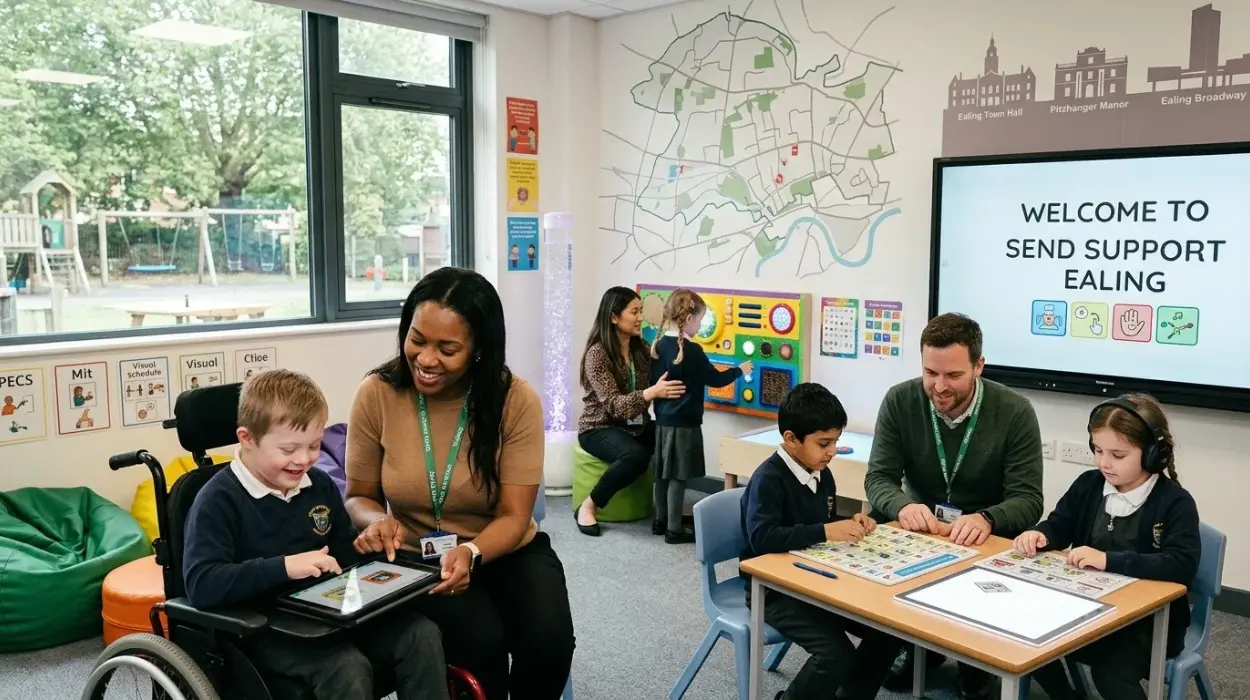
Finding the right support for a child with special educational needs and disabilities can involve schools, families, health professionals and the local authority working together. For parents and carers in Ealing, understanding where to begin can make the process much easier.
Ealing Schools SEND Support Services cover a wide range of educational, health, social care and family support. They can include help provided directly by a school, advice from a Special Educational Needs Coordinator (SENCO), specialist teaching, educational psychology, speech and language services, occupational therapy, Education, Health and Care (EHC) needs assessments and support through Ealing’s Local Offer.
Ealing Council’s Local Offer brings together information about services for children and young people aged 0 to 25 with SEND. It covers education, health, family support, leisure, short breaks, travel assistance, preparing for adulthood and other areas.
What Does SEND Support Mean In Ealing?
SEND refers to special educational needs and disabilities. A child or young person may have SEND when they have a learning difficulty or disability that means they need additional or different support from that normally available to children of the same age.
SEND can cover a broad range of needs. These may include learning difficulties, communication and interaction needs, sensory needs, physical disabilities, autism and complex health requirements.
Not every child with SEND needs an Education, Health and Care Plan. Many children receive support through their school or early-years setting under SEN Support.
This distinction is important because parents sometimes assume that an EHCP is the starting point for all SEND support. In practice, support can begin within the school through discussions with teachers and the SENCO, with more specialist assessment considered where appropriate.
Start With Your Child’s School And SENCO
For a child already attending an Ealing school, the school’s Special Educational Needs Coordinator, usually known as the SENCO, is often an important first point of contact.
The SENCO coordinates the school’s approach to special educational needs and can discuss concerns with parents, teachers and other professionals. They may help identify what support is already available and whether additional assessment or specialist involvement should be considered.
Ealing’s school information explains that every school has a SENCO who oversees SEND support.
A parent might notice that their child is struggling with reading, communication, attention, social interaction, physical access or classroom routines. Rather than trying to identify the correct service independently, they can start by discussing the concern with the child’s teacher or SENCO.
This can help establish whether school-based adjustments or SEN Support could address the need.
Understanding SEN Support In Mainstream Schools
Many children with SEND attend mainstream schools. Support can be adapted according to the individual child’s needs.
Examples might include additional classroom support, differentiated teaching, assistive resources, communication strategies, adjustments to the learning environment or targeted interventions.
The exact support depends on the child’s needs and the school’s available provision. A useful conversation with the SENCO should focus on what the child finds difficult, what has already been tried and what outcomes the family and school want to achieve.
Parents should also remember that SEND support is not limited to academic attainment. Communication, independence, participation, emotional wellbeing, physical access and social development may also be relevant depending on the child’s circumstances.
Ealing’s Local Offer For SEND Families
The Ealing Local Offer is one of the most useful starting points for families searching for local SEND information.
It is designed to explain what support is available locally and how families can access it. The Local Offer includes information about early years and childcare, SEND provision within schools, EHC assessment and plans, health and wellbeing, specific conditions, short breaks, money and benefits, housing adaptations, travel assistance and preparing for adulthood.
This breadth is important because SEND support is not only about education.
For example, a family may need help understanding school provision while also looking for speech and language support, travel assistance or information about transition into adulthood. Having these areas brought together can make the search for appropriate services more manageable.
SENDIASS Ealing: Independent Information And Advice
Parents and young people may have questions about SEND rights, education provision, meetings, assessments or disagreements with a school or local authority.
Ealing provides SENDIASS, the Special Educational Needs and Disabilities Information, Advice and Support Service. Ealing Council describes SENDIASS as an impartial, confidential and free service funded by the council to support Ealing families.
This can be particularly useful when a parent is unsure how to communicate concerns or understand the SEND process.
For example, a parent might have received information about an assessment and not understand what happens next. Another family may want help preparing for a meeting with a school. A young person may also need information about their own education and support.
SENDIASS is therefore different from a school-based service. Its role is to provide information, advice and support around SEND.
Education, Health And Care Plans Explained
An Education, Health and Care Plan, commonly called an EHCP or EHC plan, is a legal document for children and young people who need more support than can normally be provided through SEN Support.
The assessment considers the child’s education, health and social care needs where relevant. The resulting plan sets out the child’s needs, outcomes and the special educational provision required.
Ealing’s SEN Assessment Service, known as SENAS, processes referrals for Education, Health and Care Plans.
Parents should not assume that having a particular diagnosis automatically means a child will receive an EHCP. The focus is on the child’s special educational needs and the provision required to meet them.
The Ealing Parent and Young Person’s Portal can also allow parents and young people to view information about an EHC needs assessment and plan as it progresses, where they have access through the relevant process.
When Might An EHC Needs Assessment Be Considered?
An EHC needs assessment may be considered when a child or young person’s needs cannot reasonably be met through the support normally available within their educational setting.
A parent can discuss concerns with the school and SENCO, particularly where existing support has not been sufficient or the child’s needs appear to require a more coordinated level of provision.
The assessment process involves gathering information about the child. This can include evidence from the school, parents, professionals and the young person.
Keeping useful records can therefore be helpful. Parents may wish to keep copies of school reports, professional assessments, correspondence and examples of how the child’s needs affect everyday learning and participation.
The exact process and eligibility decisions should be discussed with the relevant Ealing SEND service rather than relying on general assumptions.
Specialist Education And Health Support
Some children require input from specialist professionals alongside school-based support.
Ealing’s Ealing Service for Children with Additional Needs, or ESCAN, brings together education, health and social care services for children and young people with SEND. The council identifies services within ESCAN including educational psychology, specialist teaching for children and young people with sensory impairments, EHC needs assessment, SEN travel assistance, paediatric occupational therapy, physiotherapy, speech and language therapy and child development services.
This multi-agency approach recognises that a child’s needs can overlap different areas.
For example, a child with communication difficulties may need support from school staff and speech and language professionals. A child with physical access requirements may need educational adjustments alongside occupational therapy or physiotherapy input.
Families should use the appropriate referral route for each service because not every service is accessed in the same way.
Support For Children With Disabilities
Ealing’s Children with Disabilities team supports children and young people up to 18 who have disabilities and are likely to have lifelong support needs. The council states that this includes children with physical or learning disabilities, complex health needs or autism.
The wider SEND system can therefore involve education as well as social care and health.
A family may need support with daily living, short breaks, communication, mobility or access to community activities in addition to school provision. Ealing’s Local Offer brings information about these wider areas together.
This can be especially important for families whose needs extend beyond the classroom.
Travel Assistance For Children With SEND
Getting to and from school can be a significant practical issue for some children with SEND.
Ealing Council explains that different transport rules apply to children with SEND and directs families to its SEND travel assistance information.
Travel support may be relevant where a child’s disability or special educational needs affect their ability to travel independently or safely.
Parents should check the current eligibility criteria and application process rather than assuming that all children with SEND automatically qualify for transport assistance.
The location of the school, the child’s needs and the nature of the journey can all be relevant when considering travel arrangements.
Early Help And Wider Family Support
SEND needs can sometimes exist alongside other family difficulties. These might involve housing, finances, parenting challenges, attendance, relationships or other circumstances affecting a child’s wellbeing.
Ealing’s Early Help Assessment and Plan (EHAP) is designed for situations where a multi-agency approach is needed. The council explains that EHAP brings relevant professionals together to discuss a family’s needs and agree a plan of support. It is voluntary and families can opt out.
The Family Information Service can also help families find information about SEND services, childcare, family support and Early Help. Ealing Council provides the Family Information Service telephone number as 020 8825 5588.
This means parents do not always have to determine which service they need before asking for help.
What If You Disagree With A SEND Decision?
SEND processes can sometimes involve disagreement between families, schools and local authorities.
If a parent or young person disagrees with certain decisions concerning an EHCP or an EHC needs assessment, there are formal routes for challenging the decision.
Ealing Council explains that appeals to the First-tier Tribunal (Special Educational Needs and Disability) can apply in specified circumstances, including challenges to the contents of an EHCP or a decision by the council not to carry out an EHC needs assessment. The council also provides information about mediation and its complaints process.
Because SEND disputes can be legally and procedurally complex, families should obtain appropriate independent information and advice before deciding what action to take.
Preparing Children With SEND For Adulthood
SEND support should not stop at school-age education.
Ealing’s Local Offer includes Preparing for Adulthood, with information covering areas such as housing, employment and support.
Planning ahead can help young people think about what they want after education. Depending on their needs and interests, this could involve further education, supported employment, apprenticeships, independent living skills, community participation or continuing health and social care support.
Ealing’s SEND strategy also identifies preparation for purposeful adulthood, including opportunities for training and meaningful employment, as one of its priorities.
For parents of teenagers, it can therefore be useful to begin discussing longer-term goals before the final school year.
A Practical Example Of Using Ealing SEND Support
Consider a primary-school child in Southall who is struggling with communication and classroom participation.
The family could begin by speaking with the class teacher and SENCO. The school might review the child’s needs and existing support. If specialist input appears appropriate, the school can discuss the relevant referral or assessment route.
If the family also needs information about wider services, they can explore Ealing’s Local Offer or contact the Family Information Service. If they need impartial information about their SEND rights or the education process, SENDIASS may be another useful source of support.
This illustrates why there is rarely one single “SEND service” that solves every issue. Support often involves several people and organisations working around the individual child.
How Parents Can Prepare For SEND Meetings
Preparation can make conversations with schools and professionals more productive.
Before a meeting, write down the main concerns and specific examples. Instead of saying that a child is “struggling”, describe what happens, how often it occurs and what effect it has on learning or daily life.
It can also help to list strategies that have already been tried and whether they made a difference.
Parents can ask practical questions such as what support will be provided, who will deliver it, how progress will be monitored and when the situation will be reviewed.
Young people should also be included in decisions where appropriate. Their views, wishes and aspirations are an important part of person-centred SEND planning.
Finding The Right Ealing SEND Support Service
There is no single pathway for every child with SEND. Some children may need support primarily through their school, while others may require specialist education, health or social care involvement.
For most families, Ealing’s Local Offer is a useful starting point because it brings together information about local SEND provision. The school’s SENCO can help families understand school-based support, while SENAS deals with EHC needs assessment processes. SENDIASS provides impartial information and advice, and specialist services within ESCAN can provide education and health support for children with more complex needs.
The most important step is to raise concerns early and keep communication open. SEND support works best when families, children and young people, schools and relevant professionals share information and work towards clear outcomes.
Frequently Asked Questions
What SEND support is available in Ealing schools?
Support can include school-based SEN Support, SENCO involvement, specialist teaching, educational psychology, speech and language therapy, occupational therapy, physiotherapy, EHC needs assessment and other education, health and social care services. Ealing’s Local Offer provides information about available provision.
How do I get SEND support for my child in an Ealing school?
A good starting point is to speak with your child’s teacher or SENCO. You can also explore Ealing’s Local Offer for information about local services. The appropriate route depends on your child’s needs and the type of support required.
What is SENDIASS Ealing?
SENDIASS Ealing is an impartial, confidential and free information, advice and support service for Ealing families dealing with special educational needs and disabilities.
Does my child need an EHCP to receive SEND support?
No. Many children receive SEN Support through their school without having an EHCP. An EHCP is considered where a child or young person may need provision beyond what can normally be provided through SEN Support.
How do I request an EHCP assessment in Ealing?
Parents can discuss their concerns with the child’s school and SENCO and ask about the EHC needs assessment process. Ealing’s SEN Assessment Service, or SENAS, processes referrals for Education, Health and Care Plans.
Can I get help with transport for a child with SEND in Ealing?
Different travel assistance rules apply to children with SEND. Ealing Council provides specific information about SEND travel assistance, including the relevant application arrangements and eligibility considerations.
Where can Ealing families find information about SEND services?
Ealing’s Local Offer is the main local information resource for children and young people aged 0 to 25 with SEND. Families can also contact the Family Information Service, speak with their child’s SENCO or use SENDIASS for impartial information and advice.