

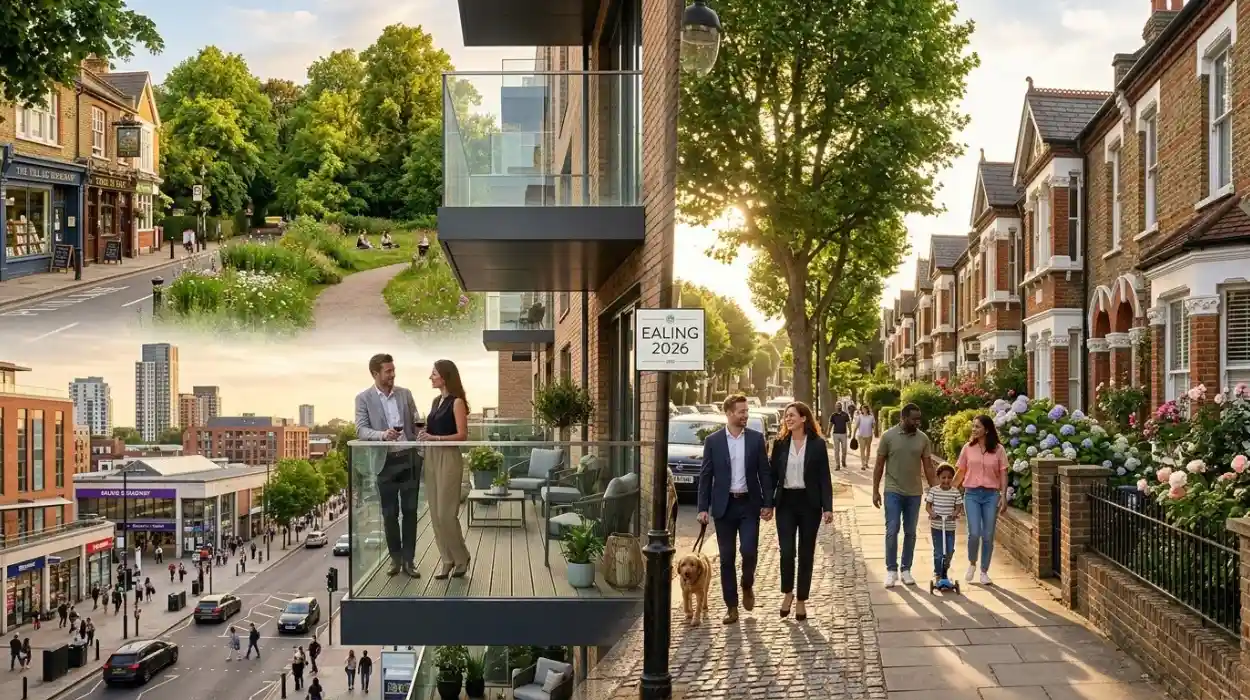
Choosing among the best areas of Ealing to live in 2026 depends on what you want from London life. Some people prioritise fast journeys into central London, while families may care more about schools, parks, space and a quieter atmosphere. First-time buyers often focus on affordability, whereas renters may be more interested in transport, local amenities and the overall feel of a neighbourhood.
Ealing is particularly interesting because it is not one single type of place. The borough contains busy town centres, leafy residential streets, period homes, modern flats, independent high streets and extensive green spaces. Ealing Council describes its neighbourhoods as having distinct identities, with town centres and local shopping parades playing an important role in community life.
In 2026, transport, housing costs, green space, safety, schools and local amenities remain among the main factors people consider when deciding whether an area is a good place to live. Ealing’s 2024 residents survey found that public transport availability, links to London, affordable housing, parks and open spaces, and safety were among the leading factors residents associated with a good local area.
Why Ealing Is Popular With London Residents
Ealing has long been associated with the idea of suburban London living without completely losing the convenience of the capital. Its transport network provides access to central London and Heathrow, while its parks, residential streets and local high streets create a less intense atmosphere than many central neighbourhoods.
The council describes Ealing as a well-connected, green and thriving town centre, with a strong retail and commercial leisure offering.
The borough is also home to a wide variety of housing. Buyers and renters can find Victorian and Edwardian houses, purpose-built flats, new developments, maisonettes and smaller period properties. This means that different parts of Ealing can suit very different budgets and lifestyles.
The right area ultimately depends on whether you want convenience, space, greenery, community atmosphere or value.
Ealing Broadway: Best for Transport and Convenience
Ealing Broadway is one of the strongest choices for people who want convenience. It is the borough’s major metropolitan centre and has an extensive selection of shops, restaurants, cafés, entertainment venues and everyday services.
Transport is a major attraction. Ealing Broadway provides Underground and rail connections, including the Elizabeth line, making it particularly appealing to commuters travelling towards central London and other major employment areas. Ealing Council identifies the area as having excellent public transport access to both Heathrow and central London.
The trade-off is that Ealing Broadway can feel considerably busier than quieter residential parts of the borough. Traffic, commercial activity and evening entertainment may be less attractive to someone looking for complete peace and quiet.
For professionals, young couples and people who value being close to restaurants and transport, however, Ealing Broadway is difficult to overlook.
Ealing Common: Best for Green Space and Character
Ealing Common is a strong option for people who want a greener residential environment while remaining close to central Ealing.
The Common itself provides open parkland, while nearby streets contain a mixture of period properties and flats. Ealing Common Underground station and Ealing Broadway station provide convenient transport options.
The area can appeal particularly to professionals and families who want access to outdoor space without moving far from London’s commercial centres.
One of its biggest advantages is the balance between convenience and atmosphere. You can reach the shops and restaurants of central Ealing relatively easily, yet parts of the surrounding residential area feel considerably quieter.
Northfields: Best for Families and Local Community
Northfields is often attractive to families and people who prefer an established residential neighbourhood with its own local identity.
Northfields has a useful high street, independent businesses, cafés and everyday services. Its location also gives residents access to transport connections towards central London and other parts of west London.
The area is particularly appealing to people who want more of a neighbourhood experience rather than living directly beside a major town centre.
When comparing Northfields with Ealing Broadway, prospective residents should consider what matters most. Ealing Broadway offers greater transport and commercial convenience, while Northfields can provide a more local, residential atmosphere.
Pitshanger: Best for a Village-Like Feel
Pitshanger is one of the most distinctive choices for people searching for a community-focused part of Ealing.
Pitshanger Lane provides independent shops and local services, while the surrounding residential streets have a strong suburban character. The area is especially attractive to families and buyers who want a neighbourhood where everyday life can revolve around a local high street.
Green space is another major advantage. Pitshanger Park forms part of Brent River Park and includes walking and cycling routes, sports facilities, a playground and other amenities. Ealing Council also notes that the park connects towards St Mary’s, Perivale and Gurnell.
Pitshanger may therefore be particularly suitable for people who value parks, community atmosphere and outdoor activities over being immediately beside a major transport interchange.
South Ealing: Best for Residential Convenience
South Ealing offers a useful middle ground. It has a residential feel but remains connected to central Ealing and surrounding areas.
The local centre provides shops, restaurants and everyday services, while transport options make commuting into London practical.
South Ealing can be worth considering for renters and buyers who find the most central parts of Ealing expensive but still want access to the area’s amenities.
It is also worth remembering that Ealing Council identifies South Ealing as one of the borough’s neighbourhood shopping centres, demonstrating its role as an established local centre rather than simply a collection of residential streets.
Hanwell: Best for Character and Outdoor Living
Hanwell has become an increasingly interesting choice for people looking for a more relaxed west London lifestyle.
Ealing Council describes Hanwell as a historic area with a bustling high street and independent shops. The neighbourhood also benefits from green spaces and access to the Grand Union Canal, adding to its appeal for people who enjoy walking and outdoor activities.
Hanwell can suit families, couples and professionals who want a community atmosphere while remaining within Greater London.
Its character is different from Ealing Broadway. Instead of prioritising a major commercial centre, Hanwell offers a combination of local businesses, residential streets, heritage and green surroundings.
West Ealing: Best for Commuters Looking for More Choice
West Ealing is another area worth investigating in 2026, particularly for people who value Elizabeth line connectivity.
The area has a mixture of housing, shops and local services, creating several different lifestyle options. Transport improvements have made the neighbourhood increasingly relevant to commuters.
However, West Ealing is not completely uniform. Some streets are quieter and more residential, while others are closer to busy roads and commercial areas.
The best approach is to view several properties rather than judging the entire neighbourhood from one visit.
Perivale: Best for Green Space and Potential Value
Perivale is particularly interesting for residents who want access to green areas and potentially more affordable options than some of the most sought-after parts of Ealing.
It has Central line access through Perivale station and is close to significant open spaces. The area can suit people who enjoy walking, cycling and outdoor activities.
Pitshanger Park, for example, is only a short walk from Perivale Underground station and provides sports facilities, paths, a playground and access to wider green corridors.
Perivale can therefore appeal to buyers and renters who are willing to trade some of the polished feel of central Ealing for space, greenery and potentially better value.
Greenford: Best for Affordability and Space
Greenford is another area to consider if affordability is one of your main priorities.
Compared with some of Ealing’s most expensive neighbourhoods, Greenford can provide access to a wider range of housing at different price points. It also has its own town centre, shops and transport connections.
For families who want more internal space or a garden, moving further west or north within the borough can sometimes provide more options than focusing exclusively on Ealing Broadway.
Greenford is also well positioned for people travelling along the A40 corridor and towards other parts of west London.
The trade-off is that commuting times can differ considerably depending on the exact property and destination. Buyers should test their actual journey rather than assuming that a Tube or rail station automatically means a short commute.
Northolt: Best for Buyers Watching Their Budget
Northolt is often overlooked when people discuss the best areas of Ealing, but it can be worth considering for people prioritising affordability and space.
Ealing Council describes Northolt as an up-and-coming area with a variety of housing and transport connections. It also highlights Northala Fields and Northolt Village as important local attractions.
Northolt can appeal to buyers who want a more suburban environment and are prepared to live further from central Ealing.
It may not provide the same concentration of restaurants and high-end amenities as Ealing Broadway, but that can actually be an advantage for people who prefer a quieter lifestyle.
Which Ealing Area Is Best for Families?
For families, there is no single winner. Pitshanger, Northfields, Ealing Common, Hanwell and parts of South Ealing can all be attractive depending on budget and priorities.
Green space is particularly important for families with young children. Pitshanger Park, Walpole Park, Ealing Common and other open spaces provide opportunities for walking, sports and outdoor activities. Ealing Council describes Walpole Park as one of the borough’s best-known parks and a venue for major summer events.
Schools should also be researched at property level. Catchment areas can change, and being within a particular neighbourhood does not guarantee admission to a particular school.
Families should therefore check current admissions information before committing to a property.
Which Area Is Best for Young Professionals?
Young professionals may prefer Ealing Broadway, Ealing Common, South Ealing or West Ealing.
Transport is likely to be the biggest consideration. Ealing’s residents survey found that public transport availability and links to London were among the most frequently mentioned characteristics of a good local area.
Ealing Broadway is particularly convenient for people who enjoy restaurants, bars and entertainment within walking distance. South Ealing and West Ealing can offer a more residential atmosphere while maintaining useful transport connections.
The best choice will depend on where you work. Someone commuting to the City may value a different route from someone travelling to Heathrow, Hammersmith or another west London employment centre.
Which Ealing Area Is Best for First-Time Buyers?
First-time buyers generally need to balance purchase price with transport and lifestyle.
Perivale, Greenford and Northolt may be worth investigating if getting more space for your budget is important. West Ealing and South Ealing can also provide alternatives to the most expensive central locations.
Flats can provide another route into areas such as Ealing Broadway and Ealing Common, where buying a house may require a substantially larger budget.
However, buyers should look beyond the purchase price. Lease length, service charges, ground rent where applicable, maintenance costs and mortgage affordability can all affect the real cost of ownership.
What Makes an Ealing Neighbourhood Good to Live In?
The answer is highly personal, but Ealing residents have already provided useful insight.
The council’s 2024 survey found that public transport availability ranked first among factors residents associate with a good local area, followed by transport links to London, affordable housing, parks and open spaces, and safety.
This is a useful framework for anyone comparing neighbourhoods.
A professional might prioritise transport. A family may prioritise schools and parks. A retiree might prefer peace and quiet, while a younger renter could value restaurants, cafés and nightlife.
There is no reason all residents should choose the same neighbourhood.
What Should You Check Before Choosing an Ealing Area?
Before renting or buying, visit your preferred neighbourhood more than once.
Walk around during the morning commute, at weekends and after dark. Check how long it actually takes to reach the nearest station, supermarket, park and high street.
Look at noise levels, parking, traffic, street lighting and the condition of pavements. If you are buying, research recent property sales and planned developments nearby.
Transport should also be tested from the exact address. Ealing Council’s transport engagement has highlighted resident demand for safer crossings, improved pedestrian environments, better lighting and cycling improvements across areas including Ealing, Hanwell and Perivale.
This is particularly important because two properties advertised as being in the same neighbourhood can offer very different day-to-day experiences.
How Ealing’s Neighbourhoods May Change
Ealing continues to experience regeneration and development, particularly around town centres and transport corridors.
The council’s planning documents identify Ealing town centre as an important focus for regeneration, including new homes, shops, offices, leisure facilities and public infrastructure.
This can create opportunities for residents but also means prospective buyers should investigate proposed developments before purchasing.
A new development may bring improved shops, public spaces and transport infrastructure, but construction activity and increased density can also affect a street’s character.
Understanding future plans is therefore just as important as looking at what exists today.
The best areas of Ealing to live in 2026 depend on your priorities rather than one universal ranking.
Ealing Broadway is excellent for transport and convenience. Ealing Common combines greenery with central accessibility. Northfields and Pitshanger are attractive for people seeking strong neighbourhood identities, while Hanwell offers historic character, independent businesses and access to outdoor spaces.
South Ealing and West Ealing provide practical residential options with useful transport connections. Perivale, Greenford and Northolt can be particularly interesting for people who prioritise space and affordability.
Ealing’s greatest strength is this variety. The borough gives residents the opportunity to choose between urban convenience, suburban calm, green surroundings and strong transport connections without leaving west London.
The best neighbourhood for you is ultimately the one that fits your budget, commute, lifestyle and long-term plans.
FAQs About the Best Areas of Ealing to Live in 2026
What is the best area of Ealing to live in?
Ealing Broadway, Ealing Common, Pitshanger, Northfields and Hanwell are among the areas worth considering, but the best choice depends on your budget, commute, family needs and preferred lifestyle.
Which area of Ealing is best for families?
Pitshanger, Northfields, Ealing Common and Hanwell can be particularly appealing to families because of their residential character, local amenities and access to green space.
Which part of Ealing is best for young professionals?
Ealing Broadway is particularly convenient for young professionals because of its transport connections, restaurants, shops and entertainment. South Ealing and West Ealing can offer quieter alternatives.
Which Ealing areas are more affordable?
Greenford, Northolt and Perivale can be worth investigating for buyers and renters looking for comparatively better value or more space. Prices vary considerably by property and exact location.
Is Pitshanger a good place to live?
Yes. Pitshanger is particularly attractive for people who want a community-focused neighbourhood, independent local shops and access to green space such as Pitshanger Park.
Is Hanwell a good area to live in 2026?
Hanwell can be a strong choice for people who want a historic neighbourhood, independent shops, green spaces and a more relaxed atmosphere while remaining connected to London.
How do I choose the right area of Ealing?
Start with your budget and commute, then compare transport, property type, schools, green spaces, local amenities and safety. Visit shortlisted streets at different times before making a final decision.