
Walking home through a park can be convenient, especially when a green space provides a shorter route between a station, residential street and local destination. In Ealing, parks and open spaces such as Walpole Park, Lammas Park, Gunnersbury Park and Blondin Park form an important part of the borough’s landscape. During daylight hours, they can be pleasant places to walk, exercise and travel through.
At night, however, the safety calculation changes. Lower footfall, reduced visibility, fewer open facilities and quieter paths can make a route feel significantly different after dark. This does not mean that every Ealing park is unsafe at night, nor does it mean that walking through a park automatically presents a serious danger. Safety depends on the specific location, time, route, lighting, surrounding streets, weather, current activity and whether alternative transport is available.
For someone considering walking home alone, the most sensible approach is to assess the actual journey rather than asking whether an entire park is simply “safe” or “unsafe”.
Is It Safe To Walk Through Ealing Parks At Night?
There is no universal yes-or-no answer.
A well-lit route with regular pedestrians, visible entrances and nearby residential streets can feel very different from an isolated path through a large open space late at night. The same park can therefore have different levels of perceived and practical safety depending on which entrance and path someone uses.
Local residents often make these decisions intuitively. Someone who knows the area may recognise which streets remain busy, where there are shops or transport stops and which paths become particularly quiet after dark. A visitor or new resident does not necessarily have that local knowledge.
For this reason, people walking alone at night should prioritise familiar, well-used and reasonably well-lit routes, even if they are slightly longer than a path through a park.
Why Parks Feel Different After Dark
The main difference after sunset is not necessarily that criminal activity suddenly increases. It is that the environment provides fewer natural safety advantages.
During the day, other walkers, dog owners, runners, cyclists, families and park users create activity. At night, many of these people have left.
Visibility also decreases. Trees, bushes, buildings, walls and changes in ground level can create areas where a person cannot easily see what is ahead.
A quiet park may therefore make someone feel vulnerable even when nothing suspicious is happening. That feeling should not simply be dismissed. If a route makes you uncomfortable, choosing a busier alternative can be a sensible decision.
Which Ealing Parks Might People Walk Through At Night?
Ealing contains numerous parks and open spaces, and they are not identical.
Walpole Park is close to Ealing town centre and is surrounded by established residential and urban areas. Its proximity to central Ealing means that some journeys can be made around the park rather than directly through it.
Lammas Park is another significant green space in the borough, with surrounding residential streets and routes used by local residents.
Gunnersbury Park is a much larger open space extending across the Ealing and Hounslow area. Its size means that the experience of walking along one edge can be very different from crossing more isolated sections.
Other parks and recreation grounds around Acton, Hanwell, Greenford, Northolt and Southall can also form part of local walking routes.
The key point is that a park’s name alone does not tell you whether a particular route is appropriate after dark. The exact path and surrounding environment matter.
Does Lighting Make A Difference?
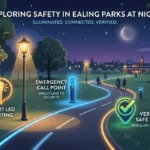
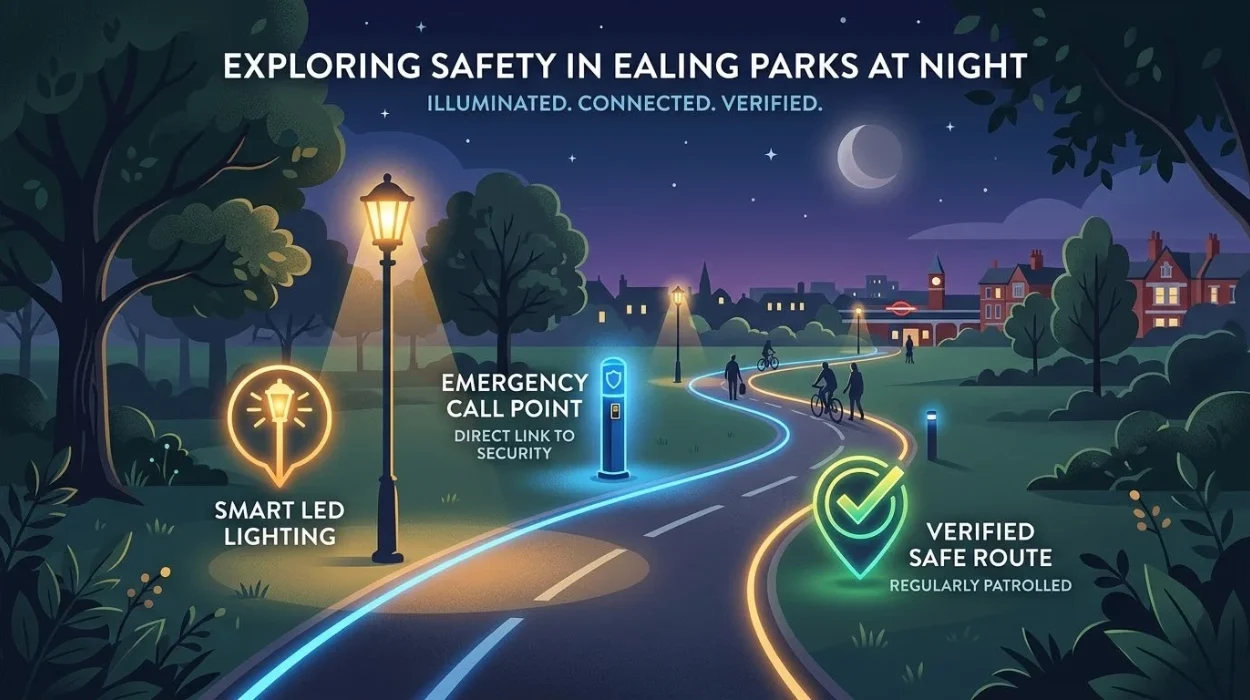
Yes. Lighting is one of the most important environmental factors when deciding whether to walk alone at night.
A route with consistent street lighting, clear sightlines and nearby occupied buildings generally provides more visibility than an unlit path through a green space.
However, lighting should not be treated as a guarantee of safety. A brightly lit route can still be quiet, while a less brightly lit area may have substantial pedestrian activity.
The strongest route usually combines several features: reasonable visibility, regular footfall, accessible streets and the ability to leave the route easily if circumstances change.
Someone walking home from Ealing Broadway, for example, may prefer a well-lit road around a park rather than taking a darker shortcut through the middle of the green space.
Is It Better To Walk Around A Park Rather Than Through It?
Often, yes, particularly when travelling alone late at night.
Walking around the perimeter can provide access to public roads, residential properties, bus stops and other people. It may add several minutes to a journey, but the trade-off can be worthwhile if the alternative involves a secluded path.
This is particularly relevant when someone is unfamiliar with the area.
Imagine a visitor leaving a restaurant near Ealing Broadway at 10.30pm and discovering that a park appears to offer the fastest route back to accommodation. A map may show the park as a convenient shortcut, but it cannot always communicate how busy or quiet that path feels at that exact time.
Taking the main road may therefore be the more sensible option.
What Time Does Walking Through A Park Become Less Advisable?
There is no universal hour when every Ealing park becomes unsafe.
Risk and perceived safety can change gradually as evening activity decreases. A route at 7pm may still have commuters, dog walkers and residents using it, while the same route at midnight could be almost empty.
Weather and the day of the week also matter. A dry summer evening may produce much more pedestrian activity than a cold, wet winter night.
The most important question is therefore not simply “What time is it?” but “How busy and visible is this particular route right now?”
If the park is empty and the alternative road remains active, the road may be the better choice.
What Should You Do If You Feel Uncomfortable?
Trusting your judgement is important.
If you enter a park and realise that it is much quieter than expected, you do not have to continue simply because it is the shortest route.
You can turn around, leave through the nearest entrance and continue along a public road. You can also enter a staffed business, station or other occupied location if you need to pause and reassess your journey.
A common mistake is worrying about appearing rude or overcautious. Personal safety does not require proving that you can manage an uncomfortable situation.
If something feels wrong, changing the route is reasonable.
Should You Use Your Phone While Walking Alone?
A phone can be useful for navigation and communication, but constantly looking at a screen can reduce awareness of your surroundings.
Before entering a park, it is better to know the general direction of travel rather than stopping repeatedly to study a map in a secluded area.
If you need to contact someone, consider doing so before entering the park or after reaching a more public location.
Keep enough battery available for emergencies and navigation. A portable charger can be useful for people who regularly make longer journeys home at night.
Is It A Good Idea To Tell Someone Your Route?
For a late-night journey, particularly one through an unfamiliar area, telling someone your expected arrival time can provide an additional layer of reassurance.
This does not have to be complicated. A simple message saying that you have left a station and expect to arrive home in 20 minutes can be enough.
For regular journeys, some people also use location-sharing features with trusted contacts.
The purpose is not to create anxiety around ordinary walking. It is simply to make it easier for someone to know where you are if your journey unexpectedly takes much longer than planned.
What If You Are Walking Home From Ealing Broadway?
Ealing Broadway is one of the busiest transport and shopping areas in the borough, so someone walking home from there has several possible routes.
If the destination is close to Walpole Park or surrounding residential streets, it may be tempting to use the park as a shortcut.
The safer choice depends on the time and the exact route. If there are still plenty of people around, the park may be reasonably comfortable for a short crossing. Later at night, walking around the edge and staying on public roads may be preferable.
Another option is to continue by bus for part of the journey rather than walking the entire distance.
This is especially useful when the final section of a route becomes quiet.
What About Gunnersbury Park At Night?
Gunnersbury Park is a large green space, so it deserves particular consideration when planning a night-time walking route.
Large parks can contain long paths and areas with fewer buildings immediately beside them. This can make them less suitable for someone who wants a highly visible route home after dark.
If your journey involves crossing a substantial section of Gunnersbury Park late at night, consider whether an alternative road route or public transport connection would be more appropriate.
During the day, the park’s size is part of its attraction. At night, that same size can mean fewer immediate alternatives if you decide you no longer want to continue along a particular path.
How Can Tourists Stay Safer In Ealing At Night?
Visitors should avoid assuming that a route is safe simply because it appears short on a map.
Before leaving a restaurant, hotel or attraction, check the route while you are still indoors. Look at where the roads, stations and main pedestrian routes are.
If you are unfamiliar with Ealing, choosing a route through populated streets is generally easier than navigating an unfamiliar park after dark.
Visitors should also avoid relying entirely on phone navigation to make decisions. A mapping application can identify the shortest walking route but does not necessarily reflect how busy a particular path feels at a specific time.
When practical, use recognised public transport connections or a taxi or private hire service for the final part of the journey.
What Should Women Consider When Walking Alone At Night?
Women may reasonably make different safety calculations when travelling alone at night.
A route that another person considers comfortable may feel unacceptable to a woman travelling alone, particularly when there are few other pedestrians.
There is no need to justify choosing a longer or more populated route. Staying near other people, choosing well-lit streets and avoiding isolated shortcuts can reduce vulnerability.
It can also be useful to have a simple plan for what to do if someone is following you. Rather than walking directly home, consider entering a busy shop, hotel, restaurant or other occupied place and reassessing the situation.
If there is an immediate threat or emergency, call 999.
What Should You Do If Someone Appears To Be Following You?
If you think someone is following you, avoid leading them directly to your home.
Change direction or cross the road to see whether the person continues following you. Move towards a busier, well-lit area or an open business rather than continuing through an isolated park.
If necessary, ask staff or other people for help.
For an immediate emergency in the UK, call 999. For situations that are not emergencies but require police assistance, 101 is the standard police contact route.
The important principle is to act early rather than waiting until you are certain something is wrong.
Does Walking With A Dog Make A Park Safer?
Having a dog can provide company and may make a person feel more comfortable outdoors, but it should not be considered a substitute for sensible route planning.
Dog walkers may also encounter quieter sections of parks, particularly later in the evening or early in the morning.
If you regularly walk a dog after dark, consider routes with good lighting, clear surfaces and easy access to surrounding roads.
A shorter route is not necessarily the best route if it takes you into an isolated section of a large park.
What Are The Best Alternatives To Walking Through A Park?
Ealing has several transport options that can reduce the need to walk through a park late at night.
Depending on the location, alternatives can include TfL buses, the Elizabeth line, the Central line, the District line, taxis and private hire services.
A person travelling from Ealing Broadway to a nearby residential area may find that taking a bus for several stops leaves only a short walk along a main road.
This can be a useful compromise between walking the entire distance and paying for a private vehicle.
It is also worth checking the last available public transport service before leaving. The safest option is often the one that gives you several choices if your original plan changes.
What Can Local Residents Do To Improve Night-Time Walking Safety?
Residents can report issues that affect the usability of public spaces, such as damaged street lighting, overgrown vegetation, broken paths or other environmental problems.
Community awareness also matters. People who regularly use an area can provide useful information about which routes remain active at different times.
However, residents should not attempt to confront suspicious individuals or investigate potentially dangerous situations themselves.
Environmental improvements such as better lighting, clear sightlines, maintained paths and accessible entrances can make public spaces easier to navigate after dark.
How Should You Plan A Night-Time Walk Through Ealing?
A sensible night-time walking plan starts before you leave.
Check the route, identify the main road alternative and look at public transport options. Keep your phone charged and tell someone if you expect to arrive home at a particular time.
If the route through the park is busy and comfortable when you reach it, you can make an informed decision. If it is unusually quiet, poorly visible or simply makes you uncomfortable, use the alternative.
The goal is not to treat every park as dangerous. It is to recognise that environmental conditions change after dark and adapt accordingly.
Walking home alone through an Ealing park at night is not automatically unsafe, but it should be approached differently from a daytime walk. Parks such as Walpole Park, Lammas Park and Gunnersbury Park can form useful walking routes, yet their conditions after dark can vary according to lighting, footfall, weather, time and the specific path being used.
For residents and visitors, the safest practical approach is to favour familiar, visible and reasonably populated routes. If a park becomes quiet or uncomfortable, walking around its perimeter or using a bus or other transport option may be a better choice.
Most importantly, safety decisions should be based on the actual circumstances rather than a blanket judgement about an entire park. Plan ahead, stay aware of your surroundings, keep communication available and change your route if something does not feel right. If you face an immediate threat, contact the emergency services on 999.
Frequently Asked Questions About Walking Through Ealing Parks At Night
Is it safe to walk through Ealing parks alone at night?
Safety varies by park, route and time. A well-used and visible route may be more comfortable than an isolated path, but anyone walking alone should consider lighting, footfall and available alternatives.
Which Ealing parks should I be more cautious about at night?
Large or quieter parks can require more consideration because some paths may have fewer people and less immediate access to surrounding streets. Gunnersbury Park, for example, is extensive, so the exact route matters more than simply the park’s name.
Is Walpole Park safe to walk through at night?
Walpole Park is close to central Ealing and surrounding urban streets, but conditions change after dark. If the park is quiet, using a well-lit road around its perimeter may be preferable to taking an isolated shortcut.
Should I walk through a park alone after 10pm?
There is no universal rule based on 10pm. Consider how busy, visible and familiar the route is at that time. If an alternative public-road route or public transport option is available, it may provide greater reassurance.
What should I do if I feel unsafe while walking through an Ealing park?
Leave the park and move towards a busier, well-lit area. If you believe someone is following you, avoid going directly home and consider entering an occupied business or other public place. Call 999 if you face an immediate emergency.
Is it safer to walk around a park instead of through it at night?
Often, walking around the perimeter can provide greater access to public roads, buildings, transport stops and other people. The longer route may therefore be preferable when the park itself is unusually quiet.
Are Ealing parks safer during the day than at night?
Daytime usually brings greater visibility and more people using parks, which can make routes feel more comfortable. Night-time conditions vary considerably, so the same path can provide a very different walking experience after dark.