

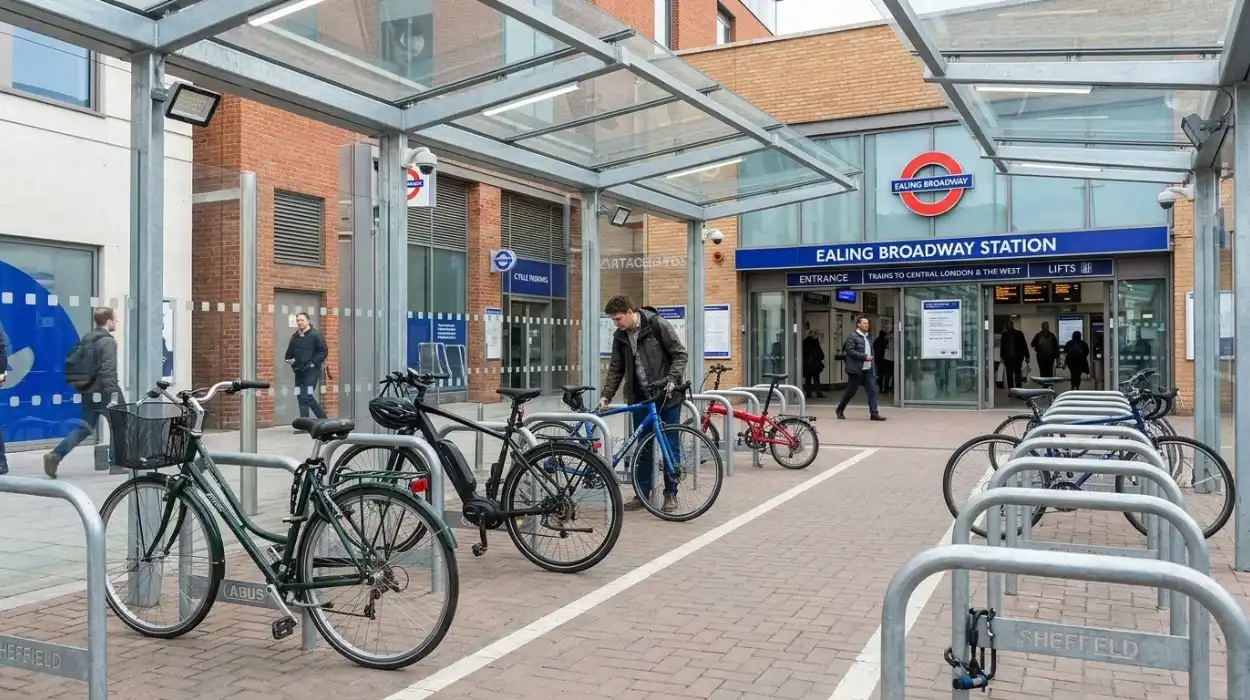
Cycling to a railway or Underground station can make travelling around Ealing quicker and more convenient, particularly for commuters who want to avoid busy roads or find an easier connection to central London. However, knowing where to leave a bicycle safely is an important part of planning the journey.
Across Ealing, cyclists can use dedicated cycle stands and other designated cycle parking facilities near transport hubs. Ealing Council also provides thousands of on-street cycle parking spaces across the borough, while Transport for London and rail infrastructure programmes have supported cycle parking improvements around several stations.
For anyone asking, “Where can I securely park my bicycle at Ealing stations?“, the answer depends on the station, the type of bicycle, how long it will be left and the level of security required. A short daytime journey has different requirements from leaving an expensive bicycle at a station for several hours.
Why Cycle Parking Matters Around Ealing Stations
Ealing has several important transport hubs, including Ealing Broadway, West Ealing, South Ealing, Ealing Common, North Ealing, Hanwell, Drayton Green and Perivale. These connect local neighbourhoods with the Elizabeth line, London Underground and National Rail services.
Cycle parking helps create a practical first-and-last-mile connection. Instead of cycling all the way into central London, a commuter can ride from home to a station, secure the bicycle and continue by train or Tube.
Ealing Council describes the borough as a “biking borough” and provides a mixture of cycle stands and secure bike hangars. More than 3,700 on-street cycle parking spaces are available across the borough, including Sheffield stands in areas where demand is high.
This means cyclists should generally look for an official cycle parking facility rather than attaching a bicycle to railings, signs, pedestrian barriers or other street furniture.
Ealing Broadway Station Cycle Parking
Ealing Broadway is one of the area’s busiest transport interchanges, serving the Elizabeth line, Central line and District line. It is therefore one of the most logical places for cyclists to combine a bicycle journey with public transport.
TfL’s design guidance specifically uses an Ealing Broadway cycle hub as an example of a cycle parking hub. The guidance explains that cycle hubs are intended to provide larger amounts of secure cycle parking close to stations and should be conveniently located, with good natural surveillance and suitable CCTV coverage.
If you are cycling to Ealing Broadway, look for designated cycle parking around the station rather than assuming that the nearest railing or open space is suitable. The station environment can change because of redevelopment, public-realm work or operational requirements, so checking the latest station information before travelling is sensible.
For a commuter leaving a bicycle every weekday, security should be treated as a separate consideration from convenience. A visible official cycle stand is preferable to an isolated location, but your own lock remains an important layer of protection.
West Ealing Station and the Elizabeth Line
West Ealing is another useful rail option for cyclists living around West Ealing, Hanwell and neighbouring residential areas. The station forms part of the Elizabeth line network and has benefited from wider transport and public-realm improvements.
TfL documentation on Crossrail complementary measures records cycle parking and related improvements at West Ealing and other stations in the area.
The practical lesson for cyclists is simple: use the designated cycle facilities provided around the station and avoid obstructing entrances, footways or pedestrian routes.
This is particularly important during busy periods. A bicycle parked across a pavement can create difficulties for wheelchair users, people with pushchairs and pedestrians, even when the cyclist is only planning to leave it for a short time.
South Ealing, Ealing Common and Other Tube Stations
Not every Ealing station has the same cycle parking arrangement. Tube stations such as South Ealing and Ealing Common serve different local catchments and have different station layouts.
At Ealing Common, TfL lists the station on Uxbridge Road and identifies it as serving the District and Piccadilly lines.
Cyclists should therefore check the station surroundings for marked cycle stands and use facilities intended specifically for bicycles. Do not assume that a Tube station’s entrance itself is an appropriate place to leave a bike.
For smaller stations, cycle parking capacity can also be more limited. During weekday commuting periods, the most convenient stands may fill quickly. Arriving slightly earlier can make it easier to find an appropriate space without leaving the bicycle in an unsuitable location.
Are Ealing’s Bike Stands Secure?
A cycle stand is useful, but it is not the same as a fully enclosed or access-controlled bicycle storage facility.
Ealing Council recommends using two locks and following Metropolitan Police guidance, including using Gold Standard locks. The council also recommends registering a bicycle with BikeRegister and checking that insurance covers the circumstances in which the bicycle is stored.
A Sheffield stand can allow the bicycle frame and wheel to be secured properly. However, the strength and position of the lock still matter.
A sensible routine is to:
- Park only in a designated cycle stand.
- Lock the frame to the stand.
- Secure the wheel where possible.
- Keep the lock away from the ground.
- Remove easily detachable accessories.
- Avoid leaving valuable items attached to the bicycle.
- Check that the stand itself is firmly fixed.
- Choose a visible location rather than an isolated corner.
These measures are particularly relevant when a bicycle will remain at a station for several hours.
What Is the Difference Between Cycle Stands and Bike Hangars?
One of the most important distinctions for Ealing residents is between public cycle stands and secure bike hangars.
Cycle stands are designed for convenient short- or medium-term parking. They are useful when cycling to a station for a working day, shopping trip or local journey.
Bike hangars provide a different level of storage. Ealing Council describes them as secure and dry facilities with key access for members. The compact units can accommodate up to six bicycles and are intended primarily for residents who lack suitable storage at home.
The council states that applications for new hangar spaces are managed through Falco, while existing locations are managed through Hooplr.
A bike hangar is therefore not simply another type of station rack. It is a more appropriate option for someone who needs regular secure storage close to home.
How Should Tourists Park a Bicycle Near an Ealing Station?
Visitors may have different requirements from daily commuters. A tourist might hire a bicycle, cycle between attractions or use a bike to reach a station before continuing elsewhere on public transport.
The safest approach is to use an official cycle parking facility and avoid leaving the bicycle in a place that could obstruct pedestrians or station access.
It is also worth considering how long the bicycle will be unattended. Leaving a basic rental bicycle for a short period is different from leaving a high-value personal bicycle for an entire day.
If you are unfamiliar with the area, allow a few minutes to locate the cycle parking before your train departure. This avoids the temptation to leave a bicycle quickly beside an entrance because you are running late.
What Should Commuters Do With an Expensive Bicycle?
Owners of higher-value bicycles should think about security before arriving at the station.
A bicycle that costs several hundred or several thousand pounds represents a different financial risk from a basic commuter bike. If a secure, access-controlled facility is not available, consider whether leaving the bicycle unattended for the entire day is appropriate.
Use a strong lock, secure the frame rather than only the wheel and remove accessories that can be detached easily. For regular commuters, bicycle registration and suitable insurance can provide additional protection.
Ealing Council specifically recommends bicycle registration and checking insurance arrangements when using secure storage.
Do Not Confuse Bicycle Parking With E-Bike and E-Scooter Bays
Ealing has also been developing designated parking arrangements for rental e-bikes and e-scooters. These are different from conventional cycle stands.
The council states that rental e-bikes and e-scooters should start and end journeys in designated parking bays. Some bays may be marked physically, while others have historically been visible through operator apps. The council has been moving towards more clearly marked carriageway-based parking.
Therefore, if you are using a rental e-bike, follow the operator’s parking instructions rather than assuming that any bicycle stand is an authorised end-of-journey location.
What If There Is No Space at the Station?
During busy commuting periods, cycle stands can become full. When this happens, do not simply leave the bicycle against a fence, lamp post or station barrier.
Instead, look for another official cycle parking location nearby. Ealing Council provides a wider network of on-street cycle stands, so the nearest available option may be a short walk from the station entrance.
This is particularly useful around major areas such as Ealing Broadway, where demand for transport and public space is naturally higher.
Planning an alternative parking point before leaving home can also reduce stress. A commuter who knows where the second cycle stand is located does not need to make a last-minute decision when the primary facility is full.
How Can You Make Station Bicycle Parking Safer?
Secure parking is not only about the location. It is also about how the bicycle is secured.
Before walking away, check that the lock has actually closed and that the frame is attached to the stand. Look around the immediate area and make sure you have not accidentally secured only the front wheel.
For longer stays, avoid leaving lights, bags, computers or other valuable accessories on the bicycle. Photographing the bicycle and recording its frame number can also help with identification if it is ever lost or stolen.
Ealing Council advises cyclists to park responsibly and avoid blocking footways, particularly because obstruction can make access more difficult for people with mobility challenges.
A Practical Example for an Ealing Commuter
Imagine someone living near West Ealing who cycles to the station every weekday morning.
They could leave home with enough time to reach the station, locate the designated cycle parking, secure the frame and wheel with appropriate locks, remove valuable accessories and then continue to the platform.
On returning in the evening, they collect the bicycle and cycle home.
The same principle works for someone cycling to Ealing Broadway from another part of the borough. The difference is that a busier transport interchange may require more planning because available cycle spaces can be in greater demand.
For occasional visitors, the process is even simpler: identify the official cycle parking, check the parking arrangement, secure the bicycle properly and avoid obstructing pedestrian routes.
Finding somewhere to park a bicycle near an Ealing station is usually a matter of choosing the right type of facility rather than simply finding the closest object to lock a bike against.
Ealing has an expanding network of cycle stands and other cycling facilities, while transport improvements have included cycle parking around several major stations. Ealing Broadway is particularly relevant because TfL has used its cycle hub as an example of how station cycle parking can support public transport interchange.
For everyday journeys, use designated cycle parking, secure the bicycle correctly and consider the length of time it will be unattended. For residents needing longer-term residential storage, a secure bike hangar may be more suitable.
Most importantly, check current station arrangements before travelling because parking capacity, access routes and transport infrastructure can change. The combination of official cycle parking, sensible locking practices and advance planning gives cyclists a more reliable way to combine cycling with Ealing’s rail and Underground network.
Frequently Asked Questions
Where can I park my bicycle at Ealing Broadway Station?
Look for designated cycle parking around the station rather than using railings or pedestrian barriers. Ealing Broadway has been identified by TfL as a location for cycle hub facilities and improved transport interchange infrastructure.
Is bicycle parking free at Ealing stations?
Cycle stands are generally different from paid car parking, but individual facilities can have their own arrangements. Always check the signage and current station information before leaving a bicycle.
Can I leave my bicycle overnight at an Ealing station?
It may be physically possible where cycle parking is available, but cyclists should check the specific facility and consider security carefully. For a valuable bicycle, longer unattended periods increase the importance of strong locks and suitable insurance.
Does Ealing have secure bike storage for residents?
Yes. Ealing Council provides bike hangars that offer secure, dry and key-access storage. They are intended particularly for residents who do not have suitable bicycle storage at home.
Are bike hangars available near Ealing stations?
Bike hangar locations are distributed around the borough rather than being exclusively station facilities. Residents can check available locations and apply through the council’s current management arrangements.
What is the safest way to lock a bicycle at a station?
Use a designated cycle stand and secure the bicycle frame to it with a strong lock. Where practical, use two locks to secure the frame and wheels. Ealing Council specifically recommends two Gold Standard locks as part of its cycle-security guidance.
Can I park a rental e-bike in any bicycle parking space?
Not necessarily. Rental e-bikes and e-scooters must follow the relevant operator’s designated parking arrangements. Ealing Council states that rental vehicles should end journeys in designated parking bays, which may be marked or shown through the operator’s system.