
Starting a business in London means choosing a location where customers, transport, local demand and business opportunities come together. For entrepreneurs considering West London, Ealing offers a particularly interesting combination of established town centres, diverse communities, strong transport connections and a wide range of commercial environments. The borough is home to seven main areas Acton, Ealing, Greenford, Hanwell, Northolt, Perivale and Southall each with its own character and business potential.
The best places to start a business in Ealing depend on the type of company you want to build. A café may benefit from the footfall of Ealing Broadway, while a logistics or manufacturing company may find industrial locations around Greenford, Perivale or Acton more suitable. A specialist food business could benefit from Southall’s established cultural identity, whereas a professional service may prefer the centrality and connectivity of Ealing itself.
Why Ealing Is Attractive for New Businesses
Ealing has a strong local economy supported by thousands of businesses, established high streets and excellent connections with both central London and Heathrow. Ealing Council describes the borough as economically strong, with more than 13,000 businesses and good transport links to major destinations.
The borough also has a useful balance between inner-London connectivity and suburban living. Entrepreneurs can access a substantial residential population while remaining connected to central London. This creates opportunities for businesses serving local residents, commuters, visitors and other companies.
Another important advantage is the variety of commercial environments. Ealing is not one uniform business district. Its town centres include busy retail areas, independent shopping streets, residential neighbourhoods and employment locations. Ealing Council recognises town centres and high streets as important economic and social focal points that attract businesses and jobs.
Ealing Broadway: Best for Retail, Hospitality and Professional Services
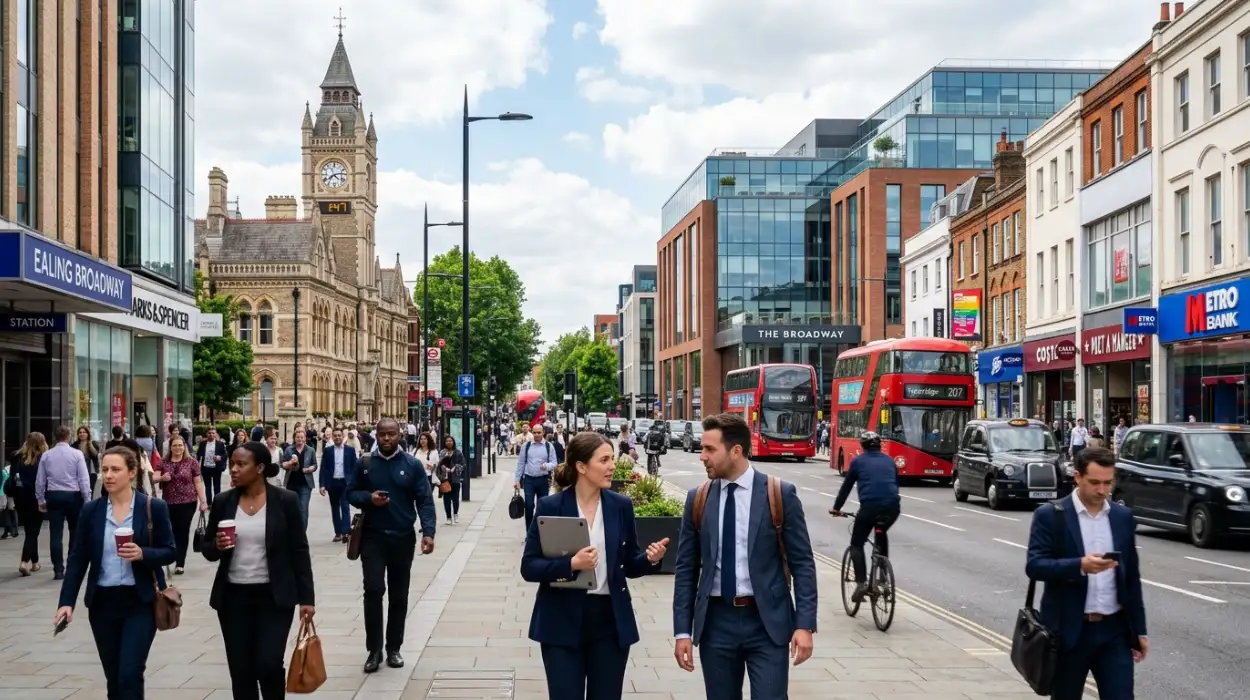
Ealing Broadway is one of the strongest choices for businesses that depend on visibility, convenience and a steady flow of potential customers. The area combines shopping, cafés, restaurants, entertainment, offices and residential neighbourhoods, creating a broad customer base.
The location is particularly suitable for cafés, restaurants, beauty businesses, fitness studios, professional services, retail shops and businesses targeting commuters. Ealing Broadway also benefits from major transport connections, including the Elizabeth line, Central line, District line and National Rail services.
For example, a new coffee shop could target morning commuters, remote workers and local residents, while a beauty salon could attract customers living within walking distance as well as people travelling through the town centre.
However, prime commercial space can be expensive. Entrepreneurs should therefore compare rent, business rates, frontage, floor space and expected customer numbers before committing to a unit.
Acton: A Strong Choice for Growing Businesses
Acton is another attractive option, particularly for entrepreneurs looking for a location with excellent connectivity and a mixture of residential, commercial and employment activity. The area includes several transport options and has a busy high street with independent shops, food businesses and services.
Acton’s position in the eastern part of Ealing also places it close to other important West London employment areas. The wider North Acton and Park Royal area has significant development and investment potential, making the area relevant to businesses looking towards long-term growth. Ealing Council has highlighted North Acton and Park Royal as important economic areas with opportunities connected to regeneration, industry and employment.
Acton can therefore work well for food and drink businesses, creative companies, professional services, retail, property-related businesses and companies that need access to a large West London customer base.
Southall: Ideal for Food, Retail and Cultural Businesses
Southall stands out because of its distinctive identity and strong community-based economy. Often associated with South Asian food, jewellery, clothing and cultural businesses, the area has a long-established commercial character.
The arrival of the Elizabeth line has strengthened Southall’s connectivity with central London and Heathrow. Ealing Council also identifies Southall as a growing neighbourhood with potential for new employment and economic diversification.
This makes Southall particularly interesting for entrepreneurs operating restaurants, cafés, specialist grocery shops, fashion businesses, beauty services, jewellery businesses and other consumer-focused ventures.
A business does not necessarily have to compete directly with existing South Asian businesses. The diverse customer base can also support complementary concepts, such as modern cafés, delivery services, professional services, digital businesses and specialist lifestyle services.
Greenford: Practical for Industrial and Trade Businesses
Greenford can be a better fit for businesses that need more space than a traditional town-centre shop can provide. Its commercial environment makes it worth considering for wholesalers, storage businesses, trades, workshops, distribution companies and other operations where premises and accessibility matter more than premium high-street visibility.
For example, a small construction supplier may need vehicle access, storage and affordable floor space rather than a prominent shopfront. Greenford can offer a more practical environment for this type of operation.
Entrepreneurs should still examine individual industrial estates and commercial units carefully because accessibility, parking, loading facilities and planning restrictions can vary considerably from one property to another.
Hanwell: A Good Option for Independent Businesses
Hanwell has a strong neighbourhood character and can suit businesses that depend on repeat local customers rather than huge volumes of passing traffic. Independent cafés, restaurants, personal services, specialist shops, studios and community-focused businesses can all benefit from a location where customer relationships matter.
The key advantage of a neighbourhood business is the possibility of building loyalty. A hairdresser, physiotherapy practice, café or tutoring centre, for instance, may gain more from regular customers living nearby than from occasional visitors.
For entrepreneurs, Hanwell is therefore worth considering when the business model is based on local reputation, recommendations and repeat visits.
Northolt: Consider Lower-Cost Local Opportunities
Northolt can be attractive for entrepreneurs whose priority is serving a residential community rather than competing for premium central-London footfall. The area offers opportunities for practical services, convenience businesses, food outlets, personal services and businesses that solve everyday local problems.
The most important question is not simply whether Northolt is a good business location, but whether a specific street or unit has the right customer profile. A convenience-led business might benefit from being close to residential areas, schools or transport links, while a destination business may need easier parking and larger premises.
Perivale: Useful for Commercial and Employment-Based Businesses
Perivale is another location to consider when the business requires a commercial or employment-focused setting. It can be particularly relevant to companies that need operational space rather than a conventional high-street presence.
Businesses such as storage providers, distributors, workshops, trade suppliers and other B2B operations should assess Perivale alongside Greenford and Acton. The right choice will depend on premises availability, vehicle access, workforce requirements and proximity to suppliers and customers.
How to Choose the Right Business Location in Ealing
Choosing among the best places to start a business in Ealing requires more than looking at rent. Start by identifying your ideal customer. Ask where they live, work, travel and spend money.
Next, consider footfall and accessibility. A retail business may need strong pedestrian movement, whereas an online company may only require affordable office space and reliable transport connections.
Competition also matters. Competitors can indicate that a location has proven demand, but excessive competition may make customer acquisition difficult. Look for gaps in the market rather than automatically avoiding areas with similar businesses.
Property costs should be assessed alongside business rates, utilities, insurance, service charges, refurbishment costs and staffing. A cheaper unit can become expensive if it requires major renovation or has poor visibility.
Transport is another major consideration. Ealing’s connections are a significant advantage for businesses whose employees, customers or suppliers travel regularly. The borough has links through the Elizabeth line, Underground and National Rail, although the exact advantages vary between neighbourhoods.
Business Support Available in Ealing
New entrepreneurs do not have to make every decision alone. Ealing Council and its partners provide business support, while organisations and local Business Improvement Districts help strengthen individual commercial areas.
The council lists West London Business, Make It Ealing, Acton BID and West Ealing BID among organisations supporting businesses in the borough.
The local business support network can be useful for entrepreneurs researching premises, networking, business development, marketing and growth. Ealing’s inward-investment programme also promotes opportunities across the borough’s seven towns.
Before signing a commercial lease, new business owners should also investigate planning requirements, licensing, business rates, waste arrangements, signage restrictions and any permissions required for their particular business activity.
Is Ealing Good for Small Businesses?
Ealing can be a strong location for small businesses because it offers several different customer markets rather than relying on one commercial centre. A start-up can choose between busy retail districts, neighbourhood high streets and employment-focused commercial areas.
Recent analysis reported that Ealing had 17,835 VAT and/or PAYE-registered businesses in 2025, compared with 17,885 in 2019, indicating that the borough has maintained a substantial business base despite economic pressures.
For a small business owner, this means there is an established commercial ecosystem to join. The challenge is finding the specific location where the business model, customer demand and property costs make sense.
The best places to start a business in Ealing vary according to your industry, budget and target customer. Ealing Broadway is compelling for high-footfall retail, hospitality and professional services, while Acton offers connectivity and opportunities linked to wider economic development. Southall is particularly strong for culturally relevant food, retail and community businesses, while Greenford and Perivale can suit companies requiring practical commercial premises.
Hanwell and Northolt may appeal to businesses focused on neighbourhood customers and repeat trade. The important point is to assess each location on its own merits rather than assuming that the most famous town centre is automatically the best choice.
For entrepreneurs, Ealing’s greatest advantage may be its variety. The borough combines transport connectivity, diverse communities, established town centres and different types of commercial property. By matching the business model with the right neighbourhood, customer base and premises, a new company can build a much stronger foundation for sustainable growth.
Frequently Asked Questions
What is the best area in Ealing to start a business?
Ealing Broadway is one of the strongest options for businesses needing high visibility and customer footfall. However, Acton, Southall, Greenford, Hanwell, Northolt and Perivale may be better depending on the industry and premises requirements.
Is Ealing good for small businesses?
Yes. Ealing has an established business community, diverse customer base and several town centres. The borough also provides access to local business support and networking opportunities.
Is Ealing Broadway expensive for businesses?
Prime Ealing Broadway premises can be more expensive because of their visibility, retail environment and transport connections. Entrepreneurs should compare total occupancy costs rather than rent alone.
Which part of Ealing is best for a restaurant?
Ealing Broadway and Southall can be attractive for restaurants because of their established food cultures, customer activity and transport links. The best choice depends on cuisine, pricing and target audience.
Is Southall a good place to start a business?
Southall can be particularly suitable for food, retail, fashion, jewellery, beauty and community-focused businesses. Its strong cultural identity and Elizabeth line connection add to its commercial appeal.
Which Ealing areas are suitable for industrial businesses?
Greenford, Perivale and parts of Acton are worth considering for businesses needing workshops, storage, distribution or other commercial premises. Availability and planning restrictions should be checked for each property.
How can I get business support in Ealing?
Ealing Council provides business support information and connects businesses with organisations such as West London Business, local BIDs and wider London business-support services.