
Ealing is increasingly attracting attention as one of West London’s most promising locations for business, investment and entrepreneurship. Once widely viewed primarily as a residential part of London, the borough has developed into a diverse economic area where established companies, independent businesses, start-ups and investors can find different opportunities. Strong transport connections, a growing population, established town centres and access to central London are helping reshape the way businesses view Ealing.
The question of why Ealing is becoming a major business destination is therefore about more than one new development or transport improvement. It is the result of several factors working together. Ealing combines the advantages of a well-connected London borough with the character of distinct local communities, creating different environments for retail, hospitality, professional services, creative businesses, technology companies and commercial operations.
Ealing’s Strategic Location in West London
One of Ealing’s greatest advantages is its location. Situated in West London, the borough provides relatively convenient access to central London, Heathrow Airport and other important commercial areas across the capital and surrounding regions.
For businesses, location affects much more than commuting. A company needs to consider how easily employees can reach the workplace, how customers can access its premises and how efficiently suppliers and business partners can travel. Ealing’s position gives companies access to a large metropolitan market while allowing them to operate outside the most expensive central business districts.
This makes the borough particularly interesting for companies that want London connectivity without necessarily requiring a traditional City or West End address.
Excellent Transport Connections Are Supporting Growth
Transport is one of the strongest reasons Ealing is becoming a major business destination. The borough benefits from several Underground, National Rail and Elizabeth line connections, linking different parts of Ealing with central London and other major destinations.
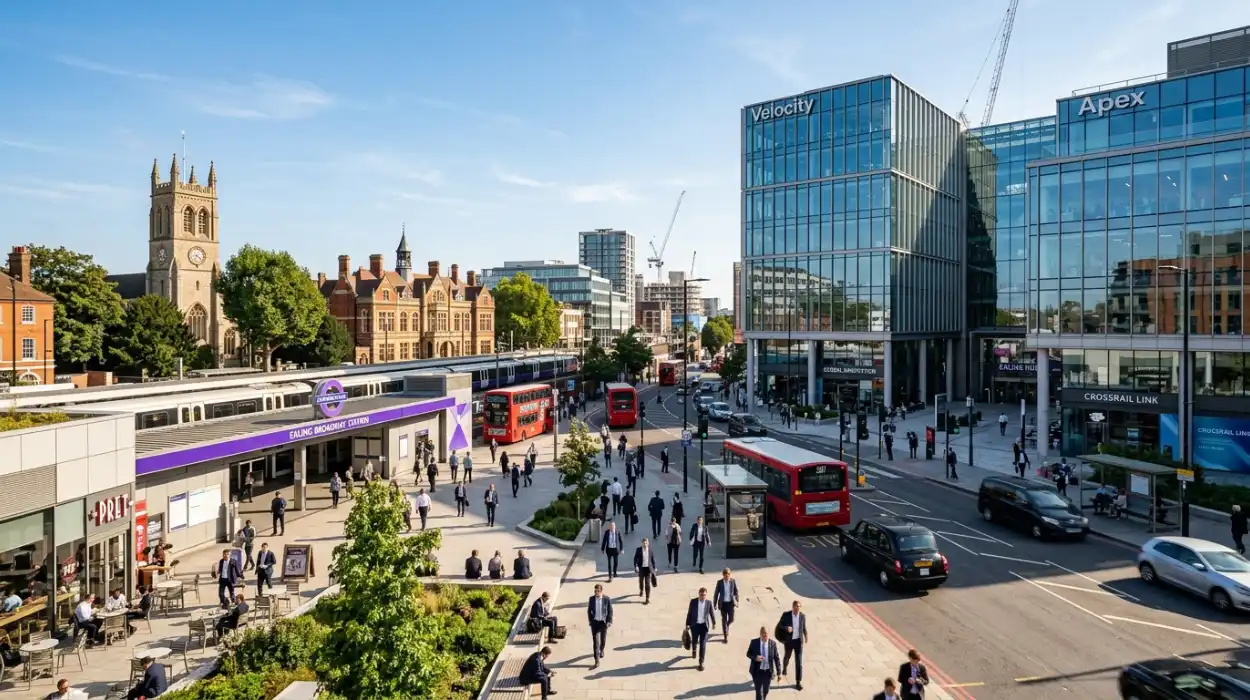
The Elizabeth line has been particularly significant for areas such as Ealing Broadway and Southall. Faster connections can influence where businesses choose to locate because accessibility affects employees, customers and investors alike.
For example, a professional services company based near Ealing Broadway can potentially attract employees from different parts of London. A restaurant in Southall can benefit from easier access for visitors, while a company in Acton can use the area’s connections to reach surrounding employment centres.
Transport improvements also have a wider economic effect. When an area becomes easier to reach, commercial property can become more attractive, footfall can increase and businesses may have greater confidence about future demand.
Ealing Broadway Has Become a Strong Commercial Centre
Ealing Broadway is central to the borough’s business identity. The area combines retail, hospitality, professional services, entertainment, offices and residential communities, creating a diverse commercial environment.
For retailers and hospitality businesses, this mixture is particularly valuable. Customers may visit for shopping, work, leisure, food or everyday services, allowing businesses to reach several types of consumers rather than relying on a single market.
Ealing Broadway is also attractive to professional businesses because of its transport connectivity and established commercial environment. Accountants, estate agents, recruitment firms, legal practices, marketing agencies, consultants and other service providers can benefit from being located in an area that customers already recognise and visit.
The presence of different business categories can also create opportunities for collaboration. A new business does not necessarily need to operate in isolation; it can become part of an established commercial ecosystem.
Acton Is Strengthening Ealing’s Business Network
Acton adds another important dimension to Ealing’s economy. The area has a mixture of residential neighbourhoods, high-street businesses, offices, creative enterprises and employment areas, making it suitable for different business models.
Its location also places it close to North Acton and Park Royal, both important parts of the wider West London economy. This creates connections between local businesses and larger employment, industrial and development areas.
For entrepreneurs, Acton can offer a useful balance between accessibility and commercial opportunity. Restaurants, independent retailers, creative businesses, professional services and growing companies can all consider the area depending on their requirements.
The development of surrounding areas also matters because businesses often benefit from investment beyond the immediate street where they operate. New housing, offices, transport improvements and public-space projects can gradually increase demand for local services.
Southall Brings a Distinctive Business Identity
Southall is one of Ealing’s most recognisable commercial areas and demonstrates how a strong local identity can support economic activity. The area is well known for its South Asian food, fashion, jewellery, grocery businesses, restaurants and cultural enterprises.
This established commercial character creates a powerful customer base for both traditional and new business concepts. Entrepreneurs can serve existing demand while also identifying gaps for complementary products and services.
The Elizabeth line has further strengthened Southall’s connectivity, making the area more accessible to people travelling across London and towards Heathrow.
Southall also demonstrates why diversity is an economic asset. A wide range of cultures, languages, cuisines, shopping habits and community networks can create opportunities for businesses that understand and respond to different customer needs.
Greenford and Perivale Offer Space for Commercial Businesses
Ealing’s business growth is not limited to high streets. Greenford and Perivale are important for businesses that need commercial, industrial or operational space.
Companies involved in distribution, storage, manufacturing, trade, workshops and logistics often have different requirements from cafés or professional offices. They may need loading facilities, vehicle access, larger floor areas and practical premises rather than prominent retail frontage.
Greenford and Perivale can therefore contribute to Ealing’s wider business economy by providing environments for operational businesses.
For example, a growing online retailer may need a warehouse close to London’s customer base. A trade supplier may need vehicle access and storage. A small manufacturing business may require workshop space. These businesses can contribute employment and economic activity without needing a traditional town-centre location.
A Diverse Local Customer Base Creates Opportunities
Another reason Ealing is becoming a major business destination is its diverse population and range of neighbourhoods. The borough includes established residential communities, commuters, students, professionals, families and international residents.
This creates different forms of consumer demand. A business can target local residents with everyday services, commuters with convenience products, professionals with business services or visitors with hospitality and leisure offerings.
For entrepreneurs, this diversity means that market research is especially important. A concept that works in Ealing Broadway may not perform in Northolt, while a neighbourhood-focused service may perform better in Hanwell than in a busy commercial centre.
Successful businesses therefore need to understand the specific community around their chosen premises rather than treating the whole borough as one market.
Regeneration Is Creating New Business Opportunities
Regeneration is another important part of Ealing’s changing economic landscape. New housing, improved public spaces, transport investment and redevelopment can change the commercial potential of an area.
When new residents move into an area, demand can increase for cafés, restaurants, childcare, fitness, healthcare, convenience retail, professional services and other local businesses. New employment space can similarly create demand from workers and companies.
This creates opportunities for entrepreneurs who identify changes early. Instead of simply following established footfall, businesses can consider where population growth and investment may create future customer demand.
However, regeneration should be assessed carefully. Proposed development does not automatically mean that every nearby business will succeed. Entrepreneurs should investigate actual project timelines, planning decisions, local competition and commercial property conditions before making major investments.
Ealing Can Appeal to Start-Ups and Established Companies
A major business destination needs to support more than large corporations. Ealing’s strength is its ability to accommodate different stages of business development.
A freelancer might begin with a home-based operation or flexible workspace before moving into an office. A start-up could establish a small team in a well-connected neighbourhood and expand later. An established company might choose Ealing for its workforce accessibility and connections with the wider London economy.
This range creates a more resilient business environment. Independent businesses can benefit from local customers, while larger organisations can access professional talent and transport links.
The same principle applies to international entrepreneurs considering London. A company does not necessarily need to locate in central London to gain access to the capital’s wider economy.
Why Ealing Appeals to Different Industries
Ealing’s economic diversity means that several sectors can potentially benefit from the borough’s growth.
Hospitality businesses can take advantage of local residents, commuters and visitors. Retailers can choose established town centres and neighbourhood high streets. Professional service firms can benefit from connectivity and a large potential workforce.
Creative and digital companies may be attracted to the wider West London ecosystem, while logistics, trade and operational businesses can consider commercial areas such as Greenford and Perivale.
Healthcare, education, fitness, beauty and personal services can also benefit from established residential communities and recurring local demand.
The important point is that Ealing is not dependent on one industry. Its business potential comes from the interaction between multiple sectors.
What Makes Ealing Different From Central London?
Central London remains one of the world’s most important business locations, but not every company needs a central address. Office and commercial costs, competition for premises and commuting pressures can influence decisions.
Ealing offers an alternative within London. Businesses can remain connected to the capital while operating in an environment with established communities, local town centres and different property types.
For a small company, this can be particularly valuable. Instead of paying a premium simply for a central postcode, an entrepreneur can prioritise accessibility, customer demand, workspace requirements and long-term sustainability.
The right decision ultimately depends on the company’s business model rather than the prestige of a postcode.
How Businesses Can Take Advantage of Ealing’s Growth
Businesses considering Ealing should begin with local research. Identify the customer, examine competitors and understand how people move through the chosen neighbourhood.
Property research should go beyond advertised rent. Entrepreneurs should consider business rates, service charges, utilities, insurance, refurbishment, licensing, planning requirements and potential staffing costs.
Transport should also be assessed from the perspective of employees and customers. A premises may look affordable but become less attractive if it is difficult to reach or lacks suitable parking and loading arrangements.
Finally, entrepreneurs should connect with local business networks and organisations. Local knowledge can help new businesses understand commercial areas, upcoming developments, community needs and opportunities for collaboration.
The Future of Ealing as a Business Destination
Ealing’s business story is likely to continue evolving as transport connectivity, regeneration, population change and commercial investment influence the borough.
Its biggest advantage is its variety. Ealing Broadway provides a major commercial centre, Acton connects businesses with wider West London opportunities, Southall offers a distinctive cultural economy, and Greenford and Perivale provide practical commercial environments.
Neighbourhoods such as Hanwell and Northolt also contribute to the borough’s economic diversity by supporting local businesses and community-focused services.
Rather than becoming another conventional central-London business district, Ealing’s future may lie in being a connected, diverse and flexible business destination where different types of companies can operate successfully.
Why Ealing is becoming a major business destination can be explained through a combination of accessibility, investment, diverse communities, established town centres and varied commercial opportunities. The borough offers businesses the ability to reach London’s wider economy while remaining connected to strong local markets.
Its transport infrastructure, particularly the Elizabeth line, has strengthened important commercial areas, while regeneration and development are creating additional opportunities. At the same time, established communities in Ealing Broadway, Acton, Southall, Greenford, Perivale, Hanwell and Northolt provide different customer and business environments.
For entrepreneurs, investors and established companies, the key is understanding which part of Ealing best matches their objectives. Businesses that research local demand, property costs, transport, competition and future development can make better-informed decisions.
Ealing is not simply benefiting from London’s growth. It is developing its own economic identity, making it an increasingly important destination for businesses looking for connectivity, diversity and long-term opportunity.
Frequently Asked Questions
Why is Ealing becoming a major business destination?
Ealing is becoming more attractive because of its strong transport connections, diverse population, established town centres, commercial property options and ongoing investment. These factors create opportunities for businesses across different sectors.
Is Ealing a good place to start a business?
Yes. Ealing offers several business environments, from high-footfall areas such as Ealing Broadway to commercial and industrial locations in Greenford and Perivale. The best location depends on the business model and target customers.
How has the Elizabeth line affected Ealing businesses?
The Elizabeth line has improved connectivity for areas including Ealing Broadway and Southall. Better connections can increase accessibility for customers and employees while making commercial locations more attractive.
Which Ealing areas have the strongest business potential?
Ealing Broadway, Acton and Southall are important commercial areas, while Greenford and Perivale can be suitable for businesses requiring larger operational premises. Hanwell and Northolt offer opportunities focused on local communities.
Is Ealing suitable for international businesses?
Ealing can be suitable for international businesses seeking access to London’s economy without necessarily locating in central London. Its transport connections and diverse communities can be useful for companies serving different customer markets.
What types of businesses are growing in Ealing?
Ealing supports a wide range of businesses, including hospitality, retail, professional services, creative companies, personal services, trade, logistics and other commercial operations. Opportunities vary between neighbourhoods.
Will Ealing become one of London’s major business hubs?
Ealing has the potential to become an increasingly important West London business hub. Continued transport connectivity, regeneration, commercial investment and business activity will influence how strongly its economy develops in the coming years.