
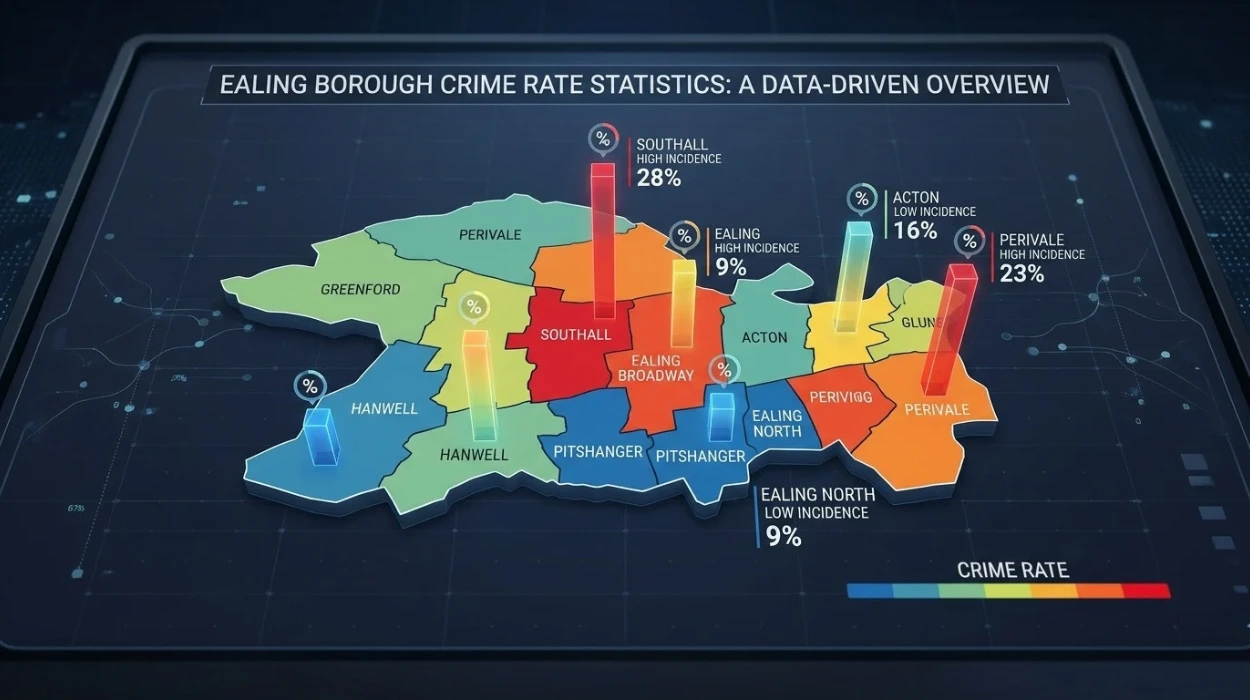
Ealing is a large and diverse West London borough made up of busy town centres, residential neighbourhoods, shopping areas, transport hubs, parks and commercial districts. Like other parts of London, crime is not distributed evenly across the borough. Some locations record more reported offences than others, particularly areas with high footfall, retail activity, nightlife, transport connections and larger commercial centres.
When people search for the areas of Ealing with the highest crime rates, they are often trying to answer several different questions. Which parts of Ealing have the most reported crime? Are Ealing Broadway, Southall or Acton safe? Which types of crime are most common? Should tourists take additional precautions? And does a higher number of reported offences necessarily mean an entire neighbourhood is unsafe?
The answer requires some context. Ealing Council’s Local Area Profile identifies crime hotspots around the borough’s main town centres, where high footfall and commercial and retail activity bring more people together. These areas also contain shops, food outlets, entertainment venues and transport hubs.
How Crime Is Distributed Across Ealing
Crime statistics should be interpreted carefully because a neighbourhood’s reported crime total is not the same as the personal risk faced by every resident.
A town centre can record hundreds of offences because thousands of people visit it every day, while a quieter residential area may record fewer offences simply because fewer people pass through it. Shoplifting, theft and anti-social behaviour are particularly influenced by commercial activity and public footfall.
Ealing Council’s 2026 Local Area Profile shows that crime during 2025 was concentrated primarily around the borough’s main town centres. The council links these concentrations with higher footfall and commercial activity, including retail premises, food outlets, entertainment venues and transport hubs.
This is why crime data is most useful when combined with information about the type of offence, location, time and local environment.
Ealing Broadway
Ealing Broadway is one of the most prominent crime-reporting areas in the borough. It is also one of Ealing’s busiest commercial and transport centres, so its relatively high reported crime level needs to be understood in that context.
Metropolitan Police data for July 2026 shows shoplifting as the most commonly reported crime in the Ealing Broadway policing area, with 50 recorded offences. Anti-social behaviour and violence and sexual offences each recorded 46 offences, followed by other theft with 20.
The wider pattern also shows fluctuations rather than a constant level. Monthly recorded crime in the Ealing Broadway area ranged from 184 offences in February 2026 to 265 in March 2026 during the period shown by the Metropolitan Police.
For residents and visitors, this means that the main concern around Ealing Broadway is not necessarily violent crime. Theft, shoplifting and anti-social behaviour are significant parts of the reported picture.
People using Ealing Broadway’s shops, restaurants, transport connections and entertainment venues should therefore use ordinary London safety precautions. Keep valuables secure, remain aware in crowded areas and avoid leaving phones or bags unattended.
Southall Broadway
Southall Broadway is another important crime area within Ealing. The neighbourhood is a major commercial centre with busy streets, restaurants, shops, markets and transport connections.
Ealing Council’s previous analysis of crime and alcohol-related incidents identified Ealing and Southall town centres among the locations with the highest volume of alcohol-flagged crime. The council found that violence accounted for almost 70% of these alcohol-flagged incidents in the 2022 and 2023 analysis, with incidents particularly concentrated around weekends and between approximately 6pm and 3am.
This information does not mean that Southall is unsafe throughout the day or that everyone visiting the area will experience crime. Instead, it highlights how particular circumstances, including nightlife, alcohol consumption and weekend footfall, can influence local crime patterns.
For visitors, Southall remains a major destination for food, shopping and cultural experiences. As with other busy town centres, sensible precautions are particularly useful during crowded periods and late evenings.
Acton and South Acton
Acton contains several distinct neighbourhoods and policing areas, so it should not be treated as one uniform crime zone.
South Acton currently shows a relatively high volume of reported offences compared with many other Ealing policing areas. Metropolitan Police data for July 2026 records 115 incidents of anti-social behaviour, 55 violence and sexual offences, 27 public-order offences and 20 cases of other theft.
The monthly figures also show variation. South Acton recorded 308 offences in October 2025, while July 2026 recorded 286.
The distinction between different crime categories matters. A high total does not automatically indicate a high level of serious violent crime. Anti-social behaviour can represent a substantial part of the overall figure in particular locations.
Acton is also undergoing significant residential and commercial change, with established communities alongside newer developments, businesses and transport infrastructure. Crime patterns can therefore differ considerably between streets and individual locations.
Ealing Common
Ealing Common is another area where reported crime is influenced by its position within a well-connected part of West London.
Metropolitan Police figures for July 2026 show anti-social behaviour as the most commonly reported category, with 34 offences. Violence and sexual offences recorded 22, vehicle crime 21 and shoplifting 17.
The area recorded 134 offences in July 2026, while monthly totals over the preceding year varied considerably. October 2025 recorded 146 offences compared with 87 in February 2026.
This illustrates why a single month’s figure should not be treated as a permanent measure of safety.
Ealing Common is also primarily residential in character, with green space, roads, Underground access and local businesses. Someone visiting the common during the day may have a very different experience from someone travelling through nearby commercial areas late at night.
Lady Margaret and Southall’s Wider Area
Lady Margaret is another Ealing policing area where violence and anti-social behaviour feature prominently in reported crime.
For July 2026, the Metropolitan Police recorded 52 violence and sexual offences and 31 anti-social behaviour offences in Lady Margaret, followed by 14 vehicle crimes and 10 other theft offences.
These figures are useful for understanding what is being reported locally, but they should not be interpreted as evidence that every part of the ward has the same level of risk.
Ealing contains a mixture of housing estates, residential streets, schools, parks, shops and main roads. Crime can be concentrated around particular facilities or routes rather than being evenly distributed throughout the whole area.
Perivale and Greenford
Perivale and Greenford contain several different policing areas, and their crime profiles vary.
In Perivale, the Metropolitan Police recorded 46 violence and sexual offences and 44 anti-social behaviour offences in July 2026. Vehicle crime accounted for 13 offences and other theft for 12.
Greenford also has several policing areas, including Central Greenford, Greenford Broadway and North Greenford. This distinction is important because a crime figure for one policing area should not automatically be applied to the entire Greenford neighbourhood.
Ealing Council’s crime analysis has identified Greenford among the areas featuring more prominently for certain categories of crime, particularly non-domestic violence with injury during specific night-time periods in its 2022–2023 analysis. Acton, Southall and North Acton also appeared within that category.
For people living or visiting these areas, the practical lesson is to pay attention to the particular location and time of travel rather than assuming the entire district has the same risk.
Dormers Wells and Northolt
Dormers Wells is another area where reported crime includes significant levels of violence and anti-social behaviour.
The Metropolitan Police recorded 44 violence and sexual offences and 39 anti-social behaviour offences in July 2026. Vehicle crime accounted for 11 offences and drugs for nine.
Northolt is divided into different policing areas, including Northolt Mandeville and Northolt West End. This means that crime information should ideally be checked at the relevant ward or policing-area level rather than using one number for all of Northolt.
For residents, postcode-level or ward-level information can therefore provide a more useful picture than borough-wide headlines.
Why Town Centres Often Have Higher Crime Totals
One of the most important concepts when understanding Ealing crime rates is the difference between residential population and daytime population.
A town centre may have relatively high crime numbers because people travel there to shop, work, eat, socialise or use public transport. Retail premises also create opportunities for shoplifting and theft, while busy public areas can experience more anti-social behaviour.
Ealing Council’s 2026 Local Area Profile specifically identifies the borough’s main town centres as crime hotspots because of high footfall, commercial activity, retail premises, entertainment venues and transport hubs.
This explains why Ealing Broadway can have a higher number of reported offences than a quieter residential street without necessarily being a more dangerous place to live.
Which Types of Crime Are Most Common?
The most useful way to understand crime in Ealing is to examine individual categories rather than looking only at the total number.
Anti-social behaviour appears prominently in several Ealing areas. This can include behaviour causing harassment, alarm or distress and can involve issues such as nuisance behaviour or disorder.
Violence and sexual offences are also among the commonly reported categories in several areas. However, the category combines a range of offences, so it should not automatically be interpreted as meaning that serious violence is widespread.
Shoplifting is particularly important in busy retail centres such as Ealing Broadway. Vehicle crime and other theft also appear in several areas.
The type of crime therefore affects how residents and visitors should think about practical safety.
Is Ealing Safe for Tourists?
Ealing can be a perfectly practical base for tourists visiting West London, but visitors should use the same sensible precautions they would use elsewhere in London.
Busy areas such as Ealing Broadway and Southall are convenient for shopping, restaurants and transport, but crowded environments can create opportunities for theft. Tourists should keep phones and wallets secure, avoid displaying large amounts of cash and pay attention to belongings on public transport.
At night, sticking to well-used routes and using reputable transport options can also reduce avoidable risks.
The existence of a crime hotspot does not mean tourists should automatically avoid an entire neighbourhood. Crime is usually concentrated in particular places and circumstances rather than uniformly spread across every street.
How Residents Can Check Current Crime in Their Area
Crime patterns change over time, so anyone moving to Ealing or assessing a particular neighbourhood should check current information rather than relying on old lists of “dangerous areas”.
The Metropolitan Police provides local policing pages for Ealing’s wards and neighbourhoods, including reported crime categories and monthly crime levels.
Ealing Council also provides Ealing Data, where residents can explore information by postcode or ward through its local data tools.
These sources are more useful than generalised online claims because they allow people to investigate the specific area they are interested in.
What Should You Consider When Choosing an Ealing Area?
Crime should be only one factor when choosing where to live or stay in Ealing.
Transport links, housing costs, schools, parks, shopping facilities, local amenities, commuting time and the character of individual streets can all matter. A person working near Ealing Broadway may value transport convenience, while a family may prioritise green space and schools.
It is also worth visiting an area at different times of day. A street can feel completely different during a weekday morning, Saturday afternoon and late evening.
Looking at current police data alongside a physical visit gives a much more balanced impression than relying on a single crime ranking.
The areas of Ealing with the highest reported crime levels tend to include major town centres and busy urban locations such as Ealing Broadway, Southall and parts of Acton, alongside particular neighbourhoods where specific categories of crime are more prominent.
However, crime statistics need context. Ealing Council’s data shows that crime is concentrated around areas with greater footfall, retail activity, entertainment, food outlets and transport hubs.
Current Metropolitan Police data also demonstrates that different areas experience different crime profiles. Ealing Broadway has notable levels of shoplifting and anti-social behaviour, South Acton records substantial anti-social behaviour, while Perivale, Ealing Common, Lady Margaret and Dormers Wells show different combinations of violence, anti-social behaviour, theft and vehicle-related offences.
For residents and tourists, the most useful approach is not to label entire neighbourhoods as unsafe. Instead, look at the latest local data, consider the type and timing of offences, understand the environment around transport and commercial areas, and follow sensible personal-safety practices.
Frequently Asked Questions
What area of Ealing has the highest crime rate?
Ealing Broadway has historically been identified by Ealing Council as having a particularly high level of reported crime, while current police figures also show substantial reported crime in areas such as South Acton and other busy parts of the borough. Rankings can change depending on the period and whether figures are measured as totals or rates.
Is Ealing Broadway a high-crime area?
Ealing Broadway records a relatively high volume of reported crime, partly because it is a major shopping, transport and entertainment centre. In July 2026, shoplifting, anti-social behaviour and violence and sexual offences were among its most commonly reported categories.
Is Southall safe to visit?
Southall is a busy and popular part of Ealing with shops, restaurants, food businesses and transport connections. Like other busy town centres, visitors should take sensible precautions, particularly during crowded periods and late evenings.
Is Acton one of the highest-crime areas in Ealing?
Some Acton policing areas record relatively high crime levels. South Acton, for example, recorded 115 anti-social behaviour offences and 55 violence and sexual offences in July 2026. However, crime varies considerably between different parts of Acton.
What is the most common crime in Ealing?
There is no single crime type that dominates every part of Ealing. Anti-social behaviour, violence and sexual offences, shoplifting, theft and vehicle crime are among the categories frequently reported across different Ealing policing areas.
Is Ealing safe for families?
Many families live across Ealing, but safety varies between individual streets and neighbourhoods. Families should consider current local crime data alongside schools, transport, parks, amenities and the character of the specific area they are considering.
Where can I check the latest crime statistics for Ealing?
The Metropolitan Police provides crime information for individual Ealing policing areas, while Ealing Council’s Ealing Data service provides local information that can be explored by postcode or ward. These sources are preferable to relying on outdated online crime rankings.