
Morning traffic around schools can become particularly difficult in busy London boroughs, where parents are dropping off children, staff are arriving for work, buses are operating and commuters are travelling through residential roads at the same time. In Ealing, School Streets have been introduced to manage some of these pressures around school entrances.
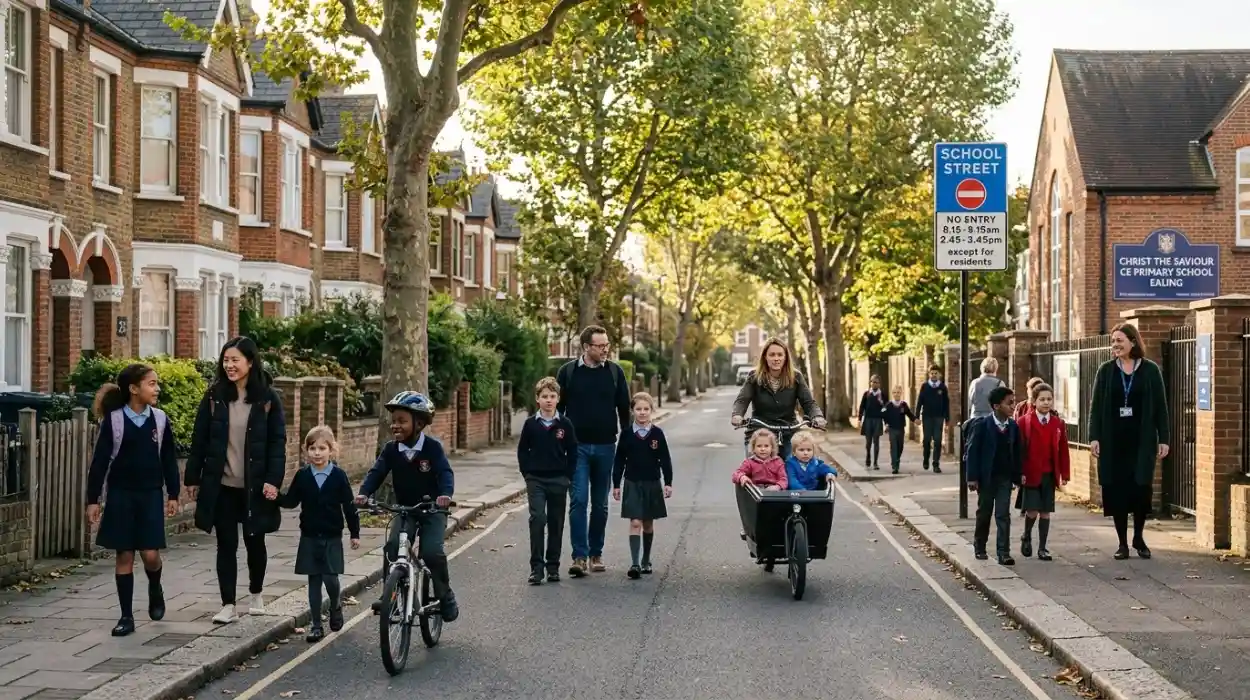
An Ealing School Street restricts access for most vehicles on selected roads close to school gates during specific periods at the beginning and end of the school day. The restrictions operate during term time, with exact hours shown on signs at the entrances. Residents and certain other eligible vehicles can receive permits, while pedestrians and cyclists continue to have access.
This means morning traffic is not simply disappearing. Instead, the pattern of movement around a school can change. Drivers may need to use alternative routes, parents may park further away and walk, and more children may walk, cycle or scoot for part of their school journey.
Understanding how these changes work is important for Ealing residents, parents, commuters, visitors and anyone driving through areas such as West Ealing, Southall, Northolt, Acton, Perivale and other parts of the borough.
What Is An Ealing School Street?
A School Street is a designated area where access for most motor vehicles is restricted for a short period around school opening and closing times.
The purpose is to reduce unnecessary traffic close to school entrances and create a lower-traffic environment for children, parents, pedestrians and cyclists. Ealing Council states that restrictions normally operate for around 30 to 60 minutes, although afternoon periods can sometimes be longer because schools may have different finishing times.
Automatic Number Plate Recognition cameras are used at many School Streets to identify vehicles entering during restricted periods. Drivers without the appropriate permission can receive a Penalty Charge Notice.
For someone who normally drives through a particular school road each morning, this can therefore represent a significant change to their routine.
Why Were School Streets Introduced In Ealing?
One of the main reasons for the programme is the amount of traffic associated with school journeys.
Ealing Council says that one quarter of London’s morning peak-hour traffic is made up of families on the school run. The council also reports that 86% of primary school-aged children in Ealing live within one mile of their school, a distance it describes as roughly a 20-minute walk or five-minute cycle ride.
The argument behind School Streets is therefore that some short car journeys can potentially be replaced with walking, cycling or scooting.
There is also a road-safety consideration. When numerous vehicles arrive at a school entrance within a short period, problems can include stopping on narrow roads, obstructing pavements, reversing, turning around and competing for limited parking space.
A School Street changes the environment during those critical minutes rather than attempting to control traffic throughout the entire day.
How Do School Streets Affect Morning Traffic?
The most immediate effect is a reduction in vehicle access on the road directly affected by the restriction.
A driver who previously used a school road as a shortcut may have to find another route. A parent who previously drove directly to the school gate may need to park outside the restricted area and walk the remaining distance.
This can make the school street itself noticeably quieter.
However, this does not automatically mean every road in the surrounding neighbourhood becomes empty. Traffic patterns depend on the road network, alternative routes, school size, local travel behaviour and the number of families who change their transport habits.
Ealing Council monitors these effects through traffic surveys. Automatic Traffic Counts can record vehicle numbers, speeds and vehicle types on school roads and adjacent roads. Surveys are commonly carried out before a School Street begins and around six months afterwards.
This approach matters because the impact should be considered across the surrounding network rather than by looking only at the road immediately outside the school.
Does Traffic Simply Move To Nearby Roads?
This is one of the biggest concerns for local drivers.
Someone living just outside a School Street may reasonably wonder whether restricting one road simply pushes cars into neighbouring streets. The answer can vary by location.
Ealing Council says its experience and monitoring indicate that school-related traffic tends to decrease rather than simply move elsewhere. The council also states that once schemes have become established, they do not usually cause additional traffic or parking problems in surrounding areas during the restricted periods.
That does not mean every nearby road will experience identical conditions. A particular junction can still become busy because drivers choose different routes, while normal commuter traffic may overlap with school traffic.
This is why local traffic surveys are more useful than assuming that every School Street will produce exactly the same result.
What Happens To Parents Who Usually Drive?
Parents and carers dropping children at school are generally not exempt simply because they are making a school journey.
Ealing Council states that parents cannot normally drive into a School Street during its restricted period unless they qualify for a specific exemption, such as a relevant Blue Badge arrangement or resident permit. Parents who need to drive can legally park outside the restricted area and walk the remaining distance.
Some schools and schemes can also support a “Park & Stride” approach, where families leave the vehicle further away and complete the final section on foot.
For a family that previously parked directly outside the school, this may initially make the morning routine feel longer. Over time, however, the journey can become predictable if the family chooses a consistent drop-off point.
How Do School Streets Affect Parking?
Parking behaviour is closely connected to morning school traffic.
Without restrictions, parents may compete for limited spaces close to school gates. This can result in vehicles stopping temporarily, parking partly on pavements or waiting in locations that make it harder for pedestrians and other road users to pass.
A School Street reduces vehicle access during its operational period, so parking directly outside the school becomes less available to people arriving by car.
This can change where drivers leave their vehicles. Instead of trying to reach the school entrance, families may use nearby legal parking locations and walk the final section.
Ealing Council specifically notes that parents who need to drive should park legally outside the School Street and walk to the school.
Are School Streets Better For Walking And Cycling?
Encouraging active travel is one of the central objectives of Ealing’s programme.
The council reports that its School Street programme has been associated with reductions in school-related car use of up to 18% and increases in walking, scooting and cycling of up to 29%. These are figures reported by Ealing Council for its programme rather than a guarantee that every individual School Street will produce the same result.
The reasoning is straightforward. If fewer vehicles are entering the road immediately around a school, children and parents have more usable road space.
For a child who lives relatively close to school, the difference can be practical. Instead of being driven for a short distance, they may walk from home, cycle or scoot.
This can also change the morning experience for families. A short walk can become part of the daily routine rather than an additional activity.
What About Residents Living Inside A School Street?
Residents inside a School Street are treated differently from ordinary visitors.
Eligible residents can apply for a free virtual vehicle permit, allowing their registered vehicles to access the zone during restricted times. Businesses and carers can also qualify in relevant circumstances.
However, simply visiting a property within the zone does not normally give a visitor permission to drive through during the restriction.
This distinction is important for local residents who have relatives, tradespeople, deliveries or other visitors arriving during the morning.
Residents should check the specific rules for their School Street rather than assuming that living nearby automatically provides an exemption.
How Do School Streets Affect Taxis And Deliveries?
Taxis must follow School Street restrictions and generally cannot enter during restricted periods. Ealing Council says special arrangements can be considered where mobility issues create a specific need.
This can matter to residents who regularly depend on taxis, private hire vehicles or other transport services.
Deliveries and tradespeople are also subject to the restrictions. Businesses located near a School Street do not automatically receive unrestricted access during operational periods.
For anyone arranging a delivery, appointment or service visit, checking the School Street hours in advance can prevent a driver from arriving at a restricted entrance and being unable to continue.
What Does Morning Traffic Feel Like Near An Ealing School?
The experience can vary considerably between roads.
On the School Street itself, the change can be obvious: fewer cars, less stopping and starting, fewer vehicles attempting to turn around and more space for people walking.
Ealing Council has published feedback from residents, parents and school staff describing quieter roads, reduced school-related parking problems and a calmer morning environment.
At the same time, a driver travelling through the wider neighbourhood may experience a different perspective. Their usual route may no longer be available during the restricted period, requiring a small change to their journey.
This is why the effect of School Streets should be understood at several levels: the school gate, nearby residential roads and the wider journey network.
Practical Advice For Drivers In Ealing
If your regular route passes a School Street, check the signs before entering. The operating times are displayed at scheme entrances, and restrictions generally apply only during specific periods rather than throughout the entire day.
Drivers should avoid assuming that restrictions operate only on normal school days. Ealing Council states that School Streets operate during term time and can also operate on individual INSET and occasional school days.
If you are driving a child to school, identify a legal drop-off location outside the restricted area and allow enough time to walk.
For commuters, checking an alternative route before the morning journey can be useful, particularly if your normal route passes several schools.
A Typical Morning Scenario
Imagine a driver travelling through West Ealing at 8.30am who normally uses a residential road beside a primary school as a shortcut.
During a School Street’s operating period, the driver reaches the restriction and cannot continue without the relevant permit. They therefore use an alternative road.
Meanwhile, a parent who previously drove to the school gate parks further away and walks with their child. Another family walks from home, while pupils arriving by scooter use the lower-traffic area around the school.
The immediate result is a different distribution of road users.
The important point is that School Streets are designed around a short, predictable period of peak school activity. They are not intended to restrict the same roads throughout the whole day.
How Ealing Measures The Traffic Impact
Ealing Council does not rely solely on opinions about whether a School Street is working.
Traffic surveys collect information about vehicle volumes, speeds, directions and vehicle types. The council can compare conditions before and after a scheme is introduced and examine both the school road and surrounding roads.
This provides a more useful basis for understanding changes in morning traffic.
The council’s School Street programme began in 2020, and Ealing states that its target of delivering School Streets at 50 schools was met in January 2026.
That makes School Streets an established part of the borough’s approach to school travel rather than a small, isolated traffic experiment.
What Do Ealing School Streets Mean For Local Morning Journeys?
Ealing School Streets can change morning traffic by restricting most vehicle access close to participating schools during the busiest school-run period.
For parents, this can mean parking further away and walking. For commuters, it can mean choosing an alternative route. For residents inside a scheme, it can mean using a permit to maintain access. For pedestrians and cyclists, the intention is to create a less vehicle-dominated environment around school entrances.
The effect is therefore more complicated than simply saying that traffic has increased or decreased.
The strongest evidence comes from the combination of traffic monitoring, reported changes in school-related car use and feedback from local communities. Ealing Council reports reductions in school-related car use and increases in active travel across its programme, while also monitoring surrounding roads to understand local traffic effects.
For anyone travelling through Ealing in the morning, the practical lesson is simple: check whether your route passes a School Street, look at the displayed restriction times and plan your journey accordingly. For parents, residents and local commuters, understanding the scheme before setting off can make the morning journey more predictable.
Frequently Asked Questions About Ealing School Streets And Morning Traffic
Do Ealing School Streets operate every morning?
They operate during school term time on participating school days, generally around school opening and closing periods. Exact times vary by location and are displayed on signs at the entrances.
Can parents drive through an Ealing School Street?
Parents cannot normally enter during restricted times simply to drop off or collect children. They may qualify for specific exemptions, such as certain Blue Badge arrangements or a resident permit.
Do School Streets reduce traffic in Ealing?
Ealing Council reports reductions in school-related car use of up to 18% across its School Street programme. Individual results can vary by location, so local traffic monitoring remains important.
Do School Streets cause more traffic on nearby roads?
Ealing Council says its monitoring and experience indicate that school traffic generally decreases rather than simply moving to surrounding roads. Traffic surveys are used to assess school roads and adjacent roads.
Can residents drive into a School Street?
Eligible residents living within the designated zone can apply for a free virtual vehicle permit. Residents outside the zone do not automatically receive access during restricted times.
Can taxis enter Ealing School Streets during restricted hours?
Taxis must follow the restrictions and generally cannot enter during operational periods. Ealing Council can consider special arrangements where mobility needs create a particular requirement.
How can I check whether my route is affected by a School Street?
Check the School Street signs and Ealing Council’s School Streets information and map for the relevant location. The displayed signs provide the operational times that apply at that entrance.