
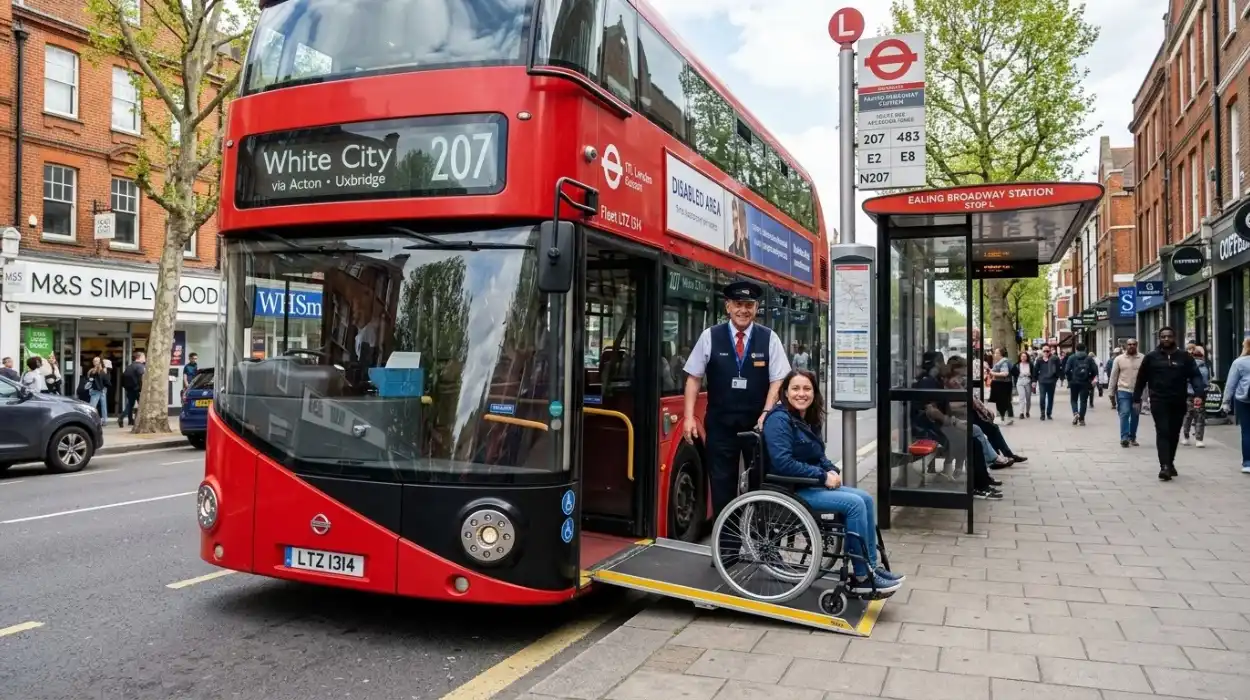
For wheelchair users, buses can make travelling around Ealing considerably easier because they provide direct connections between neighbourhoods without requiring access to every Underground station. But accessibility is not simply a question of whether a bus has a ramp. The complete journey also depends on the bus stop, pavement, kerb, boarding space, wheelchair area, driver assistance, passenger behaviour and the accessibility of the destination.
Ealing Council works with Transport for London (TfL) to improve bus-stop accessibility, including accessible kerbs, passenger waiting areas and restrictions on parking at bus stops. TfL also provides accessible buses across its network, with ramps and designated wheelchair spaces.
For a wheelchair user living in or visiting Ealing, the practical question is therefore not simply “Are Ealing buses wheelchair accessible?” It is whether a particular journey can be completed comfortably, safely and independently from the starting point to the final destination.
Are Ealing Buses Wheelchair Accessible?
Yes. TfL’s bus network is designed to accommodate wheelchair users, and every TfL bus has a designated wheelchair space. Wheelchair and mobility scooter users have priority for this area because it is the part of the bus where they can travel safely.
The accessibility features are particularly useful for journeys across Ealing, including trips between areas such as Ealing Broadway, Acton, Southall, Greenford, Northolt and Perivale.
However, accessibility can vary in practice depending on the conditions at the particular bus stop and how busy the service is. A wheelchair-accessible bus still needs enough space to approach the kerb and deploy its ramp safely.
This distinction is important for people planning journeys around Ealing. A journey can be technically accessible while still presenting practical challenges.
How Does A Wheelchair User Board An Ealing Bus?
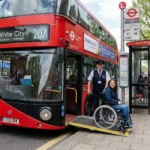
On an accessible TfL bus, the driver can lower the vehicle and deploy the ramp when required. TfL says drivers are trained to assist passengers who need accessibility support. They should pull close to the kerb, lower the bus, deploy the ramp where necessary and allow the passenger sufficient time to board safely.
On a dual-door bus, wheelchair and mobility scooter users normally board through the centre doors. The designated wheelchair space is generally positioned close to this entrance.
Once inside, the wheelchair user moves into the priority area and positions the wheelchair safely. The space includes appropriate restraints or positioning features intended to make travelling safer.
For someone using buses for the first time in Ealing, the process may initially feel unfamiliar. In practice, communicating with the driver and allowing enough time for the ramp and boarding process can make the experience much easier.
What Happens If The Wheelchair Space Is Occupied?
This is one of the biggest practical concerns for wheelchair users.
The designated wheelchair area can also be used by passengers with buggies or other mobility aids when it is not required by a wheelchair user. However, wheelchair users have priority.
TfL instructs drivers to ask passengers to make space for wheelchair users where appropriate. A buggy user may therefore be asked to fold the buggy or move elsewhere when a wheelchair user needs the priority area.
This does not mean that wheelchair users should have to argue with another passenger. The driver is responsible for managing the boarding process.
For example, a parent with a pushchair may already be occupying the wheelchair area when a wheelchair user arrives at a stop in Ealing. The driver can ask the passenger to make the necessary space. If the space is large enough, a wheelchair user and buggy may sometimes share it, but the wheelchair user’s needs take priority.
Are Ealing Bus Stops Accessible?
The accessibility of the bus stop itself is just as important as the bus.
Ealing Council says it works with TfL to improve bus-stop accessibility by maintaining accessible kerbs, improving passenger waiting areas and preventing parking at bus stops.
A properly designed kerb helps reduce the gap between the pavement and the bus ramp. This can make a substantial difference to someone using a manual wheelchair, powered wheelchair or mobility scooter.
Nevertheless, real-world conditions can change. Parked vehicles, roadworks, street furniture, temporary barriers, damaged pavements or overcrowded waiting areas can make boarding more difficult.
This is why wheelchair accessibility should be considered as a complete route rather than a feature of the bus alone.
Can Wheelchair Users Travel Independently On Ealing Buses?
Many wheelchair users can travel independently on TfL buses, particularly when the route and stops are suitable for their mobility needs.
TfL provides accessibility information and journey-planning tools that allow passengers to consider access requirements when planning public transport journeys. Ealing Council also points disabled passengers towards TfL’s accessibility information and free travel mentoring service.
Travel mentoring can be particularly useful for someone who is nervous about travelling independently for the first time. The service is designed to help people plan and carry out journeys around London.
A person who has never used an Ealing bus in a wheelchair might therefore benefit from planning the route in advance rather than relying on improvisation at the bus stop.
Are Wheelchair Users Charged To Travel On TfL Buses?
Wheelchair and mobility scooter users can travel free on TfL bus services. TfL’s conditions of carriage state that wheelchair and mobility scooter users can travel free at all times. A person travelling with them still needs to follow the applicable fare requirements.
Eligible London residents may also qualify for a Disabled Person’s Freedom Pass, depending on their circumstances. Ealing Council provides information about Freedom Passes and other concessionary travel options for disabled residents.
For visitors, the situation can be different, so it is sensible to check the applicable TfL travel conditions before making a journey.
What Types Of Wheelchairs Can Ealing Buses Accommodate?
TfL specifies accessibility limits for mobility aids.
Its current conditions of carriage state that buses can accommodate wheelchairs up to 70cm wide and 120cm long when unfolded, subject to the applicable weight limit displayed on the ramp or beside the doorway. Specific dimensions also apply to mobility scooters and wheeled mobility walkers.
This is particularly important for people using larger powered wheelchairs or mobility scooters.
A person should not assume that every mobility aid will fit simply because the bus is described as accessible. Dimensions, turning space and the safe positioning of the mobility aid all matter.
TfL also operates a Mobility Aid Recognition Scheme to help users establish whether a mobility scooter is suitable for travelling on its public transport services.
What If The Bus Is Too Crowded?
Crowding can make an otherwise accessible journey more difficult.
TfL’s conditions allow the driver to refuse travel where the bus is so crowded that the wheelchair or mobility aid user cannot travel safely. Travel can also be refused if the mobility aid exceeds the specified dimensions or if the wheelchair space is already occupied by another wheelchair user.
This does not mean that wheelchair users are routinely turned away because a bus is busy. Rather, there are safety limits that drivers must consider.
For someone travelling at a busy time around Ealing Broadway, Acton or Southall, choosing a quieter departure when practical can sometimes make boarding and positioning easier.
The important point is that a wheelchair user should not be expected to compromise their safety simply to fit onto an overcrowded vehicle.
What Should A Wheelchair User Do At The Bus Stop?
Arriving at the correct boarding point can make the process smoother.
Where possible, position yourself where the driver can clearly see that you are waiting to board. When the bus approaches, the driver should identify the accessibility requirement and pull in appropriately.
TfL’s driver guidance specifically instructs drivers to acknowledge wheelchair and mobility scooter users, pull close to the kerb and ensure that obstacles do not prevent safe ramp deployment.
If parked cars or other obstructions prevent the ramp from being safely deployed, the driver may need to reposition the bus.
This can take longer than ordinary boarding, so wheelchair users should not feel pressured by passengers waiting behind them. Accessibility is part of the normal bus service.
What About Getting Off The Bus?
Alighting should also be planned.
A wheelchair user normally uses the designated accessible door and waits for the driver to deploy the ramp where required. TfL’s guidance requires drivers to provide sufficient time for the wheelchair or mobility scooter user to position themselves safely before the bus moves away.
If you are approaching a busy destination such as Ealing Broadway, it can be useful to signal your intention to leave in advance.
The pavement outside the bus stop matters here too. Even if the bus ramp reaches the kerb successfully, a blocked pavement or badly positioned street furniture can create an obstacle immediately after leaving the vehicle.
How Accessible Are Buses Around Ealing’s Main Areas?
Ealing is a large borough, so accessibility should be assessed on a journey-by-journey basis.
Someone travelling between Ealing Broadway and Acton may have a different experience from someone travelling towards Greenford, Northolt or Southall. Bus routes, stops, pavement conditions, congestion and interchange points can all affect the practical experience.
Ealing Council says TfL provides route, timetable and bus information for services operating in the borough, while the council works with TfL on bus-stop accessibility.
For visitors staying near Ealing Broadway, it can be useful to investigate the complete route before leaving the hotel or accommodation. A destination that looks close on a map may involve a difficult pavement, an unsuitable crossing or a less convenient bus stop.
This is particularly relevant when travelling to shopping areas, healthcare appointments, parks, community centres and transport interchanges.
What Alternatives Are Available If A Bus Journey Is Difficult?
Buses are not the only accessible transport option available to people in Ealing.
Ealing Council provides information about Ealing Community Transport, which offers accessible and affordable transport for people who find public transport difficult to use. Its PlusBus service provides door-to-door transport for people who have difficulty using mainstream public transport.
There is also the Taxicard scheme for eligible London residents with serious long-term mobility or severe sight impairments. Participating black cabs have ramps and are accessible to wheelchair users.
This gives wheelchair users more choice when a particular bus journey is impractical.
The best transport option depends on the individual’s mobility needs, destination, time of day and level of independence.
What If You Are Visiting Ealing In A Wheelchair?
Tourists and visitors should plan more than just the bus route.
Before travelling, check the accessible status of the bus journey, identify the boarding and destination stops, and consider whether the surrounding pavements and crossings are suitable.
If your journey involves changing between buses and rail services, check each part separately. Accessibility on the bus does not automatically mean that every station, platform or connecting route will be step-free.
Ealing has several major transport points, including Ealing Broadway and Acton, so visitors should consider the complete journey rather than assuming that the nearest station or bus stop is automatically the easiest option.
TfL’s accessibility information can help passengers build a route around their specific access requirements.
Practical Tips For Wheelchair Users Using Ealing Buses
The most useful preparation is simple. Check your route before travelling, confirm that the mobility aid falls within TfL’s dimensions, and identify the most suitable boarding and alighting points.
Allow additional time for boarding because the ramp may need to be deployed and the wheelchair space may need to be cleared.
If a buggy is occupying the wheelchair area, speak to the driver rather than confronting another passenger. The driver can manage the priority space.
It is also sensible to keep a backup option for longer or unfamiliar journeys. Ealing Community Transport and Taxicard services may provide alternatives where mainstream public transport is particularly challenging.
For regular journeys, travel mentoring can also help build confidence and familiarity with accessible routes.
Overall, local buses for wheelchair users in Ealing are considerably more accessible than the idea of ordinary London bus travel might suggest. TfL buses provide wheelchair spaces, ramps and trained drivers, while Ealing Council and TfL continue to improve bus-stop accessibility across the borough.
The main challenge is that accessibility involves the entire journey. A wheelchair-accessible bus can still be difficult to use if the stop is blocked, the pavement is unsuitable, the bus is exceptionally crowded or the destination creates an accessibility barrier.
For local residents, planning familiar routes can make independent travel much easier. For visitors, checking accessibility before travelling can reduce uncertainty and help identify alternatives where necessary.
Ealing also provides community transport and Taxicard options for people who find mainstream public transport difficult to use.
The practical conclusion is straightforward: Ealing’s buses are designed to accommodate wheelchair users, but the quality of an accessible journey depends on the bus, stop, route, driver, surrounding environment and individual mobility needs.
Frequently Asked Questions About Local Buses For Wheelchair Users In Ealing
Are buses in Ealing wheelchair accessible?
Yes. TfL buses are designed to accommodate wheelchair users and have designated wheelchair priority spaces and accessible boarding arrangements.
Can a wheelchair user travel free on an Ealing bus?
Yes. TfL states that wheelchair and mobility scooter users can travel free on its bus services.
Can a wheelchair user make a bus driver lower the ramp?
Yes. TfL bus drivers are trained to assist passengers who need accessibility support and can lower the bus and deploy the ramp when required.
What happens if someone is using the wheelchair space with a buggy?
Wheelchair users have priority. A buggy user may be asked to move or fold the buggy so that the wheelchair user can use the designated priority area.
Can large electric wheelchairs use Ealing buses?
They can if the wheelchair meets TfL’s applicable dimensions and weight requirements and can be safely positioned in the designated space.
What can I do if buses are difficult for me to use?
Ealing offers alternatives including Ealing Community Transport and the Taxicard scheme for eligible residents. TfL also provides travel mentoring for people who want support with independent journeys.
Are Ealing bus stops accessible for wheelchair users?
Ealing Council works with TfL to improve bus-stop accessibility, including accessible kerbs and passenger waiting areas. However, temporary obstacles, parking, roadworks and local conditions can still affect individual stops.