

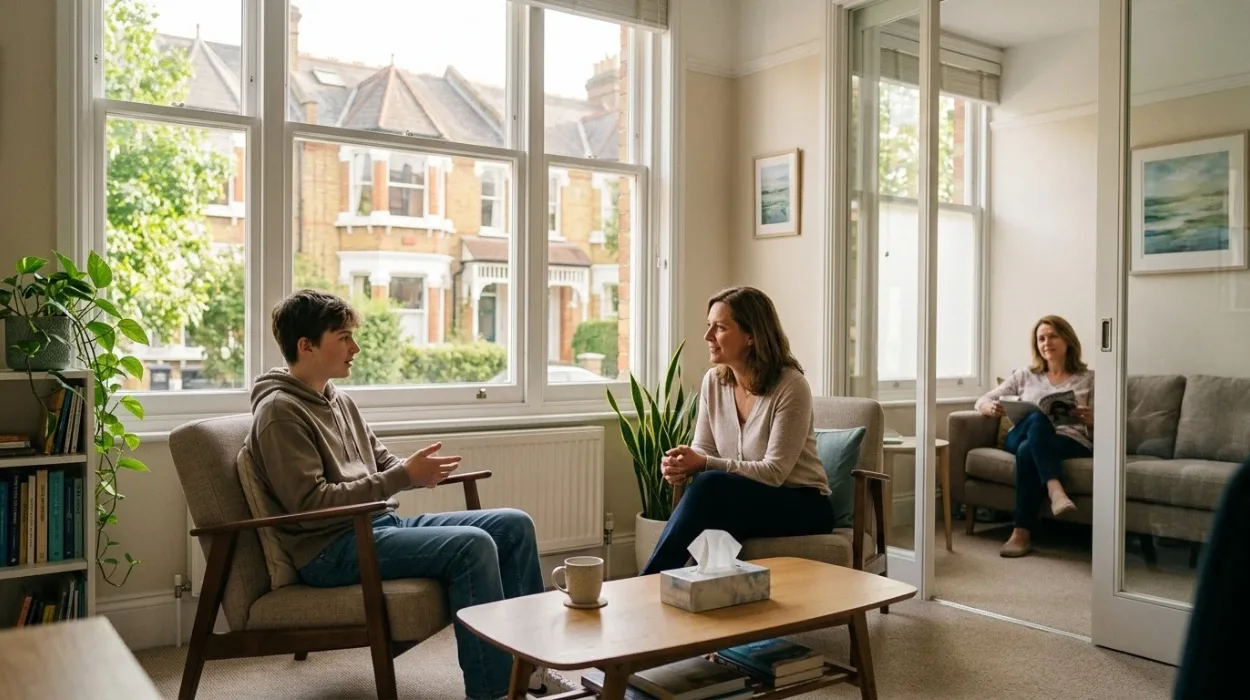
Finding the right mental health support for a teenager can feel difficult, particularly when a parent is unsure whether their child’s changes are part of normal adolescence or something that needs professional attention. Anxiety, persistent low mood, withdrawal, problems at school, changes in sleep or eating, self-harm and difficulty managing emotions can all be reasons to seek advice.
Families in Ealing have several routes into support, ranging from schools and GPs to specialist Child and Adolescent Mental Health Services (CAMHS), online counselling and local crisis support. The most suitable route depends on the young person’s age, symptoms, level of difficulty and whether there is an immediate safety concern.
It is also important to remember that asking for help does not automatically mean a teenager needs a diagnosis or specialist treatment. Early advice can help parents understand what is happening and identify an appropriate next step.
When Should Parents Look For Mental Health Support?
Teenagers naturally experience changes in emotions, friendships, independence and behaviour. However, concerns become more significant when difficulties persist, become more intense or start affecting everyday life.
A parent might notice that their teenager has stopped enjoying activities they previously liked, is avoiding friends, struggling to attend school, becoming unusually irritable or experiencing ongoing worry. Changes in sleeping or eating patterns, difficulties concentrating and frequent physical complaints without an obvious cause can also be worth discussing with a professional.
The key issue is not whether a teenager displays one particular symptom. It is whether the change is affecting their wellbeing, relationships, education or ability to manage normal daily activities.
For example, a student who becomes nervous before an important exam may need reassurance and practical support. A teenager who has been unable to attend school for several weeks because of overwhelming anxiety may need a more structured assessment.
Start With A GP Or Another Trusted Professional
For many families, speaking to the teenager’s GP is a sensible starting point. A GP can discuss the concerns, consider physical and emotional factors and advise whether another service would be appropriate.
Parents can also speak to professionals who already know the young person. Depending on the circumstances, this could include a teacher, school pastoral lead, school counsellor, social worker, paediatrician or educational psychologist.
Ealing CAMHS explains that a GP or professionals working with children and families can refer a child or young person when specialist mental health support is appropriate.
This means parents do not necessarily have to work out the correct service themselves. Explaining what has changed, how long the problem has been present and how it is affecting the teenager can help the professional decide what should happen next.
What Is CAMHS In Ealing?
Child and Adolescent Mental Health Services, commonly known as CAMHS, provide assessment, support and treatment for children and young people experiencing emotional, behavioural or mental health difficulties.
West London NHS Trust provides CAMHS services for children and young people across Ealing, Hammersmith and Fulham, and Hounslow. The service works with young people and their families and includes multidisciplinary professionals such as psychiatrists, psychologists, psychotherapists, nurses and family therapists.
Ealing CAMHS is based at 1 Armstrong Way in Southall. The listed telephone number is 020 8354 8160.
CAMHS is generally more relevant when a young person’s difficulties are severe, complex or require specialist assessment and treatment. A referral is screened to consider factors including severity, duration and complexity before the appropriate level of support is determined.
Can A School Help A Teenager With Mental Health Difficulties?
Yes. School can be an important part of the support network because teachers and pastoral staff may notice changes that parents do not see at home.
A teenager might feel more comfortable speaking to a trusted member of staff rather than immediately talking to a parent or GP. Schools may also provide counselling, wellbeing support or referrals to other services.
West London NHS Trust states that its Ealing school support team works with schools in the borough, providing wellbeing support.
Parents can ask the school what support is currently available. It can be useful to explain specific concerns rather than simply saying that a teenager is “struggling”. For example, a parent could mention repeated school refusal, panic symptoms, social withdrawal or difficulties concentrating.
Working with school can also help create a consistent approach between home and education.
What If My Teen Wants Online Mental Health Support?
Some teenagers find online support easier to approach than face-to-face appointments. Digital services can provide a degree of privacy and may feel less intimidating for a young person who is reluctant to speak to an adult in person.
Ealing’s public health information states that young people aged 11 to 25 can access Kooth, an NHS-commissioned digital mental health service offering online counselling and support.
West London NHS Trust also lists Best For You as a digital resource for young people, alongside other local support options.
Online support should not be treated as a replacement for urgent clinical care. If a teenager is at immediate risk of harming themselves or someone else, parents should use urgent or emergency services rather than relying on an online platform.
What Is Speak CAMHS?
Speak CAMHS is particularly useful when a parent is unsure what local mental health service to approach.
The specialist helpline is available to anyone concerned about a child or young person under 18 living in Ealing, Hounslow or Hammersmith and Fulham. This includes parents, carers, young people and professionals such as teachers or GPs.
The current number is 0800 328 4444, option 2. The service is listed as being open Monday to Friday from 8am to 11pm and weekends and bank holidays from midday to 8pm.
This can be helpful when the situation does not appear to require an emergency response but the family needs professional advice about what to do next.
What Is The Circle In Ealing?
The Circle is a local crisis-prevention space supporting young people in Ealing who are approaching or experiencing a mental health crisis.
West London NHS Trust describes The Circle as a hub and café where young people can access mental health support through drop-in and appointment-based services. The service is intended to provide earlier intervention and help prevent situations from escalating.
Ealing’s public health report also identifies The Circle as a local option for children and young people near or experiencing a mental health crisis.
This type of service can be particularly useful when a teenager needs more immediate emotional support but the family needs guidance about the appropriate level of care.
What Should I Do If My Teen Is Self-Harming Or Talking About Suicide?
This situation should always be taken seriously.
If a teenager is expressing suicidal thoughts, has seriously self-harmed, has taken an overdose or there is an immediate concern about their safety, do not wait for a routine appointment or referral.
West London NHS Trust advises that urgent or emergency situations involving self-harm, suicidal thoughts or an overdose should be assessed through the nearest A&E department, where the young person can be assessed by appropriate emergency or CAMHS services.
If there is an immediate danger to life, call 999 or go to the nearest A&E department.
For urgent emotional support, the local Speak CAMHS helpline can also provide specialist advice, while the NHS-listed crisis resources include free 24/7 text support by texting NATTER to 85258.
Parents should avoid trying to manage an immediate safety crisis alone.
How Can Parents Encourage A Teenager To Accept Help?
Teenagers may reject the idea of counselling or professional support because they worry about being judged, labelled or misunderstood. A parent can make the conversation easier by focusing on what the teenager is experiencing rather than immediately suggesting a diagnosis.
Instead of saying, “You need therapy”, it may be more productive to say, “I’ve noticed things have been difficult recently. Would you like us to find someone you can talk to?”
Giving a teenager some choice can also help. They might prefer to speak to a GP, school professional, helpline worker or online counsellor first.
Parents should also listen without immediately trying to solve every problem. Sometimes the first objective is simply to make the teenager feel heard and safe enough to accept further support.
What Information Should You Give When Asking For Help?
Before contacting a service, it can help to make a short record of what has changed.
Include when the difficulties started, how frequently they happen, whether school attendance has changed, sleep or appetite changes, social withdrawal, self-harm concerns, substance use, major family or friendship problems and anything the teenager has said about their emotional wellbeing.
This does not need to be a formal report. A few clear examples can help a GP, school professional or CAMHS team understand the situation.
It is also useful to tell professionals what the teenager says they want. Their own perspective can be important when deciding how support should be provided.
Support For Teenagers With Additional Needs
Some young people have mental health concerns alongside neurodevelopmental or other additional needs. These situations may require professionals to consider several aspects of the young person’s wellbeing together.
Ealing CAMHS has a neurodevelopmental service for eligible children and young people, and its guidance explains that mental health concerns can be considered alongside neurodevelopmental needs.
Parents can explain the complete picture rather than focusing on one symptom. Information about communication difficulties, attention, sensory needs, behaviour, learning, relationships and emotional wellbeing may all be relevant.
What If A Teenager Is Struggling With Drugs Or Alcohol?
Mental health concerns can sometimes occur alongside alcohol or drug use. Parents should not assume that substance use is simply a behavioural problem.
Ealing has the EASY Project, a free and confidential service for young people aged 10 to 18 who are using drugs or alcohol, thinking about using them, or affected by someone else’s substance use. Ealing’s public health information states that young people can self-refer and receive support in different settings, including schools and community locations.
If substance use is connected with immediate danger, overdose or serious mental health concerns, urgent medical assistance takes priority.
Getting Mental Health Support For A Teen In Ealing
The right starting point depends on what your teenager is experiencing.
For general concerns, a GP or school professional can help assess the situation and identify an appropriate route. For specialist or more complex difficulties, Ealing CAMHS may be involved through referral. For young people who prefer digital support, Kooth and other online resources may provide an accessible first step.
When parents are unsure what local service to use, Speak CAMHS can provide specialist advice about children and young people under 18 in Ealing and neighbouring boroughs. If a young person is approaching crisis, The Circle provides local crisis-prevention support. For immediate danger, self-harm, suicidal thoughts or an overdose, urgent emergency assessment is required.
Most importantly, parents do not need to wait until a problem becomes severe before asking for advice. Early conversations with a GP, school, helpline or appropriate local service can help families understand what is happening and find the right level of support.
Frequently Asked Questions About Teen Mental Health Support In Ealing
How do I get my teenager referred to CAMHS in Ealing?
A GP or another professional working with children and young people can make a referral to Ealing CAMHS when specialist support is appropriate. Schools and other professionals may also be able to refer.
Can parents contact Speak CAMHS directly?
Yes. Speak CAMHS is available to parents, carers, young people and professionals who are concerned about someone under 18 living in Ealing, Hounslow or Hammersmith and Fulham. The listed number is 0800 328 4444, option 2.
Is there free online mental health support for teenagers in Ealing?
Yes. Ealing’s public health information states that young people aged 11 to 25 can access Kooth, an NHS-commissioned digital mental health service.
Can my teenager get mental health support through their school?
Potentially. Schools may have counselling or wellbeing services and can help connect young people with appropriate support. Parents should ask their teenager’s school what services are currently available.
Where can a teenager go during a mental health crisis in Ealing?
The Circle provides crisis-prevention support for young people in Ealing who are near or experiencing a mental health crisis. Speak CAMHS can also provide specialist advice. For an immediate emergency, use A&E or emergency services.
What should I do if my teenager is self-harming?
Take the situation seriously and seek professional help. If there is an immediate safety risk, suicidal thinking, serious self-harm or an overdose, seek emergency medical assessment rather than waiting for a routine appointment.
Can a 16 or 17-year-old access adult mental health support in Ealing?
The appropriate service can depend on the young person’s circumstances. Ealing Talking Therapies states that people aged 16 or 17 who want a referral should speak with their GP or a CAMHS worker if they are already receiving CAMHS support.