
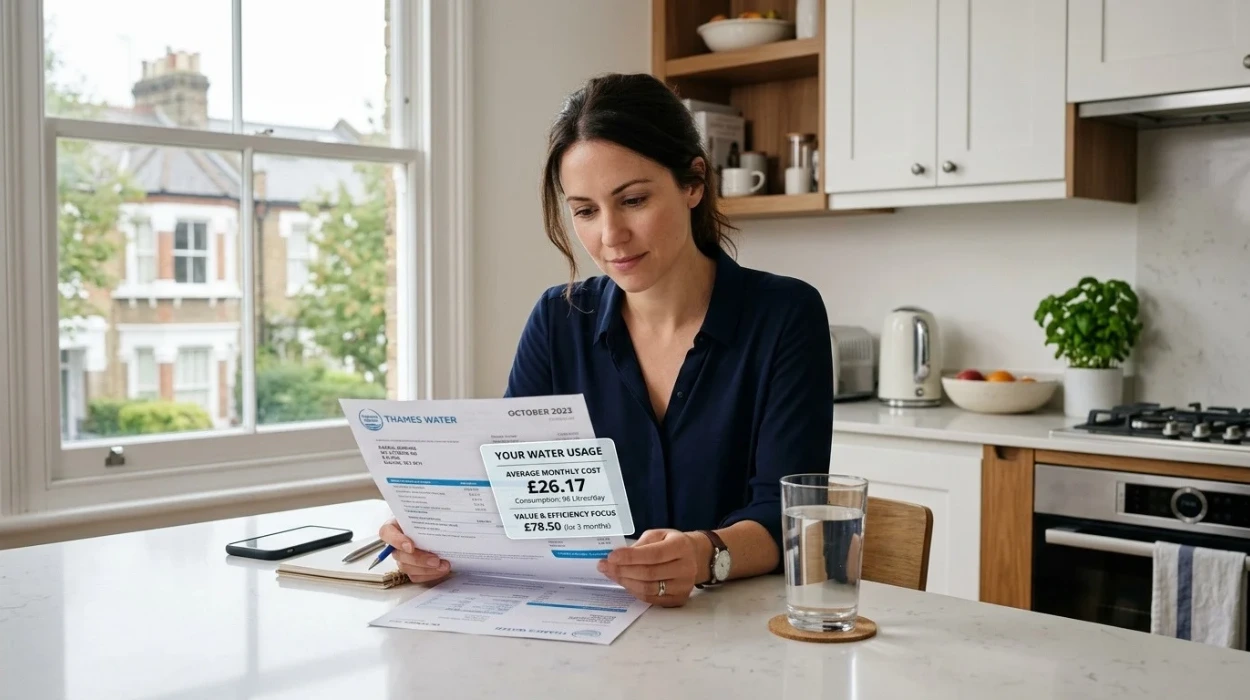
Understanding the average water bill cost for Ealing residents can make household budgeting much easier, particularly as water and wastewater charges change from year to year. For people living in Ealing, Acton, Greenford, Perivale, Hanwell, Southall, Northolt and surrounding areas, the amount paid can depend on the water supplier, whether the property has a meter, household size and how much water is used.
Ealing Council states that drinking water in the borough is supplied by Thames Water and Affinity Water, so the exact arrangements can vary by property. For many households, however, Thames Water is the relevant supplier and its 2026–27 charges provide a useful guide to current costs.
It is also important to understand that a household water bill normally covers more than water coming through the taps. Charges can include clean water supply, wastewater collection and treatment, drainage and fixed service costs.
What Is The Average Water Bill Cost For Ealing Residents?
There is no single water bill that every Ealing household pays. The cost depends on how the property is charged and, for metered homes, how much water the household consumes.
For 2026–27, Thames Water’s published figures show that a typical metered household using 80 cubic metres of water has a combined water and wastewater bill of approximately £532 per year. This works out at roughly £44 per month when averaged across twelve months. A household using 50 cubic metres has a combined annual bill of approximately £405, while one using 120 cubic metres has a combined bill of about £700.
These figures are useful benchmarks rather than guaranteed prices for every Ealing property. A household with lower consumption can pay less, while a larger family or property with high water use can pay considerably more.
Thames Water itself distinguishes between an “average” bill and a “typical” bill. Its typical figures are designed to give customers a more practical indication of what they may actually pay, while an average can be affected by customers on different tariffs and support schemes.
Why Water Bills Differ Between Ealing Homes
Two homes on the same street can have noticeably different water bills. One major reason is the way the property is charged.
Metered customers pay according to the volume of water they use. Thames Water’s 2026–27 metered rates are £2.7346 per cubic metre for clean water and £1.4721 per cubic metre for wastewater. One cubic metre equals 1,000 litres. Fixed charges are then added to the bill.
Unmetered customers are charged differently. Their bills can be based on the property’s rateable value, while certain households may qualify for an assessed household charge. This means that the size, characteristics and charging history of a property can influence the amount paid.
For Ealing residents, this is why simply asking what the “average water bill” is may not produce a figure that matches a particular household.
How Much Do Metered Ealing Households Pay?
A water meter can make household water costs more closely connected to actual consumption. Thames Water’s published 2026–27 figures give several useful reference points.
A household using around 50 cubic metres a year has a typical combined water and wastewater bill of about £405 annually. At 80 cubic metres, the figure is around £532, while 120 cubic metres corresponds to approximately £700.
This creates a useful range for households trying to understand their likely costs. Someone living alone and spending much of the day away from home may use significantly less water than a family of four where several people shower daily, washing machines run frequently and a dishwasher is used regularly.
Thames Water’s usage examples also show how lifestyle can affect annual costs. Its 2026–27 figures range from relatively low usage to high usage, with the difference becoming particularly significant as household occupancy increases.
For example, a one-person household with low usage could have a substantially different bill from a four-person household with high usage. This is why household size and daily routines are important when estimating water costs.
What Is Included In A Water Bill?
A water bill is not simply a charge for the litres of water used.
The clean water element covers the supply of treated water to the property. Wastewater charges cover services associated with taking away and treating used water. Bills can also include fixed charges that contribute towards essential services such as pipe maintenance, billing and payment processing.
For 2026–27, Thames Water lists fixed charges of £66.87 for water and £128.13 for wastewater for standard metered household arrangements. A wastewater surface-water drainage rebate may reduce the wastewater fixed charge where the relevant conditions apply.
This explains why reducing water consumption does not necessarily make the entire bill disappear. Some parts of the bill are fixed rather than directly linked to the number of litres consumed.
How Much Do Unmetered Properties Pay?
Ealing residents without water meters may receive bills calculated through an unmetered tariff. For some properties, the charge is connected to the property’s rateable value.
Thames Water explains that the rateable value was historically determined according to factors such as the property and its location, and the value can differ between neighbouring homes. For 2026–27, charges are calculated using the relevant charging-area rates.
There is another important option for some households: the assessed household charge. This can apply where Thames Water has attempted to install a meter but cannot do so. The charge is based on the number of bedrooms rather than actual measured consumption.
For 2026–27, Thames Water’s assessed household figures are £626.34 for a zero- or one-bedroom property, £660.41 for a two-bedroom property, £724.36 for a three-bedroom property, £775.26 for a four-bedroom property, and £842.99 for properties with five or more bedrooms. A single-occupier assessed household figure is £552.30.
These are annual examples and should not be treated as the bill for every Ealing property.
Does Having A Water Meter Reduce The Bill?
A water meter does not automatically mean a household will pay less. Its main difference is that charges are linked more directly to measured consumption.
For a small household that uses relatively little water, a meter can potentially produce a lower bill than an unmetered arrangement. For a large household with high consumption, the opposite can happen.
Thames Water says requesting a water meter is free and provides tools for customers to check whether metering could change their bill.
A practical approach for an Ealing resident is to look at the current bill, household occupancy and water usage before deciding whether metering could be useful.
What Makes Water Usage Higher?
Everyday habits can have a noticeable effect on metered water bills. Longer showers, frequent baths, repeated washing-machine cycles, dishwasher use, garden watering and running taps unnecessarily can all increase consumption.
Leaks are another important consideration. A toilet that continually runs or a hidden pipe leak can waste substantial quantities of water without being immediately obvious.
For example, imagine a family living in a four-bedroom house in Perivale. Four people shower every day, the washing machine runs frequently and the garden is watered during warmer months. Their annual consumption could be much higher than that of a single person living in a one-bedroom flat in Ealing Broadway who spends most weekdays away from home.
This is why comparing bills between neighbours without considering usage can be misleading.
How Ealing Residents Can Keep Water Costs Under Control
The simplest way to understand a metered bill is to monitor consumption rather than concentrating only on the final amount.
Shorter showers, repairing dripping taps, fixing leaking toilets, using washing machines with full loads and avoiding unnecessary outdoor watering can help reduce consumption. A water-efficient showerhead or tap fitting may also help where appropriate.
Households should also check their bills regularly. An unexpected increase may result from higher usage, a meter reading issue, a change in charging rates or another billing adjustment.
Thames Water’s charges changed from 1 April 2026, with the company reporting that typical water and wastewater customers would pay around £2 more per month on average during 2026–27.
What If You Are Struggling To Pay Your Water Bill?
Residents experiencing financial difficulty may have access to support schemes.
One example is WaterSure, which is available to eligible metered customers who meet specific requirements. Thames Water says the scheme can help households with higher-than-average water use because of a large family or certain medical circumstances, provided other eligibility conditions are met.
For 2026–27, Thames Water states that WaterSure caps eligible combined water and wastewater bills at £658, subject to the scheme’s conditions.
Residents should check the current eligibility requirements rather than assuming they qualify. Other support options may also be available depending on individual circumstances.
What Should Ealing Residents Expect To Pay?
For a broad 2026–27 benchmark, a metered household using around 80 cubic metres of water can expect a combined water and wastewater bill of approximately £532 a year, or about £44 a month when averaged across the year. Lower consumption can produce a smaller bill, while higher consumption can push the annual cost towards or beyond £700.
Unmetered and assessed properties can have different charges, so the best estimate depends on the property’s billing method.
The key point is that there is no universal “Ealing water bill”. Supplier, tariff, property type, household size and consumption all matter. Residents should therefore use published tariff information as a guide and check their own bill for the exact charges applying to their property.
For anyone moving to Ealing from another part of the UK or overseas, understanding these differences is particularly useful when estimating monthly living costs. Water is only one household expense, but knowing whether a property is metered and understanding its previous bills can make budgeting considerably easier.
Frequently Asked Questions
What is the average water bill cost for Ealing residents?
For a Thames Water household using around 80 cubic metres annually, the 2026–27 combined water and wastewater figure is approximately £532 per year, or around £44 per month when averaged across twelve months. Actual Ealing bills vary by tariff and usage.
Is water expensive in Ealing?
Water costs vary between properties rather than being a single Ealing-wide price. Metered households pay according to consumption, while unmetered properties can be charged differently. The relevant supplier and tariff should therefore be checked before estimating the cost.
How much water does an average household use?
Water consumption depends on the number of people living in the property and their daily habits. Showering, bathing, laundry, dishwashing and garden use can all affect consumption. Thames Water publishes different examples based on household occupancy and usage levels.
Is it cheaper to have a water meter in Ealing?
Not necessarily. A meter links the bill more closely to actual consumption, which may benefit lower-use households but does not automatically reduce costs for everyone. Thames Water provides tools to help customers assess whether metering could be suitable.
Who supplies water in Ealing?
Ealing Council states that drinking water in the borough is supplied by Thames Water and Affinity Water. The supplier relevant to an individual property should be confirmed rather than assumed from its location alone.
Why has my water bill increased in 2026?
Water and wastewater charges changed from 1 April 2026. Thames Water says its typical water and wastewater customers saw an average increase of around £2 per month for 2026–27, although the actual change varies by tariff, usage and property.
Can I get help if I cannot afford my water bill?
Potential support is available for eligible households. WaterSure, for example, can cap bills for qualifying metered customers who meet the scheme’s financial and household or medical criteria. Thames Water should be contacted to check current eligibility and other available support.