
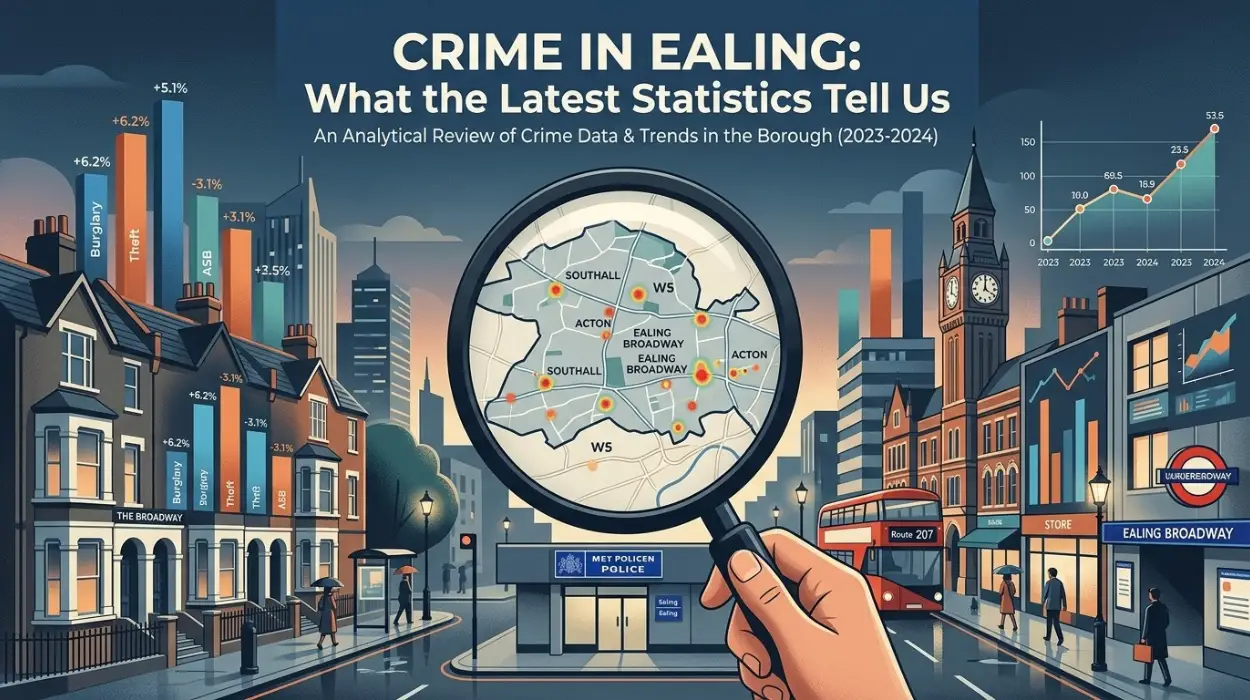
Crime is an important consideration for people who live in Ealing, are thinking about moving to the borough or are planning a visit to West London. Ealing is a large and varied London borough, containing busy town centres, residential neighbourhoods, shopping streets, transport hubs, parks and commercial areas. As a result, crime levels and the types of offences reported can differ considerably between locations.
The latest available figures provide a more useful picture than broad claims about whether Ealing is simply “safe” or “unsafe”. Reported crime can be affected by population, visitor numbers, retail activity, nightlife, public transport and the characteristics of individual neighbourhoods. Understanding these factors helps residents and tourists interpret the statistics without unnecessarily judging an entire area based on a single number.
Understanding Crime Statistics in Ealing
Crime statistics record offences reported to or identified by the police. They can help reveal patterns, but they do not measure every aspect of personal safety or provide a guarantee about what will happen in a particular street.
This distinction is especially important in Ealing because the borough contains several busy town centres. Ealing Broadway, Southall Broadway and parts of Acton attract large numbers of residents, commuters, shoppers and visitors. More people using an area can create more opportunities for offences such as shoplifting, theft and anti-social behaviour.
Ealing Council’s Local Area Profile identifies the borough’s main town centres as areas where crime is concentrated. The council associates these patterns with high footfall, retail premises, food outlets, entertainment venues and transport hubs.
Therefore, a higher number of recorded offences does not automatically mean that everyone living in the surrounding residential streets faces the same level of risk.
What the Latest Ealing Crime Data Shows
The Metropolitan Police publishes local crime information for individual Ealing policing areas, allowing residents to examine reported offences by category and month.
The data shows that crime profiles differ from one part of Ealing to another. Some areas have particularly high levels of anti-social behaviour, while shoplifting is more prominent around busy retail centres. Violence and sexual offences, vehicle crime, theft and public-order offences also appear across different policing areas.
Monthly figures can change significantly. This means that comparing one month’s total with another does not necessarily indicate a long-term rise or fall in crime.
For example, Ealing Broadway recorded 265 offences in March 2026 compared with 184 in February 2026, according to Metropolitan Police data. Looking at several months rather than one isolated figure provides a more meaningful understanding of local patterns.
Ealing Broadway and Reported Crime
Ealing Broadway is one of the borough’s major commercial and transport centres and consequently features prominently in local crime statistics.
In July 2026, Metropolitan Police data recorded 50 shoplifting offences in the Ealing Broadway policing area. Anti-social behaviour and violence and sexual offences each accounted for 46 offences, while other theft accounted for 20.
The figures illustrate an important point about crime in busy town centres. Shoplifting and theft can be closely connected with retail activity, while anti-social behaviour and public disorder can be influenced by the number of people using the area.
For residents and visitors, practical precautions remain sensible. Keeping phones and wallets secure, paying attention to belongings in crowded places and avoiding leaving bags unattended are straightforward measures that can reduce opportunities for theft.
Southall and Crime Patterns
Southall is another major commercial area within Ealing and attracts visitors from across London for shopping, restaurants, food businesses and cultural activities.
Crime patterns in Southall can vary depending on the time and location. Ealing Council’s analysis of alcohol-related crime has identified Southall and Ealing town centres as locations with notable volumes of alcohol-flagged incidents. The council’s analysis of 2022 and 2023 data found that violence represented a substantial proportion of these incidents, with concentrations particularly associated with weekends and evening and night-time periods.
This does not mean that Southall is unsafe throughout the day. Instead, it demonstrates how nightlife, alcohol consumption and increased footfall can influence the nature and timing of reported offences.
Someone visiting Southall during the day for shopping or a meal may have a very different experience from someone travelling through a busy entertainment area late at night.
Crime in Acton
Acton contains several different neighbourhoods, so it is more accurate to consider individual policing areas rather than describing the whole of Acton as one crime zone.
South Acton, for example, recorded significant levels of anti-social behaviour in the latest Metropolitan Police figures. In July 2026, there were 115 reported anti-social behaviour offences, followed by 55 violence and sexual offences, 27 public-order offences and 20 other theft offences.
The monthly total also fluctuated. South Acton recorded 308 offences in October 2025 compared with 286 in July 2026.
These figures demonstrate why crime categories matter. A neighbourhood with a high total may have a substantial proportion of anti-social behaviour rather than the total being made up entirely of serious violent offences.
Crime in Ealing Common
Ealing Common provides another example of a mixed local crime profile.
Metropolitan Police figures for July 2026 recorded 34 anti-social behaviour offences, 22 violence and sexual offences, 21 vehicle crimes and 17 shoplifting offences in the Ealing Common policing area.
The area recorded 134 offences during that month. However, monthly totals had varied over the previous year, with 146 offences recorded in October 2025 and 87 in February 2026.
This variation demonstrates why residents should be cautious about treating a single month’s statistics as a permanent description of an area.
Ealing Common is also a largely residential area with green space, local businesses and Underground access. Crime around busy roads and commercial locations may therefore differ from what someone experiences within quieter residential streets.
Perivale, Greenford and Northolt
Crime is also reported across Perivale, Greenford and Northolt, although each area contains different neighbourhoods and policing boundaries.
In Perivale, July 2026 Metropolitan Police figures recorded 46 violence and sexual offences and 44 anti-social behaviour offences. Vehicle crime accounted for 13 offences and other theft for 12.
Greenford is divided into several policing areas, including Central Greenford, Greenford Broadway and North Greenford. Consequently, figures for one part of Greenford should not be used as a description of the entire district.
Northolt similarly contains separate policing areas, including Northolt Mandeville and Northolt West End.
For someone considering a particular property or accommodation, checking the relevant local policing area is more useful than relying on a borough-wide crime figure.
What Types of Crime Are Common in Ealing?
There is no single crime category that represents the entire borough.
Anti-social behaviour is prominent in several Ealing policing areas. It can include behaviour that causes harassment, alarm or distress and may involve nuisance or disorder in public places.
Violence and sexual offences also appear regularly in local statistics. However, this is a broad police-recorded category containing different types of offences, so the category should not automatically be interpreted as evidence of widespread serious violence.
Shoplifting is particularly relevant to busy commercial centres. Other theft and vehicle crime are also reported in several parts of the borough.
Understanding the individual categories makes crime statistics more useful because residents can think about the practical risks associated with their circumstances.
Why Reported Crime Is Higher in Some Locations
Crime is not simply determined by how many people live in an area. The number of people visiting an area during the day can also influence recorded offences.
A town centre may have a relatively small residential population but thousands of daily visitors. Shops, restaurants, transport stations and entertainment venues create a much busier environment than a quiet residential street.
This helps explain why Ealing Broadway and Southall can appear prominently in crime statistics.
The distinction between crime totals and crime rates is also important. A location with more recorded offences may simply have more people passing through it. Conversely, a smaller number of offences in a low-population area may represent a different level of risk when measured per resident.
Is Ealing Safe for Tourists?
Ealing can be a convenient place for tourists to stay and explore West London. The borough has transport links, restaurants, parks, shopping areas and attractions, while central London is accessible by Underground, Elizabeth line and other transport connections.
Visitors should nevertheless follow normal urban safety precautions.
Busy transport stations and shopping streets are environments where opportunistic theft can occur. Tourists should keep valuables secure, avoid displaying expensive belongings unnecessarily and remain aware of their surroundings.
At night, it is sensible to stay on well-used routes and use reputable transport options. People unfamiliar with London should also plan their journey rather than relying on unfamiliar shortcuts through poorly lit or isolated areas.
These precautions are useful throughout London and should not be viewed as evidence that Ealing as a whole is dangerous.
How Crime Can Affect Local Residents
For residents, the concerns can be broader than personal safety. Anti-social behaviour, vehicle crime, burglary, theft and public disorder can affect people’s perception of their neighbourhood even when they have never personally experienced a serious offence.
Residents may also notice differences between daytime and night-time environments. A busy high street can feel lively and convenient during the day but may become quieter after businesses close.
Local knowledge can therefore be valuable. Residents can report persistent problems, stay informed about neighbourhood policing activity and use official police and council information when assessing local concerns.
Community engagement can also contribute to safer neighbourhoods because residents, businesses, councils and police can identify recurring problems that may not be obvious from national statistics.
How to Check Crime Statistics for Your Ealing Area
Anyone researching crime should use current official sources rather than relying solely on old articles or social media discussions.
The Metropolitan Police provides local crime information for Ealing neighbourhoods and policing areas. These pages allow users to see reported crime categories and monthly figures.
Ealing Council also provides local data through Ealing Data, including information that can be explored by ward or postcode.
This is particularly useful for people considering a move. Instead of asking whether “Ealing is safe”, someone can investigate the specific ward, neighbourhood or area surrounding a prospective home.
It is also sensible to visit a location at different times of day. Statistics provide one perspective, while experiencing the environment, transport links, lighting, pedestrian activity and local amenities provides another.
Should Crime Statistics Affect Where You Live?
Crime is a reasonable factor to consider when choosing a home, but it should not be the only one.
Housing costs, transport, schools, green spaces, employment opportunities, shops, healthcare, community facilities and commuting times may have a much greater effect on everyday life.
A person working in central London may prioritise proximity to an Underground or Elizabeth line station. A family may give greater importance to schools and parks. Someone working from home might place more emphasis on the residential character of a particular street.
Crime data should therefore form part of a wider decision rather than becoming the sole measure of neighbourhood quality.
Crime in Ealing varies considerably between neighbourhoods, and the latest statistics show why location, crime type and timing all matter. Busy areas such as Ealing Broadway, Southall and parts of Acton can record higher numbers of offences, partly because they contain commercial centres, transport connections, entertainment venues and high levels of footfall.
The latest Metropolitan Police figures also show different crime profiles across areas such as Ealing Common, Perivale, Lady Margaret and Dormers Wells. Anti-social behaviour, violence and sexual offences, shoplifting, theft and vehicle crime all contribute to the borough’s overall crime picture.
The most responsible way to interpret these figures is to avoid labelling an entire neighbourhood as dangerous based on a single statistic. Residents and tourists should examine current official data, consider the particular types of offences reported and take account of the time and location involved.
For anyone living in, visiting or considering moving to Ealing, official Metropolitan Police and Ealing Council information provides a much stronger basis for understanding local crime than outdated rankings or anecdotal claims.
Frequently Asked Questions
Is crime high in Ealing?
Crime levels vary across Ealing. Busy town centres such as Ealing Broadway and Southall can record higher numbers of offences because of high footfall, retail activity, transport and entertainment. Crime is not evenly distributed throughout the borough.
Which area of Ealing has the most crime?
Ealing Broadway is among the areas with substantial reported crime, while parts of Acton, Southall and other busy neighbourhoods also record significant numbers. Rankings depend on the period, policing boundary and whether total offences or crime rates are being compared.
What is the most common crime in Ealing?
There is no single crime type that dominates every part of Ealing. Anti-social behaviour, violence and sexual offences, shoplifting, theft and vehicle crime are among the commonly reported categories, with patterns varying between neighbourhoods.
Is Ealing safe for tourists?
Ealing can be a suitable base for tourists visiting West London. Visitors should use normal London safety precautions, particularly around busy shopping streets, transport hubs and crowded public areas where opportunistic theft can occur.
Is Ealing Broadway safe at night?
Ealing Broadway remains a busy town centre, but the character of the area can change at night. Visitors should stay aware of their surroundings, keep valuables secure and use well-used routes and reputable transport, particularly later in the evening.
Is Acton a high-crime area?
Some Acton policing areas record relatively high levels of reported crime, but Acton is not a single uniform area. South Acton, for example, has recorded substantial anti-social behaviour, while crime levels can differ between individual neighbourhoods and streets.
Where can I check the latest crime statistics for Ealing?
The Metropolitan Police provides local crime information by policing area, while Ealing Council’s Ealing Data service provides local information that can be explored by ward and postcode. These official sources are preferable to relying on outdated crime rankings.