

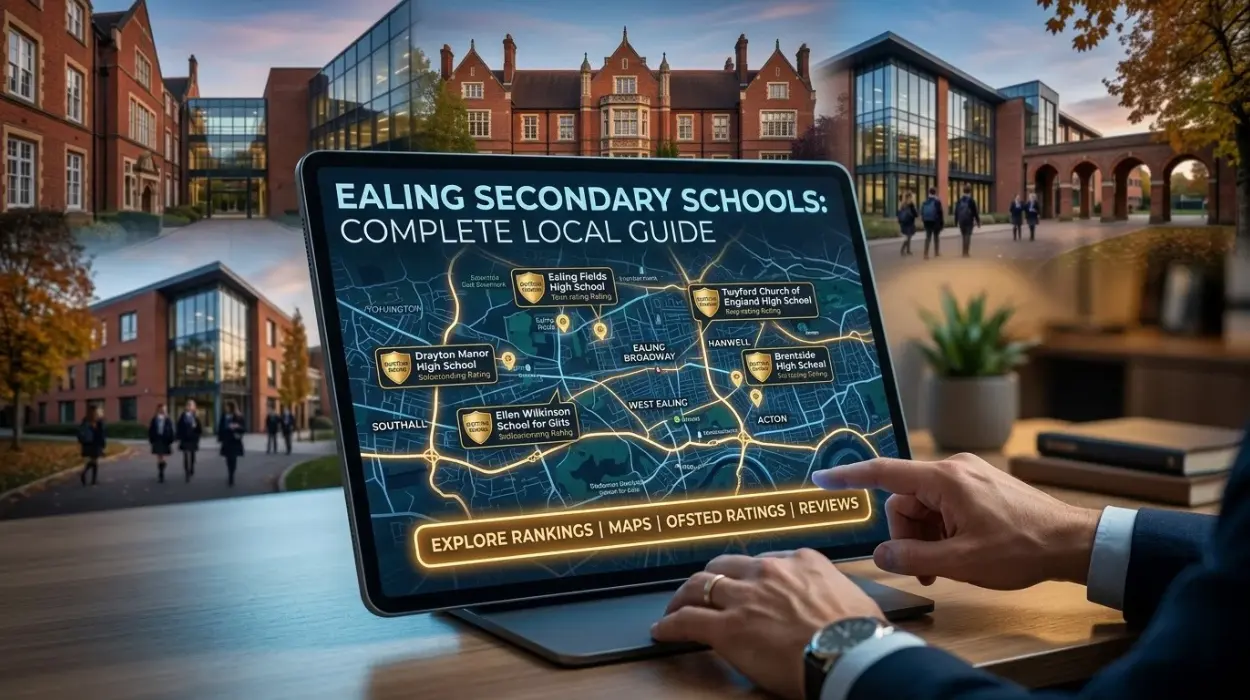
Choosing a secondary school is a major decision for families living in Ealing or planning to move to the area. Parents often search for top rated secondary schools in Ealing when comparing academic performance, Ofsted information, admissions criteria, school facilities and the wider educational environment.
Ealing, in west London, has a diverse secondary school landscape. Families can find comprehensive schools, academies, faith schools and other educational settings across neighbourhoods including Ealing, Acton, Northfields, Southall, Greenford, Northolt, Perivale and Hanwell. Each school has its own character, admission arrangements, curriculum and community.
While inspection outcomes and academic results can provide useful evidence, choosing a school should involve a broader assessment. A school that suits one child may not necessarily suit another, making it important to consider individual needs, travel arrangements, subjects, pastoral support and future educational plans.
Understanding Secondary Education in Ealing
Secondary education in England generally covers the years following primary school, with pupils progressing through Key Stages 3 and 4. Most pupils begin secondary school around the age of 11 and work towards GCSE qualifications during Years 10 and 11.
For families in Ealing, the transition from primary to secondary school usually requires careful planning. Parents need to understand application deadlines, admission criteria and the distance between their home and preferred schools.
Ealing’s secondary schools serve communities with varied cultural, social and educational backgrounds. This diversity can be an important consideration for families who want their children to learn in an inclusive and community-focused environment.
What Does “Top Rated” Mean for a Secondary School?
The phrase “top rated” can mean different things to different families. Some parents associate it with a strong Ofsted outcome, while others focus on GCSE results, sixth-form performance, extracurricular opportunities or pastoral care.
Ofsted inspections provide information about aspects of school quality, but an inspection judgement should not be treated as the only measure of a school’s suitability.
Academic results can also be useful, particularly when parents want to understand how pupils perform in GCSE or post-16 qualifications. However, results should be considered alongside the school’s curriculum, pupil intake and wider educational provision.
For example, a parent may prioritise strong science facilities because their child wants to study biology or chemistry later. Another family may give greater importance to music, sport, SEND support, languages or pastoral care.
Ofsted and Secondary Schools in Ealing
Ofsted is the Office for Standards in Education, Children’s Services and Skills. Its inspection work provides information about schools in England and can help parents understand areas such as education, behaviour, leadership and personal development, depending on the inspection framework.
When researching secondary schools, parents should look at the date of the most recent inspection and read the report rather than relying on a single label.
A school may have experienced changes in leadership, staffing, curriculum or pupil numbers since its previous inspection. Consequently, current school information can provide important additional context.
Parents should also remember that Ofsted information and examination results answer different questions. An inspection focuses on broader aspects of school provision, whereas examination results provide information about pupil outcomes.
Academic Performance and GCSE Results
GCSE performance is naturally important to many parents researching secondary education.
When comparing schools, families may examine measures relating to GCSE results, Progress 8, attainment and the proportion of pupils achieving key grades. These statistics can help parents understand academic outcomes, but they should be interpreted carefully.
A school’s results represent the performance of a particular group of pupils in a particular year. Results can therefore change over time.
Parents should also consider whether a school’s curriculum provides the subjects their child wants to study. A school with strong overall results may not necessarily offer every subject or combination that a particular pupil requires.
Ealing Secondary School Admissions
Admission arrangements are one of the most important practical issues for families.
Secondary schools publish their own admission criteria, although arrangements depend on the type of school and its governing structure. Criteria may include factors such as looked-after or previously looked-after children, siblings, medical or social circumstances, faith requirements for certain schools and distance from the school.
Being relatively close to a school does not automatically guarantee admission. Where a school receives more applications than available places, the published oversubscription criteria determine how places are allocated.
Parents should therefore read the current admission arrangements carefully rather than assuming that living within a particular neighbourhood guarantees a place.
Catchment Areas and Distance
The term “catchment area” is commonly used by parents, but school admissions do not always operate through a simple fixed geographical boundary.
Some schools use distance as one of their oversubscription criteria. In these circumstances, the distance between the child’s home and school can affect the likelihood of receiving a place, particularly when applications exceed available places.
For families considering a move to Ealing, it is sensible to investigate admission criteria before choosing a property based on a particular school.
Neighbourhoods such as Ealing Broadway, Acton, Southall, Greenford, Northolt, Perivale and Hanwell contain different schools, but the relevant admissions rules should always be checked for the specific school.
Secondary Schools Across Ealing’s Neighbourhoods
Ealing is geographically diverse, so location plays a major role in school research.
Families living around Ealing Broadway and West Ealing may consider schools that are accessible by walking, cycling or public transport. The area’s transport connections can also be useful for older pupils travelling independently.
Acton provides another substantial residential area with access to secondary education and transport links towards central London and other parts of west London.
Southall has a large and diverse community, with families often considering schools based on location, curriculum, admissions and educational support.
In Greenford, Northolt and Perivale, travel distance can become particularly relevant because families may compare schools across neighbouring parts of the borough.
Hanwell and Northfields are also residential areas where parents may consider secondary schools alongside local transport, sixth-form options and future education pathways.
Choosing a School Based on Your Child’s Needs
The best school for an individual child depends on more than rankings or inspection outcomes.
A pupil who enjoys science may benefit from well-developed laboratory facilities and a broad science curriculum. A child interested in sport may value extensive physical education and competitive opportunities. Another pupil may need strong pastoral support, learning assistance or a particularly structured environment.
SEND provision is especially important for families whose children require additional support. Parents can ask schools how they identify learning needs, communicate with families and provide appropriate adjustments.
It can also be useful to consider the transition from Year 6 to Year 7. A well-organised transition programme may help children adapt to a larger school environment, new teachers, different subjects and greater independence.
School Facilities and Extracurricular Activities
Facilities can influence the day-to-day experience of secondary pupils.
Parents may want to investigate science laboratories, libraries, sports halls, playing fields, performing arts spaces, music facilities, technology rooms and study areas.
Extracurricular activities can also contribute significantly to school life. Clubs may include sports, debating, drama, music, computing, languages, art and academic societies.
These activities can help pupils develop interests and skills outside the formal curriculum. However, availability can change from year to year, so families should check current school information.
Sixth Form and Future Education
For families thinking beyond GCSEs, sixth-form provision can be an important consideration.
Some secondary schools have their own sixth forms, while pupils may move to another sixth-form provider or further education college after Year 11.
Parents of older children can therefore investigate A-levels, vocational qualifications, subject availability, university preparation, careers advice and enrichment opportunities.
A school that provides education through to Year 13 may offer continuity, while another pupil may prefer to move to a specialist sixth-form environment after GCSEs.
Visiting Secondary Schools Before Applying
A school visit can reveal information that is difficult to understand from online research alone.
During an open evening, parents can observe the school environment, speak with staff and ask about curriculum choices, behaviour policies, pastoral support and extracurricular activities.
Parents may also want to ask how the school communicates with families, manages homework and supports pupils during examinations.
The journey to school should also be considered. A school may appear attractive academically, but a long or complicated daily commute could affect a child’s routine.
For younger secondary pupils, families may initially need to accompany them, while older pupils may eventually travel independently using London’s public transport network.
How to Compare Ealing Secondary Schools
Creating a comparison checklist can make the process easier.
Parents can record each school’s latest inspection information, GCSE outcomes, admission criteria, distance from home, curriculum, SEND provision, extracurricular opportunities and transport options.
It is useful to distinguish between objective information and personal preferences. For example, examination results are measurable data, while opinions about school atmosphere are more subjective.
Speaking with current parents can provide another perspective, but personal experiences should be treated as individual accounts rather than universal evidence.
The most reliable approach is to combine official information with school visits and questions that relate specifically to the child’s needs.
Planning Ahead for Secondary School Applications
Families should begin researching schools well before the application deadline.
The secondary school application process normally involves applying through the relevant local authority, with parents ranking their preferred schools according to the applicable process.
Dates and procedures can change, so families should use current official guidance when preparing an application.
Parents should also consider backup choices. If a highly sought-after school is oversubscribed, having several realistic preferences can make the application process less dependent on one outcome.
Families moving to Ealing from another part of the UK or overseas should start early because they may need to understand both the admissions process and the structure of English secondary education.
Researching top rated secondary schools in Ealing involves much more than checking a school ranking. Ofsted information, examination outcomes, admission criteria and school facilities can provide valuable evidence, but they should be considered alongside the individual needs of the child.
Location is another major factor for Ealing families. Schools across Ealing, Acton, Southall, Greenford, Northolt, Perivale, Hanwell and Northfields can differ in admissions arrangements and accessibility.
Parents can make the process more manageable by creating a shortlist, reading current school information, checking admission criteria, visiting schools and considering both academic and practical factors.
Ultimately, the most useful comparison is one that looks at the complete educational experience: teaching, curriculum, wellbeing, support, opportunities, community and the child’s ability to thrive throughout secondary school.
Frequently Asked Questions
What are the top rated secondary schools in Ealing?
There are several well-regarded secondary schools in and around Ealing, but parents should compare current Ofsted information, academic outcomes, admissions criteria, curriculum and individual school provision rather than relying on a single ranking.
How do I choose a secondary school in Ealing?
Start by considering your child’s educational needs, then compare schools based on location, admission criteria, curriculum, inspection information, academic results, SEND provision, extracurricular activities and school visits.
Does living near an Ealing secondary school guarantee admission?
No. Admission depends on the school’s published criteria and the number of applications received. Distance may be one factor where schools are oversubscribed, but living nearby does not automatically guarantee a place.
When should I apply for a secondary school place in Ealing?
Parents should follow the current secondary school application timetable published by the relevant local authority. Starting research early allows families enough time to compare schools and understand admission requirements.
Are Ofsted ratings important when choosing a secondary school?
Ofsted reports can provide useful information about school provision, but they are only one source of evidence. Parents should also consider curriculum, academic outcomes, pastoral support, facilities and their child’s individual needs.
Which areas of Ealing have secondary schools?
Secondary schools serve communities across areas including Ealing, Acton, Southall, Greenford, Northolt, Perivale, Hanwell and surrounding neighbourhoods. Exact admission eligibility depends on each school’s arrangements.
Should I visit an Ealing secondary school before applying?
Yes, where possible. Visiting a school can help parents understand its environment, teaching approach, facilities, behaviour expectations, pastoral support and extracurricular opportunities before making their preferences.