

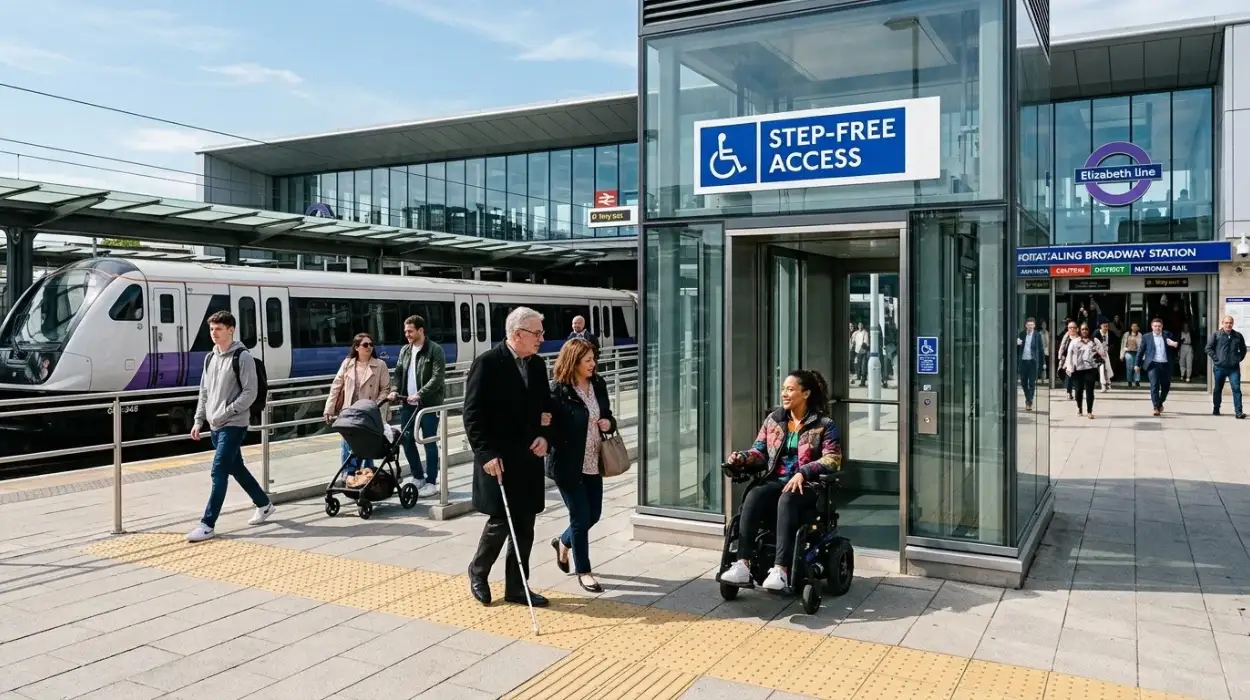
Getting around London by public transport can be very different for disabled commuters, wheelchair users, people with limited mobility, passengers travelling with mobility aids and anyone who finds stairs or platform gaps difficult to manage. In Ealing, accessibility has improved significantly through newer rail infrastructure and step-free facilities, but access is not identical at every station or on every route.
Ealing is served by several Underground stations, Elizabeth line stations and National Rail connections, including Ealing Broadway, West Ealing, Hanwell, Southall, Acton Main Line, Acton Town, Ealing Common and South Ealing. The practical accessibility of a journey depends not only on whether a station has a lift, but also on platform access, train-to-platform gaps, accessible toilets, boarding ramps, staff assistance and whether a lift is working on the day.
For disabled commuters and visitors, the most important question is therefore not simply whether an Ealing station is accessible. It is whether the complete journey from the street to the train and then to the destination can be completed without unexpected barriers.
What Does Accessibility Mean At Ealing Stations?
Station accessibility covers several different needs. Step-free access generally means that a passenger can reach a platform without using stairs, although the exact arrangement can involve lifts, ramps or level routes. It does not automatically mean that there is no gap between the platform and train.
Other useful facilities include accessible toilets, help points, boarding ramps, tactile paving, visual and audio information, accessible ticket facilities and designated assistance arrangements.
This distinction matters because a station may have a lift but still present difficulties for a wheelchair user if the train has a significant platform gap. TfL’s Tube accessibility information specifically considers the gap between platform and train and provides guidance on step-free journeys.
For commuters, accessibility also includes reliability. A working lift at 8am can make a journey straightforward, while a faulty lift can suddenly make the same route unsuitable. TfL station pages therefore provide live access information alongside normal station facilities.
Ealing Broadway Is One Of The Most Important Accessible Transport Hubs
Ealing Broadway is particularly significant because it combines the Central line, District line, Elizabeth line and National Rail services. The station has lifts and is equipped with several facilities intended to support accessible travel. Its Elizabeth line platforms are step-free, and the station has boarding ramps, help points, accessible toilets and waiting facilities.
The Elizabeth line has strengthened Ealing’s accessible transport network. TfL’s current Elizabeth line accessibility policy lists Ealing Broadway among the stations with step-free access to all platforms. Elizabeth line trains also have wheelchair spaces, priority seating and audio and visual passenger information.
For a wheelchair user travelling from Ealing Broadway towards central London, the Elizabeth line can therefore provide a useful step-free option. However, the accessibility of the destination station must also be checked. A step-free departure from Ealing does not guarantee a step-free arrival elsewhere.
Ealing Broadway also demonstrates why accessibility should be considered by individual route rather than simply by station name. Underground and Elizabeth line services use different infrastructure, so passengers should check the accessibility details for the specific service they intend to board.
West Ealing And Hanwell Offer Elizabeth Line Connections
West Ealing and Hanwell are important rail stations for residents living away from Ealing Broadway. Both are served by the Elizabeth line and provide features such as boarding ramps and help points.
TfL’s Elizabeth line accessibility policy identifies West Ealing and Hanwell among stations with step-free access to all platforms under normal conditions.
However, real-world accessibility can change temporarily. At the time of checking, TfL reported a lift-related loss of step-free access at West Ealing. TfL also reported a temporary lift issue affecting one platform at Hanwell. These examples demonstrate why checking live station information before travelling is particularly important for anyone who cannot use stairs.
A commuter who normally uses Hanwell may therefore need a contingency route if a lift is unavailable. Planning an alternative station, bus connection or assistance arrangement in advance can prevent an unexpected barrier during a daily journey.
Southall Station Has Strong Accessibility Infrastructure But Check Lift Status
Southall is another important Elizabeth line station for people travelling between Ealing and areas further west. The station has boarding ramps, help points, toilets and waiting facilities. TfL’s Elizabeth line accessibility policy lists Southall as having step-free access to all platforms.
Nevertheless, TfL was also reporting a temporary accessibility problem at Southall involving the lift serving platforms 2 and 3. This illustrates one of the most important realities of accessible rail travel: published infrastructure and live operational accessibility are not always the same thing.
For a passenger travelling towards Heathrow or Reading, checking the current platform and lift status before leaving home is particularly sensible. If the usual platform is inaccessible, the passenger may need to change the planned station or contact the operator for assistance.
What About Acton Main Line?
Acton Main Line provides another Elizabeth line and National Rail connection in the wider Ealing area. Its station facilities include boarding ramps, help points and toilets. TfL’s Elizabeth line accessibility policy identifies Acton Main Line as a station with step-free access to all platforms.
However, current operational information shows why passengers should not rely solely on a general accessibility map. TfL has recently reported temporary loss of step-free access to a platform at Acton Main Line because of a faulty lift.
For a regular wheelchair user, this can make journey planning more complex. If the lift serving the required platform is unavailable, the practical solution may involve travelling from another station rather than simply arriving earlier.
Are Ealing’s Underground Stations Fully Step-Free?
Ealing has several Underground stations, but Underground accessibility varies considerably. Ealing Broadway has lifts and provides a major interchange, while stations such as Ealing Common and South Ealing have different accessibility arrangements and should be checked individually before travel. TfL provides a dedicated step-free Tube guide showing station and platform accessibility information.
Acton Town is another important interchange, serving the District and Piccadilly lines. TfL lists lifts among its station facilities, but passengers should still check the specific step-free route and train boarding conditions before travelling.
This is especially relevant because Underground accessibility is not just about entering the station. A passenger may need to consider whether the particular platform is accessible, whether the train has an appropriate boarding arrangement and whether any interchange during the journey introduces stairs.
Why The Gap Between Platform And Train Matters
One of the most overlooked accessibility issues is the distance or height difference between a platform and the train. For someone walking normally, a small gap may be insignificant. For a wheelchair user, it can determine whether independent boarding is possible.
TfL’s accessibility guidance categorises platform-to-train gaps and provides information to help passengers understand the conditions at different stations. Staff can also arrange assistance and boarding ramps where required.
This means that “step-free station” should not automatically be interpreted as “every wheelchair user can board every train independently”. The exact combination of station, platform, train and direction matters.
Can Disabled Passengers Get Assistance At Ealing Stations?
Yes. Accessible travel assistance is an important part of London’s public transport system. Passengers who need help can plan assistance for boarding, changing trains and completing their journey.
Help points are available at several Ealing-area rail stations, including Ealing Broadway, West Ealing, Hanwell, Southall and Acton Main Line. TfL also provides accessibility information and telephone support for passengers who need help planning a journey.
Assistance can be particularly useful when a passenger is unfamiliar with a station. A visitor travelling to Ealing for the first time may not know which entrance has step-free access or where to meet staff, while a daily commuter may already know the most convenient accessible route.
How Should Disabled Commuters Plan A Journey Through Ealing?
The safest approach is to plan the entire journey rather than checking only the departure station. Start by identifying the most suitable station, then check whether the required platform is step-free and whether the train provides an appropriate boarding arrangement.
Next, check live service information shortly before leaving. Lift faults, engineering works and temporary station restrictions can change the accessibility of a route. This is particularly important because recent TfL information has shown temporary lift-related restrictions at West Ealing, Hanwell, Southall and Acton Main Line.
It is also worth considering the destination. If Ealing Broadway is accessible but the destination station has no suitable step-free route, the overall journey may still be difficult. Where possible, identify an alternative accessible station or route before travelling.
Travelling outside the busiest periods may also make navigation easier for some passengers. TfL provides predicted quieter periods on station pages, although quieter travel does not change the underlying accessibility facilities.
What Should Visitors To Ealing Know?
Visitors with disabilities should avoid assuming that London’s public transport network works identically at every station. Ealing Broadway is particularly useful because it combines several transport modes and has extensive accessible facilities, including lifts and step-free Elizabeth line platforms.
Before visiting attractions, hotels, restaurants or shopping areas in Ealing, it can be useful to identify the nearest accessible station and then check the final walking route. Pavements, crossings, roadworks and street gradients can affect a journey even when the station itself is accessible.
For international visitors, checking accessibility information before travelling is especially valuable because station layouts, platform arrangements and assistance procedures may be unfamiliar.
Accessibility Is Improving, But Live Information Still Matters
Ealing’s transport network has benefited from major investment, particularly through the Elizabeth line. Several local Elizabeth line stations are designed with step-free access, modern passenger information and facilities such as boarding ramps and help points.
At the same time, accessibility is not a fixed characteristic. Lifts can fail, platforms can become temporarily inaccessible and engineering work can change a route. The experience of a disabled commuter therefore depends on both permanent infrastructure and current operational conditions.
The most useful way to think about Ealing transport accessibility is as a complete journey: street entrance, ticketing area, lift or ramp, platform, train boarding, interchange and destination. Checking each stage can make travel considerably more predictable.
For disabled commuters, wheelchair users and visitors, Ealing offers several genuinely useful accessible transport options, particularly around the Elizabeth line. However, the need to check live station information remains essential. A station advertised as step-free under normal conditions may temporarily become unsuitable because of a lift fault or other operational issue.
Frequently Asked Questions
Which Ealing station is easiest for wheelchair users?
Ealing Broadway has extensive accessible facilities and step-free access to all Elizabeth line platforms. Its combination of lifts, boarding ramps, help points and multiple transport connections makes it an important accessible interchange.
Is Ealing Broadway Underground Station wheelchair accessible?
Ealing Broadway has lifts and accessibility facilities, but passengers should check the specific Underground route and platform-to-train conditions before travelling. Elizabeth line accessibility is particularly comprehensive, with step-free access to all platforms.
Is the Elizabeth line accessible for wheelchair users?
Elizabeth line trains include wheelchair spaces and priority seating, while many stations have step-free platform access. Ealing Broadway, West Ealing, Hanwell, Southall and Acton Main Line are included in TfL’s step-free Elizabeth line station information.
Can disabled passengers get help boarding trains in Ealing?
Yes. Boarding ramps, help points and staff assistance are part of accessible rail travel arrangements. Passengers who need assistance should plan ahead and check the relevant operator’s current guidance.
Are lifts at Ealing stations always working?
No. Lift faults can temporarily remove step-free access. TfL has recently reported temporary lift-related restrictions at several Ealing-area stations, including West Ealing, Hanwell, Southall and Acton Main Line.
Is Ealing Common Underground Station step-free?
Accessibility should be checked directly with TfL before travelling because the station has different facilities from Ealing Broadway and does not have the same level of interchange infrastructure. TfL provides station-specific step-free information for Ealing Common.
What should disabled commuters check before travelling from Ealing?
Check the station’s current lift status, the accessibility of the required platform, train boarding arrangements, any interchange requirements and the accessibility of the destination station. This is more reliable than assuming that a station’s normal accessibility status will apply on every day.