

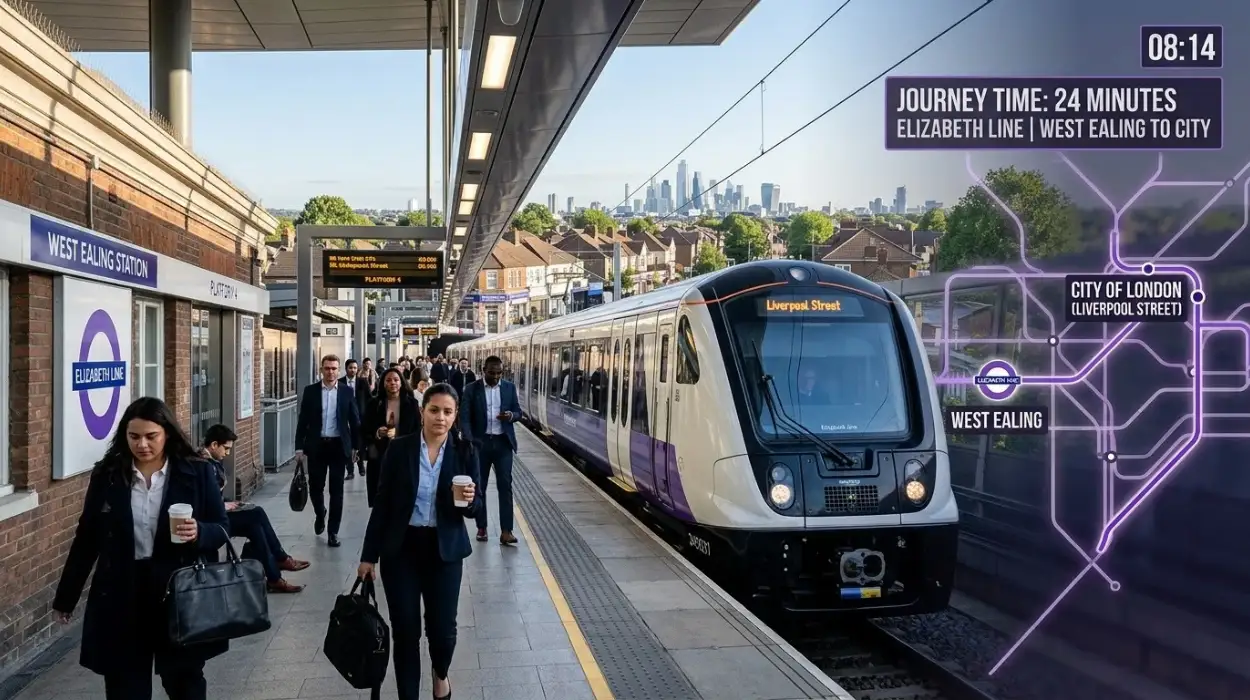
For people living in West Ealing, travelling into the City of London is a regular journey for work, business, appointments and sightseeing. The distance can look considerable on a London map, but modern rail connections make the journey relatively straightforward.
The answer to how long do commutes take from West Ealing to the City depends on exactly where in the City you are going, where you start in West Ealing and which transport connection you use. For many journeys, the Elizabeth line provides the simplest rail connection towards central and eastern London, while travelling via Ealing Broadway and the Central line can be useful for destinations around the City and the wider West End.
West Ealing station is on Manor Road and is served by the Elizabeth line. Transport for London also provides live departure information and journey-planning tools, so actual travel times should always be checked before setting off.
What Is The Typical Commute From West Ealing To The City?
For a typical weekday journey, a reasonable planning estimate is around 30 to 45 minutes from West Ealing station to a City destination, depending on the exact destination and interchange required.
The train journey itself can be shorter than the complete commute. Someone living five or ten minutes’ walk from West Ealing station may have a different door-to-door experience from someone living further towards Hanwell, Drayton Green, Northfields or Ealing Broadway.
Similarly, arriving at Liverpool Street does not necessarily mean arriving at your workplace. A City office near Bank, Moorgate, Fenchurch Street or Monument may require additional walking or an onward Tube connection.
For this reason, commuters should think in terms of door-to-door travel time, rather than simply asking how many minutes the train takes.
Why The Elizabeth Line Is Important For West Ealing
The Elizabeth line has changed the way many people travel between west London and the City.
From West Ealing, eastbound Elizabeth line services travel towards central London and continue towards destinations including Farringdon, Liverpool Street and Canary Wharf. TfL describes the Elizabeth line as running from Heathrow and Reading through central London, including the West End and the City, towards destinations in east London.
This is particularly useful for commuters whose workplace is around Farringdon, Liverpool Street, Broadgate, the City of London or Canary Wharf.
Instead of changing trains several times, many passengers can remain on the same Elizabeth line service for a substantial part of the journey.
The line also provides connections with other parts of London’s transport network, making it useful beyond the City itself.
West Ealing To Liverpool Street
Liverpool Street is one of the most useful reference points when discussing a West Ealing to City commute.
A commuter travelling to the Liverpool Street area can take an eastbound Elizabeth line train directly from West Ealing. From Liverpool Street, passengers can continue on foot or connect with other London Underground and rail services depending on their final destination.
Liverpool Street is particularly convenient for people working around Bishopsgate, Broadgate, Spitalfields, Moorgate and the eastern side of the City.
The station itself has connections with Tube, bus and rail services, giving commuters several options once they arrive.
The precise timetable varies by date and service pattern, so commuters should use the current TfL timetable or journey planner when planning a particular morning journey. TfL publishes current Elizabeth line timetables and directs passengers to its journey-planning tools.
West Ealing To Farringdon
Farringdon is another important destination for people commuting into central London.
It has become especially significant because it connects the Elizabeth line with other rail and Underground services. For someone working around Farringdon, Clerkenwell, Smithfield or Holborn, travelling via the Elizabeth line can provide a convenient route.
A major advantage is that the commuter does not necessarily need to travel all the way to Liverpool Street before reaching the central London employment areas.
The best station to use depends on the location of the workplace. Someone working near Farringdon may save walking time by getting off there, while a person whose office is closer to Moorgate may find Liverpool Street more practical.
West Ealing To Bank And The Heart Of The City
Bank is one of the most recognisable financial centres in the City of London, serving areas around Threadneedle Street, Cornhill, Mansion House and Lombard Street.
There is no Elizabeth line station directly at Bank, so the best route depends on the exact starting point and final destination.
One option is to travel by Elizabeth line to Liverpool Street and continue by walking or using the Underground. Another possibility is travelling from West Ealing towards Ealing Broadway and then using the Central line towards central London, depending on the destination and current service conditions.
TfL’s Central line timetable shows Ealing Broadway services travelling through central London, including Oxford Circus, Tottenham Court Road and onward towards stations such as St Paul’s and Liverpool Street.
The most efficient choice therefore depends on whether the priority is fewer changes, a particular station or the shortest overall walking distance.
Using Ealing Broadway And The Central Line
West Ealing residents are not limited to West Ealing station.
Depending on where someone lives, Ealing Broadway may be more convenient. It is served by the Elizabeth line, Central line and District line, giving commuters several ways to travel into London.
The Central line can be particularly useful for people whose destination is around Oxford Circus, Tottenham Court Road, Holborn, St Paul’s or Liverpool Street.
For example, a commuter working near St Paul’s might compare an Elizabeth line journey towards Farringdon or Liverpool Street with a Central line journey from Ealing Broadway.
The important point is that the “fastest” route can change according to the final walking section. A train route that saves two minutes may not save time overall if it leaves the passenger with a much longer walk.
How Peak-Time Commuting Changes The Experience
A timetable might suggest a straightforward journey, but weekday peak travel has another factor: passenger demand.
Morning trains towards central London can be busy, particularly during conventional office commuting periods. Crowding can affect comfort even when the scheduled journey time remains unchanged.
For commuters, leaving home slightly earlier can sometimes make the overall experience easier. This is particularly relevant for people carrying laptops, luggage, work equipment or other items.
Service disruption is another consideration. London transport operates a large interconnected network, and delays on one route can affect alternative connections.
Checking the TfL status before leaving home is therefore more useful than relying on yesterday’s journey time.
How Long Is The Door-To-Door Commute?
A realistic West Ealing to City commute should include several stages:
Home to station: This might involve walking, cycling or a short bus journey.
Waiting time: Even frequent services involve some waiting.
Train journey: The Elizabeth line provides the main direct rail connection from West Ealing towards central and eastern London.
Walking or interchange: After reaching Farringdon or Liverpool Street, you may still need to walk or change transport.
Workplace arrival: Your final destination could be several streets from the station.
For example, someone living eight minutes from West Ealing station and working ten minutes’ walk from Liverpool Street could potentially have a much shorter door-to-door journey than someone living 20 minutes from the station and working deep inside the City.
This is why an advertised rail journey time should not automatically be treated as the total commute.
What Is The Best Route For Different City Workplaces?
The best route depends on the neighbourhood rather than simply the word “City”.
For Liverpool Street and Bishopsgate, the Elizabeth line is a natural option from West Ealing.
For Farringdon and Clerkenwell, an Elizabeth line journey to Farringdon can be useful.
For Bank and Monument, commuters may compare Liverpool Street with other routes depending on their exact workplace.
For St Paul’s, the Central line from Ealing Broadway can be worth comparing with Elizabeth line alternatives.
For Canary Wharf, staying on the Elizabeth line can provide a particularly straightforward eastbound journey.
For Holborn, a Central line journey from Ealing Broadway may be convenient because the line serves Holborn directly.
This destination-based approach is more useful than assuming one route works equally well for every City commuter.
Is West Ealing A Practical Base For City Workers?
For people considering living in West Ealing, transport access is one of the area’s practical considerations.
The presence of West Ealing station means residents have access to the Elizabeth line, while nearby Ealing Broadway offers additional rail and Underground choices.
West Ealing station is also step-free to all platforms, according to National Rail, and has lifts, accessible toilets and passenger assistance.
This can matter to commuters with mobility requirements, parents travelling with children or anyone carrying larger items.
The area also offers a different residential environment from central London while remaining connected to major employment districts.
What About Commuting From Nearby Parts Of Ealing?
Someone searching for a West Ealing commute may actually live in Hanwell, Drayton Green, Northfields, Ealing Broadway or Perivale.
The most suitable station can therefore vary.
Hanwell has its own Elizabeth line station, while Ealing Broadway provides access to several transport modes. Someone living close to Northfields may prefer walking to Ealing Broadway or using the Central or District line depending on their destination.
For residents further west, travelling to West Ealing station by bus, bicycle or on foot can add time to the overall journey.
This is why local geography matters when estimating commuting time.
Tips For Making The West Ealing To City Commute Easier
Check the live service status before leaving home, particularly during bad weather, engineering works or major events.
Allow additional time for the first few journeys if you are new to the area. Learning the walking route between a City station and your workplace can make a noticeable difference.
If you have flexible working hours, compare different departure times rather than assuming the standard 8am or 9am journey is your only option.
It is also worth having an alternative route. A commuter who normally uses the Elizabeth line may benefit from knowing how to reach Ealing Broadway and use the Central line if disruption occurs.
For visitors staying in West Ealing, the same advice applies. The Elizabeth line can provide a useful connection into central London, but the final destination should determine where you get off.
Planning Your Journey From West Ealing
The simplest way to estimate your commute is to enter your exact home area and workplace into the current TfL journey planner.
West Ealing station is located on Manor Road, W13 0LJ, and current TfL information provides live departures, service information and Elizabeth line timetable details.
Remember to compare total journey time, number of changes, walking distance and service reliability, rather than looking only at the train duration.
For someone commuting five days a week, a difference of even ten minutes each way can become significant over a month.
Understanding Your West Ealing To City Journey
So, how long do commutes take from West Ealing to the City?
For many passengers, around 30 to 45 minutes is a useful planning range from the station to a central or City destination, although the actual time can be shorter or longer depending on the destination, interchange, walking distance, waiting time and service conditions.
The Elizabeth line is the key direct connection from West Ealing towards central and eastern London, while Ealing Broadway and the Central line provide another important option.
The most useful approach is to plan around the specific City destination. Liverpool Street, Farringdon, Bank, St Paul’s, Holborn and Canary Wharf each have different transport advantages.
For residents, workers and visitors alike, understanding these differences makes it easier to plan a realistic journey rather than relying on a single headline travel time.
Frequently Asked Questions
How long does it take from West Ealing to the City of London?
A typical journey from West Ealing station to a City destination can be planned at around 30 to 45 minutes, although the actual time depends on the destination, walking distance, interchange and service conditions.
Is there a direct train from West Ealing to Liverpool Street?
Yes. West Ealing is served by the Elizabeth line, which provides eastbound services towards Liverpool Street and other central and eastern London destinations. Always check the current timetable before travelling.
Is the Elizabeth line the best way to travel from West Ealing to the City?
The Elizabeth line provides a direct connection towards major City-area destinations such as Farringdon and Liverpool Street. The most suitable route depends on the exact location of your workplace.
Can I travel from West Ealing to Bank without changing?
Bank does not have an Elizabeth line station. Depending on your starting point and destination, you may need to walk or make an onward Tube connection from another central London station.
Is Ealing Broadway useful for commuting to the City?
Yes. Ealing Broadway provides access to the Central line as well as the Elizabeth line and District line. The Central line can be useful for destinations including Holborn and St Paul’s.
Does peak time make the West Ealing commute longer?
Peak travel can make the overall experience less comfortable and may involve more crowded trains and longer interchange or walking times. Service disruption can also affect journey times.
How can I check the exact journey time from West Ealing?
Use the current TfL journey planner and live departure information. Enter your exact starting point and workplace because walking, interchange and station choice can significantly affect the total journey time.