
Getting around the London Borough of Ealing by bus can be surprisingly convenient because the borough has an extensive network connecting Ealing Broadway, Acton, Hanwell, Greenford, Perivale, Southall, Northolt and neighbouring areas. For people who want to explore beyond a railway station or Underground stop, buses often provide a more direct way to reach residential streets, shopping areas, parks, hospitals and local attractions.
The question of the best bus routes across Ealing Borough depends on where you are starting, where you want to go and whether you value a direct journey, a frequent service or access to a particular neighbourhood. Routes such as the E1, E2, E7, E8, E9, 65, 207, 297 and 483 serve different travel needs, while routes such as the E5, E6 and E10 connect important parts of west London. TfL’s live information also shows that several services meet around Ealing Broadway, making it an important interchange for local bus travel.
Why Buses Are Important Across Ealing Borough
Ealing is a large and varied west London borough. A journey between Greenford and Southall, for example, is very different from travelling between Ealing Broadway and Brentford. The bus network helps connect areas that are not always directly linked by rail.
For local residents, buses can be useful for shopping, school journeys, work, healthcare appointments and visiting family. Tourists may use them to reach parks, high streets and neighbourhoods that are away from the main Underground stations.
Another advantage is that buses can provide a closer-to-the-door journey. Ealing Broadway, Greenford and Southall stations are major transport points, but not every destination is immediately next to a station. A bus can complete the final part of the journey without requiring another railway connection.
Ealing Broadway As A Major Bus Hub
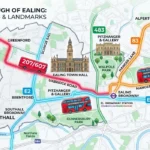
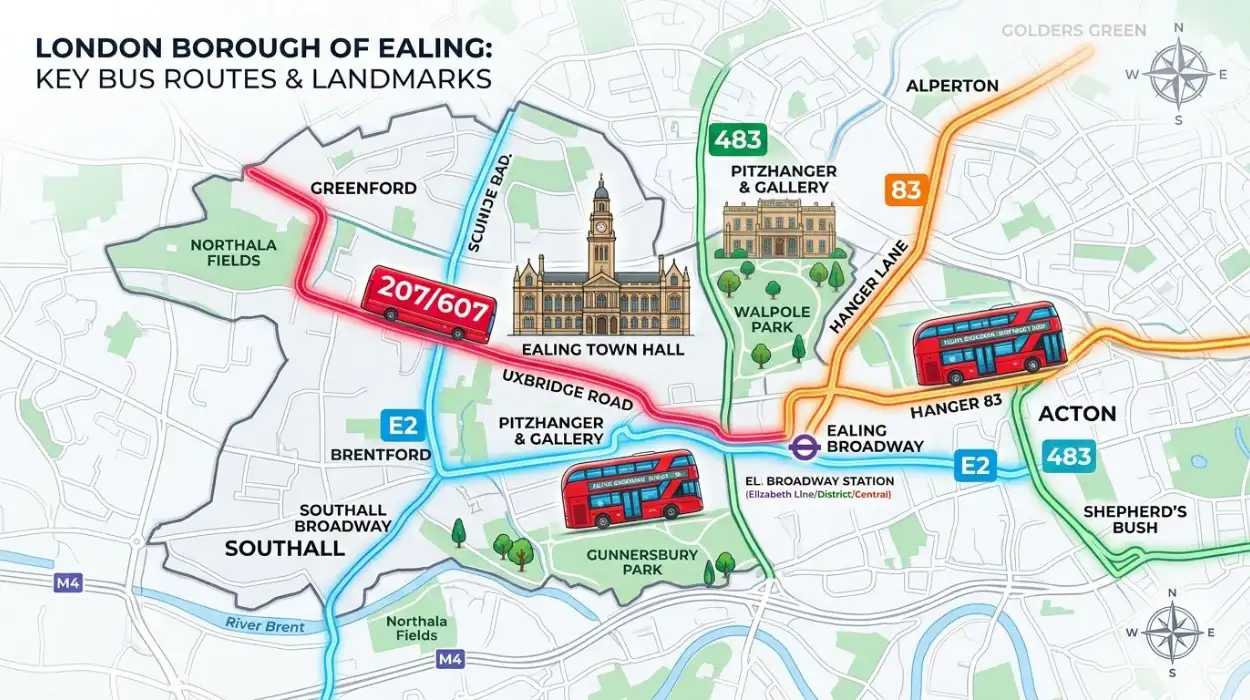
Ealing Broadway is one of the most useful places to understand the borough’s bus network. TfL currently lists routes including the 207, 483, E11 and SL8 around the station, while other stops around Haven Green serve routes such as the 297, E7, E8, E9 and E10.
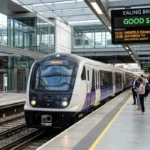
The station also connects with the Elizabeth line, Central line and District line. This creates useful combinations between bus and rail.
For example, someone living around Northolt might take a local bus towards Ealing Broadway before continuing by rail. Another passenger could use a bus from Ealing Broadway to reach a residential area that is not immediately served by a Tube station.
The important point is that there is not one single “best” bus route for the whole borough. The most suitable service changes according to the journey.
The E1 For Greenford And Ealing Broadway Connections
The E1 is particularly relevant to journeys between Greenford and Ealing Broadway. TfL route information identifies E1 services between Ealing Broadway and the Greenford area, making it useful for residents travelling across this part of the borough.
This type of route is valuable when a passenger needs to travel between residential areas and Ealing Broadway without changing buses.
A practical example would be a Greenford resident travelling to Ealing Broadway for shopping, work or a connection with the Elizabeth line. Instead of driving into central Ealing, the bus can provide a local public transport option.
The E2 For Greenford, West Ealing And Brentford
The E2 provides another important east-west connection. TfL information shows the route linking Greenford and Ealing Broadway with West Ealing, Northfields and Brentford, including Commerce Road.
This makes the E2 useful for people travelling across several neighbourhoods rather than simply heading towards Ealing town centre.
For visitors, the route can also be useful when exploring the western side of Ealing and continuing towards Brentford. For residents, it provides a connection between housing areas, local shopping streets and transport interchanges.
The E5 For Perivale, Greenford And Southall
The E5 is particularly useful when travelling between Perivale, Greenford and Southall. TfL route information identifies stops and destinations including Perivale, Greenford and Southall.
This route is relevant for everyday journeys because these areas contain major residential communities, shops, schools and other local facilities.
Someone travelling from Perivale towards Southall may find a bus more practical than travelling into central London and changing transport. The E5 therefore illustrates how Ealing’s bus network supports cross-borough movement rather than simply feeding passengers into railway stations.
The E7 For Ealing, Greenford, Northolt And Ruislip
The E7 is another major west London route. TfL information shows the service connecting Ealing Broadway with West Ealing, Greenford, Yeading and Ruislip.
This makes it useful for passengers travelling across the western side of Ealing and beyond the borough.
For a Northolt or Greenford resident, the E7 can provide a direct connection towards Ealing Broadway. For visitors staying around Ealing Broadway, it can also be useful for exploring further west without first travelling into central London.
Because route destinations can vary according to service patterns, passengers should check the live destination and timetable before boarding.
The E8 For Ealing, Hanwell And Brentford
The E8 provides an important connection through Ealing and towards Brentford and Hounslow. Current TfL information shows E8 services around Ealing Broadway and destinations including Hounslow Bell Corner.
The route can be useful for Hanwell and West Ealing residents who need to reach Brentford or Hounslow without making a journey through central London.
For tourists, this can be useful when exploring the western part of the capital. For locals, it can provide a practical alternative to driving, particularly when the destination lies along the route.
The E9 For Greenford, Ealing And Yeading
The E9 connects Ealing Broadway with areas including Greenford and Yeading, with TfL identifying Barnhill Estate as one of its destinations.
This makes the E9 useful for journeys across the northern and western parts of the borough.
It can be especially relevant for residents who live away from Ealing Broadway but still need access to the town centre. The route also demonstrates why checking the exact destination is important: several E-series buses use similar corridors but serve different neighbourhoods.
The 65 For Ealing And Kingston
The 65 provides a longer west London journey, connecting Ealing Broadway with Kingston. TfL’s current stop information shows the 65 operating at Ealing Broadway Centre, while Kingston Station also lists the 65 among its services.
This makes the route useful for passengers travelling beyond Ealing Borough rather than simply moving between Ealing neighbourhoods.
A resident travelling towards Kingston may prefer the direct bus rather than combining several Underground or railway services. The route can also be useful for visitors interested in exploring different parts of west and south-west London.
The 207 For Ealing Broadway And Hayes
The 207 is an important route around Ealing Broadway and west London. TfL’s current timetable shows buses operating from Ealing Broadway towards Hayes By-Pass, with services scheduled regularly throughout much of the daytime and evening.
This makes the 207 relevant for journeys between Ealing and areas further west, particularly when passengers want a direct bus rather than multiple changes.
Because the route can be busy, travellers should check live arrivals when planning a time-sensitive journey. TfL provides live bus information and route performance information, allowing passengers to see current service conditions.
The 483 For Ealing Hospital And Harrow
The 483 is useful for connecting Ealing with areas towards Harrow. TfL’s route information shows 483 services around Ealing Broadway and Ealing Hospital, while the route also serves Harrow Bus Station.
This is particularly relevant for residents travelling towards Ealing Hospital or further north-west.
For healthcare journeys, knowing the correct stop is important because arriving at the right hospital entrance or nearby stop can reduce the amount of walking required.
The 297 For Ealing, Northolt And Willesden
The 297 provides another cross-west-London connection and is particularly useful around Ealing Broadway, Northolt and Willesden. TfL currently lists the 297 around Ealing Broadway and other stops, while route information also shows it operating towards Willesden Bus Garage.
For local residents, this can be useful when travelling between Ealing and areas north-east of the borough.
The route also operates overnight as part of the wider night bus network on sections of its route, although passengers should always check the current timetable before travelling late at night.
Which Bus Routes Are Useful For Tourists?
Tourists staying in Ealing have several practical choices. Ealing Broadway is an obvious starting point because it combines rail, Underground and bus services.
A visitor heading towards Greenford may look at routes such as the E1, E2, E7 or E9 depending on the exact destination. Someone travelling towards Brentford can consider the E2 or E8. For a longer journey towards Kingston, the 65 provides a direct bus connection from Ealing Broadway.
The key is to plan around the destination rather than choosing a bus simply because its route number is familiar.
How To Choose The Right Ealing Bus Route
The easiest approach is to identify the nearest bus stop to both your starting point and destination. Then check the live TfL route information.
This matters because a route can have several stops in the same neighbourhood, and the correct direction is just as important as the route number.
For example, someone travelling from Ealing Broadway towards Ruislip needs to look for the E7 towards Ruislip rather than simply boarding the first E-series bus that arrives. Similarly, someone heading towards Brentford needs to distinguish between relevant routes and check the displayed destination.
TfL also publishes route performance information for London’s bus network. Its Quality of Service Indicators are designed to show reliability and the additional waiting time passengers experience because of irregularity.
Buses For Everyday Ealing Journeys
For everyday travel, buses can be particularly valuable for short and medium-distance journeys. A resident might use the E5 for a journey between Perivale and Southall, the E7 between Ealing and Ruislip, or the E8 towards Brentford and Hounslow.
The bus network is also useful when railway stations are inconveniently located. Someone may live several streets from a Tube or Elizabeth line station but have a bus stop close to their home.
For older residents and people who find conventional public transport difficult to use, Ealing Council also provides information about community transport, including Ealing Community Transport, Taxicard and other accessibility-related schemes.
How To Check Ealing Bus Times Before Travelling
Bus times can change because of traffic, roadworks, diversions, special events and service alterations. A printed timetable or an old route map should therefore not be treated as the final word.
TfL’s website provides live arrivals, route information and timetables for individual stops. The Ealing Broadway station pages, for example, display live services and route information for buses including the E2, E7 and E8, as well as other services at nearby stops.
For a journey with a fixed appointment, flight or train connection, checking shortly before departure is especially important.
There is no single bus route that is the right choice for every journey across Ealing Borough. The E-series routes form an important local network linking places such as Ealing Broadway, Greenford, Perivale, Southall, Hanwell, Northolt and neighbouring areas, while routes such as the 65, 207, 297 and 483 extend connections beyond individual neighbourhoods.
For tourists, Ealing Broadway is a useful starting point for understanding the network. For locals, choosing the right route often comes down to knowing which service provides the most direct connection between home, work, shopping areas, healthcare facilities and transport hubs.
The most reliable approach is to check the current TfL journey information, confirm the destination shown on the bus and allow extra time when travelling during busy periods or when your journey is time-sensitive.
Frequently Asked Questions About Bus Routes Across Ealing Borough
What are the main bus routes across Ealing Borough?
Important routes include the E1, E2, E5, E7, E8, E9, 65, 207, 297 and 483, although the most suitable route depends on the specific journey. TfL’s route and stop information should be checked for the current service pattern.
Which bus goes from Ealing Broadway to Greenford?
Several services connect Ealing Broadway and the Greenford area, including E1, E2, E7 and E9 depending on the exact starting and ending points. Check the destination displayed on the bus before boarding.
Which bus goes from Ealing Broadway to Brentford?
The E2 provides a connection between Ealing Broadway and Brentford, while the E8 also serves the Ealing and Brentford corridor. The exact destination and stop should be checked before travelling.
Is there a bus from Ealing Broadway to Kingston?
Yes. The 65 connects Ealing Broadway with Kingston, making it a useful option for a direct west London journey between the two areas.
Which bus goes to Ealing Hospital?
The 483 is one of the important routes serving Ealing Hospital and connects the area with destinations including Harrow. Other routes may serve nearby stops, so checking the exact hospital entrance and stop is recommended.
Are Ealing buses available at night?
Some Ealing routes have night services. TfL currently lists night routes including N7, N83 and N207 around Ealing Broadway, while other routes have different late-evening operating patterns. Check the current night timetable before travelling.
How can I find the fastest bus route across Ealing?
Use TfL’s live journey-planning and bus-arrival information rather than relying only on the route number. The fastest option can change depending on traffic, roadworks, service disruption, walking distance and waiting time.