
Step-free access is an important part of planning a rail journey, particularly for wheelchair users, people with mobility difficulties, parents with pushchairs and passengers carrying heavy luggage. In Ealing, the picture has improved significantly in recent years, especially with the arrival of the Elizabeth line and upgrades at major stations. However, not every railway station in the borough offers the same level of accessibility.
The answer depends partly on what is meant by “step-free”. A station may have a ramp, level access in one direction or step-free access to some platforms without having lifts. For passengers who specifically require a lift between street level and a raised platform, the distinction is important.
At present, Drayton Green, South Greenford and Castle Bar Park are among the Ealing railway stations without lifts, while Acton Central also has no lifts but provides step-free access to its platforms through long or steep ramps or streets. National Rail categorises Drayton Green as having no step-free access to its platforms, South Greenford as having some step-free access to all platforms, and Castle Bar Park as having some step-free access that may be available in only one direction.
For passengers planning an accessible journey, therefore, checking the exact station and route is more useful than simply asking whether a station is “accessible”.
Why Step-Free Rail Access Matters in Ealing
Ealing has a mixture of modern Elizabeth line stations, Underground stations and older suburban railway stations. These were built at different times and with very different infrastructure.
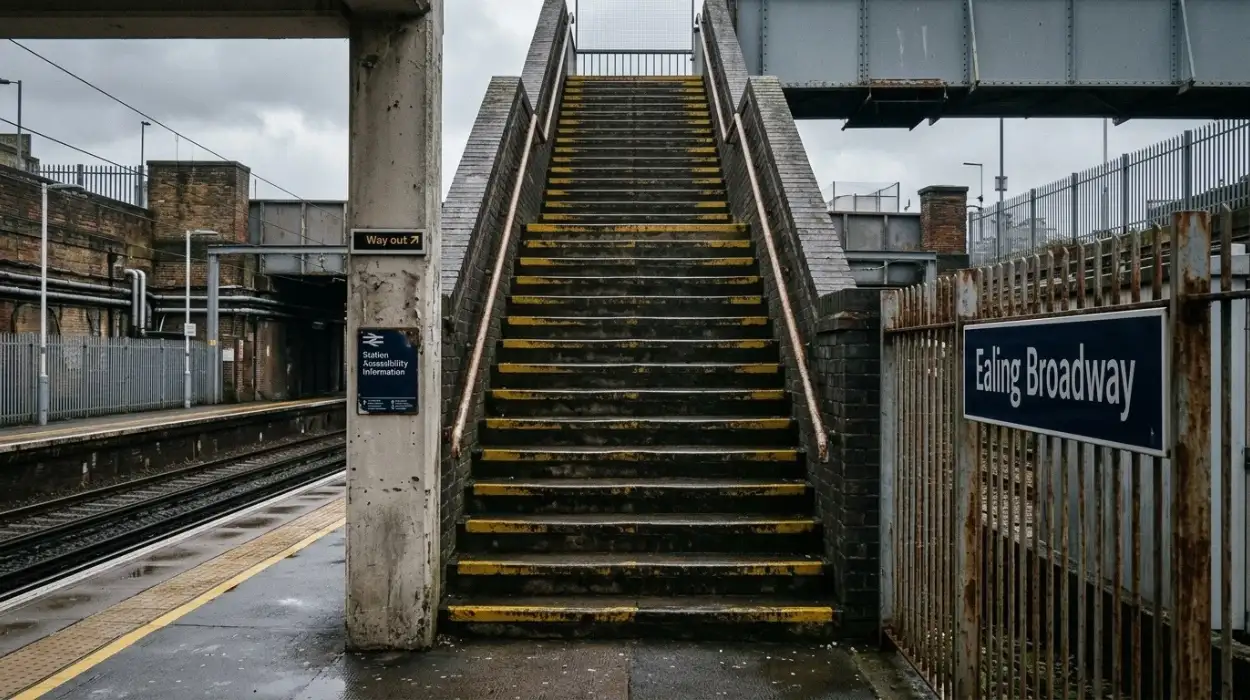
Modern accessibility standards can be difficult to apply retrospectively to historic railway stations. Platforms may be elevated, footbridges may connect platforms, and there may be limited space for lifts or new entrances.
For a passenger using a wheelchair, a step-free journey means more than avoiding stairs at the station entrance. Ideally, the passenger needs a continuous accessible route from the street to the correct platform and then an appropriate boarding arrangement for the train.
Someone travelling with a pushchair may have more flexibility, while a wheelchair user may have no practical alternative to a lift or suitable ramp.
This is why National Rail’s accessibility categories and individual station information are useful when planning a journey.
Which Ealing Railway Stations Have No Lifts?
The clearest examples are Drayton Green, South Greenford and Castle Bar Park.
Drayton Green is the most significant accessibility gap. National Rail currently categorises it as Category C, meaning there is no step-free access to the platforms, and confirms that the station has no lifts.
South Greenford is different. It has no lifts, but National Rail currently categorises it as B2, meaning there is some step-free access to all platforms. The platforms are above the level of the main entrance, so passengers should not assume that “no lifts” means the station has no accessible route whatsoever.
Castle Bar Park also has no lifts. National Rail categorises it as B3, meaning some step-free access is available to platforms, but potentially in only one direction. The station’s physical layout therefore makes it particularly important to check the direction of travel before relying on it for an accessible journey.
Drayton Green Has the Most Significant Gap
For someone searching specifically for an Ealing station without step-free platform access, Drayton Green is the clearest answer.
The station is on the Greenford branch and serves the West Ealing area. National Rail currently states that there is no step-free access to its platforms and that there are no lifts.
This creates a practical problem for wheelchair users who want to board or leave a train there.
Passenger assistance is available as part of the railway’s accessibility arrangements, but assistance does not transform a station into a step-free station. A passenger who cannot use stairs may need to choose another station or plan a different route.
For local residents, this can mean travelling to West Ealing or another accessible station instead of using Drayton Green directly.
South Greenford Has No Lifts but Some Step-Free Access
South Greenford is a useful example of why the terms “step-free” and “lift access” should not be treated as identical.
National Rail currently lists South Greenford as a B2 station. There is some step-free access to all platforms, but there are no lifts. The platforms sit above the level of the main entrance.
This arrangement may be workable for some passengers but unsuitable for others.
A passenger using a wheelchair should check the precise route and gradient before travelling. A person with limited mobility may also find a long or steep route more difficult than a conventional lift.
Consequently, South Greenford should not simply be described as either “accessible” or “inaccessible”. Its accessibility depends on the passenger’s needs and the specific journey.
Castle Bar Park Is Another Station to Check Carefully
Castle Bar Park has no lifts and is currently classified by National Rail as B3. Some step-free access to platforms is available, but it may only work in one direction.
This makes the station particularly relevant to passengers travelling on the Greenford branch.
A journey that appears straightforward on a normal route planner may not provide the same practical experience for someone who needs step-free access.
Passengers should therefore check the direction, platform and current accessibility status before setting out. If the station cannot provide the required access for the intended train, travelling to an alternative station may be more practical.
What About Acton Central?
Acton Central deserves separate mention because it has no lifts but does not fall into the same category as Drayton Green.
National Rail currently categorises Acton Central as B1. It has step-free access to all platforms, but the routes may involve long or steep ramps or access via streets. There are no lifts.
For some passengers, this can still provide a usable step-free journey. For others, the gradient may make the route unsuitable.
This illustrates an important point when researching accessible transport in Ealing: a station without lifts is not automatically a station without step-free access.
Which Ealing Stations Do Have Lifts?
The major Elizabeth line stations in the borough generally provide much better step-free infrastructure.
Ealing Broadway is currently Category A, with step-free access to all platforms and lifts.
West Ealing is also listed by National Rail as Category A, with step-free access to all platforms and lifts.
Hanwell is listed by National Rail as Category A, with step-free access to all platforms and lifts.
Southall and Acton Main Line are similarly Category A stations with lifts and step-free access to all platforms.
Greenford is also listed as Category A, with step-free access to all platforms and lifts.
This means passengers who need reliable lift-based access may find these larger stations considerably easier to use.
West Ealing and Hanwell Can Still Have Temporary Problems
Even where a station has permanent lift infrastructure, accessibility can be affected by faults.
TfL currently reports a lift-related access issue at West Ealing, stating that step-free access is unavailable because of a faulty lift.
Hanwell has also recently been reporting a faulty lift affecting one platform, meaning that its normal Category A accessibility should not be treated as a guarantee of completely uninterrupted step-free access on every day.
This is an important lesson for anyone relying on step-free travel. A station can be officially accessible while a temporary equipment failure changes the situation on the day.
Checking live station information shortly before travelling is therefore essential.
What About Ealing’s Underground Stations?
Ealing’s Underground network has its own accessibility picture.
Ealing Broadway is the strongest option because it combines National Rail, Elizabeth line, Central line and District line services and has lifts. TfL lists lifts among the station facilities, while the Elizabeth line station has step-free access to all platforms.
By contrast, Ealing Common, North Ealing and South Ealing do not currently list lifts among their station facilities. TfL’s current station information for these locations lists ticket halls and other facilities but no lifts.
This matters because someone searching for an “Ealing railway station” may actually be referring to an Underground station.
The best accessible route can therefore involve travelling slightly further to a station with better facilities rather than using the nearest station.
How Should Wheelchair Users Plan a Journey?
A wheelchair user should begin by identifying both the departure and arrival station and checking whether both provide the required type of step-free access.
The next question is whether the route between the platform and train is suitable. Step-free station access does not necessarily mean there is no gap or vertical difference between the platform and train.
Passenger assistance can also be arranged when needed. However, passengers should not assume that assistance can overcome a station’s fundamental lack of step-free access.
If a station has no lift or no step-free platform route, the practical solution may be to use another station, travel by bus or taxi to an accessible station, or alter the rail journey.
Why Nearby Accessible Stations Can Be Useful
Ealing’s network gives passengers several alternatives.
Someone who cannot use Drayton Green may consider West Ealing, subject to checking the current lift status. A passenger unable to use South Greenford might investigate Greenford or another suitable station depending on their destination.
For people travelling into central London, Ealing Broadway can be particularly useful because it offers multiple rail and Underground connections from an accessible station.
The best alternative depends on where the passenger is starting, where they need to go and whether the destination station is also step-free.
What Should Tourists and Visitors Know?
Visitors to Ealing may not be familiar with the difference between London’s Tube accessibility and National Rail accessibility.
A tourist using a wheelchair, travelling with a pushchair or carrying substantial luggage should check station facilities before choosing a route.
Ealing Broadway is particularly useful for visitors because it is a major interchange and has lifts. However, temporary faults can still affect accessibility, so checking current TfL information remains sensible.
Visitors should also consider the entire journey. A step-free station is only helpful if the surrounding pavement, bus connection, destination station and final destination can also be navigated comfortably.
Accessibility Is Improving but Still Uneven
Ealing’s transport network has become considerably more accessible, particularly through Elizabeth line investment and modernised stations.
The current National Rail information shows a clear contrast. Ealing Broadway, West Ealing, Hanwell, Southall, Acton Main Line and Greenford are Category A stations with lifts and step-free access to all platforms.
At the other end of the scale, Drayton Green remains Category C with no step-free platform access and no lifts. South Greenford and Castle Bar Park have no lifts but provide more limited forms of step-free access, while Acton Central has step-free access via ramps or streets without lifts.
For Ealing residents and visitors, the practical message is simple: do not judge accessibility solely by whether a station has the word “step-free” in its information. Check whether there are lifts, which platforms are accessible, whether the route is suitable for your mobility needs and whether any temporary faults are affecting the station.
Frequently Asked Questions About Ealing Railway Stations
Which Ealing railway station has no step-free access at all?
Drayton Green is currently the clearest example. National Rail categorises it as Category C, meaning there is no step-free access to its platforms, and it has no lifts.
Which Ealing stations have no lifts?
Drayton Green, South Greenford and Castle Bar Park have no lifts among the main National Rail stations discussed here. Acton Central also has no lifts, although it has step-free access to all platforms via long or steep ramps or streets.
Is Ealing Broadway station step-free?
Yes. Ealing Broadway is currently a Category A National Rail station with step-free access to all platforms and lifts.
Is West Ealing station accessible for wheelchair users?
West Ealing is normally a Category A station with lifts and step-free access to all platforms, but TfL is currently reporting a faulty lift and no step-free access. Passengers should check its live status before travelling.
Does South Greenford have step-free access?
South Greenford has some step-free access to all platforms but does not have lifts. National Rail categorises it as B2, so passengers should check whether the available route is suitable for their particular mobility needs.
Is Hanwell station step-free?
Hanwell is normally a Category A station with lifts and step-free access to all platforms. However, TfL is currently reporting a faulty lift affecting one platform, so passengers requiring step-free access should check the latest status before travelling.
What is the best way to check Ealing station accessibility before travelling?
Check the latest TfL or National Rail station information immediately before the journey, particularly if you require a lift. Temporary lift faults can change an otherwise step-free journey, so live accessibility information is as important as the station’s permanent accessibility category.