
Driving around Ealing can be convenient, but roadworks can quickly turn a familiar journey into a slower and more complicated trip. Temporary traffic lights, lane closures, resurfacing, utility works, pavement improvements and major construction projects can all affect journey times across the borough.
For drivers, the challenge is not simply knowing that roadworks exist. It is understanding where they are taking place, what type of traffic management is being used, how long works are expected to last and whether an alternative route makes sense.
Ealing Council coordinates roadworks carried out by the council itself as well as works undertaken by utility companies responsible for water, gas, electricity and telecommunications infrastructure. The council publishes a weekly schedule of planned road and street works, although emergency works and some very short-notice repairs may not appear in advance.
This guide explains what drivers should know about Ealing roadworks, how to check current updates and how to reduce disruption when travelling through Ealing.
Why Are There So Many Roadworks in Ealing?
Roadworks happen for several different reasons. Some are carried out to maintain the road itself, while others involve underground infrastructure or wider transport improvements.
Ealing Council is responsible for activities such as road resurfacing, footpath renewal, street-lighting repairs, pothole repairs and other highway maintenance. Utility companies may also need to excavate roads to repair or replace gas, water, electricity or telecommunications infrastructure.
This means two roads close to each other can be affected by completely different projects.
For example, a driver might encounter temporary traffic lights because a utility company is replacing a mains supply, while another nearby street could have a lane restriction because of council highway improvements.
Understanding this distinction can help explain why some works appear to last longer than expected or why traffic management changes during a project.
How to Check the Latest Ealing Roadworks
One of the most useful resources for drivers is Ealing Council’s weekly list of planned road and street works.
The schedule includes roadworks, utility works, maintenance activity and road closures planned within the borough. It can provide information about the location of works, the organisation carrying them out, the type of traffic control and the expected dates.
However, drivers should not treat the weekly list as a guarantee that every obstruction will be shown. Ealing Council specifically explains that minor repairs and emergency works carried out at very short notice may not be listed.
For this reason, checking the latest information before a longer journey is more reliable than relying on an old roadworks notice.
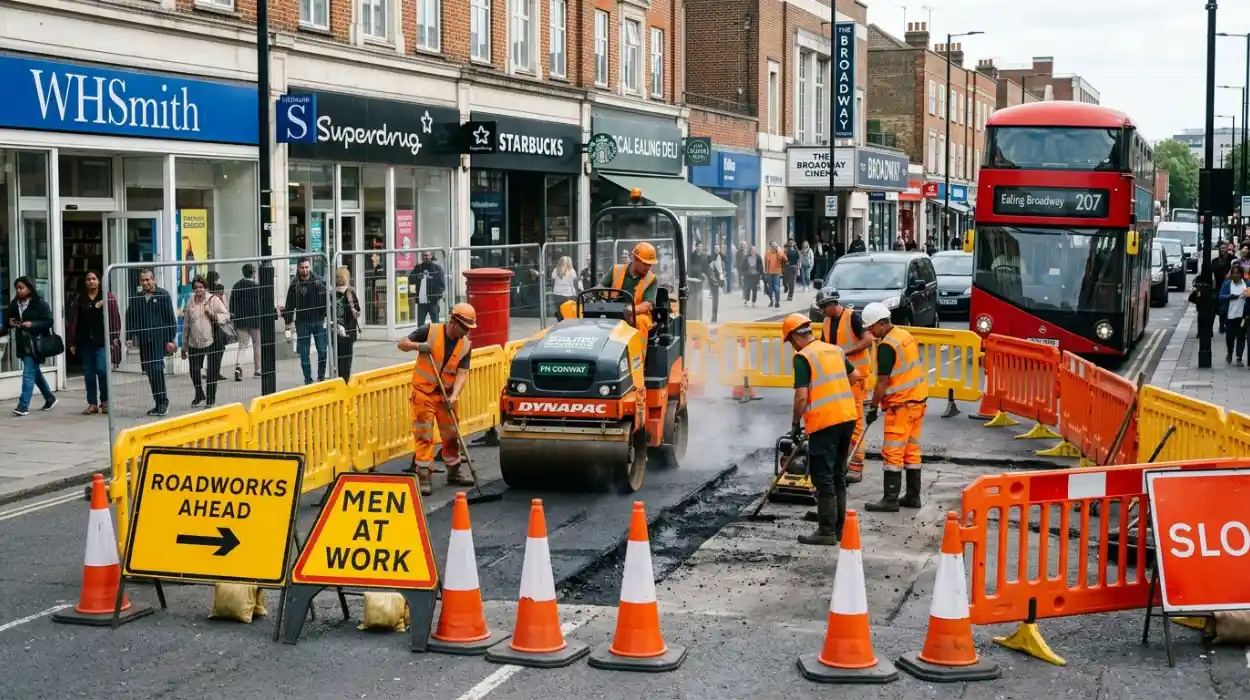
Roadworks Around Ealing Broadway
Ealing Broadway is one of the borough’s busiest areas, with shopping, restaurants, offices, residential streets and major transport connections.
Even relatively small works can affect traffic flow here because surrounding roads already carry significant amounts of traffic.
Drivers travelling towards Ealing Broadway should therefore allow extra time when roadworks, temporary traffic lights or lane restrictions are reported nearby.
It can also be useful to distinguish between the main destination and the route used to reach it. If your destination is Ealing Broadway, you may not necessarily need to drive directly along the busiest central roads. Depending on the location of the works, approaching from a different direction or parking slightly further away may make the journey easier.
Uxbridge Road and West Ealing
Uxbridge Road is an important east-west corridor through Ealing and connects several major neighbourhoods.
Roadworks along or near Uxbridge Road can have a wider impact because traffic diverted from one section may place additional pressure on neighbouring streets.
Ealing Council maintains information about proposed works and highway projects associated with Uxbridge Road.
Drivers travelling through West Ealing, Hanwell or towards Acton should therefore check the current situation before setting off, particularly during peak commuting periods.
If temporary traffic management is operating, following the signed diversion is generally preferable to making an improvised turn into unfamiliar residential streets.
Roadworks in Acton and North Acton
Acton and North Acton are important areas to watch because of ongoing development, transport improvements and major construction activity.
The council’s published roadworks information includes works associated with North Acton and surrounding streets, while longer-term construction projects can create traffic restrictions that last considerably longer than ordinary maintenance work.
The distinction between short-term road maintenance and major construction is important for drivers. A pothole repair might affect a road for a short period, whereas infrastructure or construction works can require traffic management over months or longer.
If you regularly commute through North Acton, it is worth checking route conditions regularly rather than assuming that the traffic pattern will remain unchanged.
Greenford Roadworks and Traffic
Greenford covers a large area, so roadworks can affect drivers differently depending on whether they are travelling around Greenford Broadway, North Greenford or towards Perivale and Northolt.
The council’s roadworks schedules have included works involving highway improvements, utility infrastructure and traffic control across Greenford and nearby areas. Published schedules can include measures such as multi-way traffic control, lane closures and road closures depending on the project.
Drivers should pay close attention to the type of traffic management being used.
A road listed as having a “carriageway incursion” does not necessarily mean that the entire road is closed. Traffic may still pass, although lanes could be restricted or controlled.
Northolt and Ruislip Road
Northolt is another part of Ealing where roadworks can influence journeys between neighbourhoods.
Ruislip Road is an important route for local traffic, and previous published schedules have included mains replacement works and multi-way traffic control on sections of Ruislip Road.
For drivers, this demonstrates why checking the specific traffic-control arrangement matters.
A temporary signal system may cause delays during busy periods without making the road completely inaccessible. Conversely, a full closure can require a significantly different route.
If you use Ruislip Road regularly, checking the latest weekly schedule before travelling can help you understand whether restrictions are currently affecting your journey.
Hanwell and Southall Roadworks
Hanwell and Southall also experience road and infrastructure works as part of ongoing highway maintenance and utility activity.
Roadworks can involve everything from resurfacing and drainage work to new utility connections and improvements to pedestrian infrastructure.
Southall can be particularly sensitive to disruption because of its busy high streets, residential areas and commercial activity. Drivers visiting shops or restaurants may find that a road remains accessible while parking or turning arrangements have changed.
Recent events also demonstrate why drivers should distinguish between planned roadworks and emergency incidents. For example, a temporary road closure in the Baird Avenue area of Southall following a fuel leak was lifted after the emergency response.
Emergency situations can therefore affect roads without appearing in ordinary planned roadworks schedules.
What Do Different Traffic Controls Mean?
Roadworks notices can use terminology that is unfamiliar to ordinary drivers.
Two-way traffic control generally means traffic continues to use the road in both directions, with temporary measures controlling movement.
Multi-way traffic control can be used where traffic needs to be managed through a more complicated work area.
Give-and-take traffic control usually means vehicles travelling in opposing directions take turns through a restricted section.
A lane closure means that one or more lanes are unavailable while the road may remain open.
A road closure is more significant because vehicles cannot pass through the affected section and need to use an alternative route.
Understanding these terms can help drivers interpret roadworks information rather than simply seeing a road name and assuming that it is inaccessible.
How Long Do Ealing Roadworks Last?
There is no standard duration for roadworks.
A small repair may take a short time, while mains replacement, major highway improvements or construction-related works can continue for considerably longer.
Published council schedules provide expected start and end dates, but these should be treated as planned dates rather than absolute guarantees. Works can be delayed by weather, engineering complications, additional repairs, safety requirements or changes to the project.
Utility works can also involve several stages. Excavation, infrastructure replacement, inspection and road reinstatement may happen at different times.
If a roadworks notice gives a projected completion date, drivers should still check the latest information if the restriction is important to their journey.
Why Do Roadworks Cause Traffic Jams?
Roadworks reduce available road capacity.
If a road normally has two lanes moving in each direction and one lane is temporarily unavailable, fewer vehicles can pass through the same point during each traffic cycle. Temporary signals can add further waiting time.
The problem can become greater during the morning and evening peaks.
Traffic may also divert onto surrounding roads, creating congestion beyond the immediate work area. A closure in one street can therefore affect roads several streets away.
This is why simply avoiding the visible roadworks may not always solve the problem. The surrounding network can also become congested.
Should You Take a Different Route?
Alternative routes can help, but they should be chosen carefully.
If you know that a major road is experiencing significant disruption, a route planner can help identify another way to reach your destination. However, immediately diverting onto small residential streets may not necessarily save time.
Local roads can become congested when large numbers of drivers attempt to avoid a main road.
For regular journeys, it is useful to identify two or three alternative routes before disruption occurs. This gives you options without making rushed decisions while driving.
If road signs direct you towards an official diversion, follow them rather than relying entirely on your sat-nav.
Using Sat-Nav During Roadworks
Navigation apps can be useful, but roadworks create a challenge because traffic conditions can change faster than digital maps are updated.
A sat-nav may suggest a route that looks shorter on the map but involves temporary traffic lights, narrow roads or heavy congestion.
For planned journeys, combine navigation information with official roadworks updates.
Ealing Council also directs drivers towards the interactive One.Network map for information about roadworks across London and the UK.
Using more than one source can give you a better understanding of both planned restrictions and real-world traffic conditions.
What Should You Do If You Encounter Roadworks?
When approaching a roadworks area, reduce your speed and pay attention to temporary signs.
Do not assume that your usual lane will remain open. Temporary lane markings, cones, barriers and traffic signals can change how traffic moves through the area.
Avoid sudden lane changes, especially near construction vehicles or temporary barriers.
If workers are operating close to the carriageway, give them plenty of space and follow their instructions.
Drivers should also avoid entering a restricted area simply because it appears physically possible. Temporary closures and traffic restrictions exist for safety as well as traffic management.
What If Roadworks Are Causing a Problem?
If you notice a roadworks problem, the appropriate contact can depend on which organisation is responsible.
Ealing Council explains that utility companies carry out many works across the borough. Its roadworks information provides contact details for companies including Thames Water, Affinity Water, Cadent Gas, OVO, UK Power Networks, BT Openreach and Virgin Media.
For council-related highway issues, Ealing’s roads, highways and pavements service provides information about reporting problems and highway maintenance.
If you are unsure who is responsible, checking the roadworks information first can save time.
Road Resurfacing and Highway Improvements
Not every roadworks project is about repairing an immediate fault.
Ealing Council also carries out planned road and footpath renewal works. Its published 2025–26 programme identifies roads and footpaths scheduled for improvement.
Highway improvement projects can involve resurfacing, pavement renewal, crossings, drainage, road markings and other infrastructure.
Although these projects can create short-term inconvenience, they are intended to improve the condition, safety or usability of the transport network.
For drivers, the key is to recognise that roadworks can be part of longer-term improvements rather than simply unexpected disruption.
How Drivers Can Reduce Delays
The simplest way to manage Ealing roadworks is to plan ahead.
Check the latest council roadworks schedule before a journey, particularly if you are travelling across the borough during a busy period. Allow additional time where traffic controls or closures are expected.
If you commute daily, consider whether travelling slightly earlier or later would avoid the busiest period.
For longer journeys, compare your usual route with an alternative before leaving. Keep an eye on temporary signs because conditions can change during the journey.
Most importantly, avoid making risky manoeuvres simply to save a few minutes. A slower but properly signed route is preferable to an unsafe shortcut.
Roadworks and Public Transport
When roads become congested, some drivers may consider leaving the car at home.
Ealing is served by Underground, Elizabeth line, National Rail, buses and other public transport connections, depending on the neighbourhood.
For journeys into busy centres such as Ealing Broadway, Acton or Southall, public transport can sometimes provide a more predictable alternative when roadworks are causing substantial delays.
This is especially useful for commuters who do not need their vehicle at their destination.
However, the best option depends on your starting point, destination, travel time and accessibility requirements.
The Future of Ealing’s Roads
Ealing’s road network is continuing to evolve through maintenance, transport improvements, cycling infrastructure, pedestrian schemes and major development.
The council’s roads and highways programme covers areas such as resurfacing, pavement renewal, highway improvement works, road markings and other infrastructure.
As Ealing develops, roadworks will remain part of maintaining and upgrading the borough’s transport network.
For drivers, this means that checking current information should become part of planning journeys rather than something done only when traffic is already bad.
Ealing roadworks can be frustrating, particularly when they affect a familiar commuting route or create unexpected delays. However, understanding why works happen and knowing where to find reliable updates can make driving around the borough considerably easier.
Ealing Council publishes a weekly schedule covering planned road and street works, including utility projects, maintenance and road closures. It also provides access to wider roadworks information through One.Network.
Because emergency works and very short-notice repairs may not appear in the planned schedule, drivers should combine official information with live navigation and traffic updates.
Whether you are travelling through Ealing Broadway, West Ealing, Hanwell, Southall, Greenford, Northolt, Perivale or Acton, a few minutes of preparation can make a significant difference.
Check before you travel, allow extra time when necessary, follow temporary signs and avoid unsafe shortcuts. Roadworks may be temporary, but careful journey planning can prevent them from becoming a major disruption to your day.
Frequently Asked Questions
Where can I find the latest Ealing roadworks updates?
Ealing Council publishes a weekly list of planned road and street works, including road closures, utility works and maintenance activity. Drivers can also use the One.Network map for wider roadworks information.
Are all roadworks in Ealing listed online?
No. Ealing Council explains that minor repairs and emergency works carried out at very short notice may not appear on the planned weekly schedule.
Why are there so many roadworks around Ealing?
Roadworks can be carried out for road resurfacing, pothole repairs, pavement renewal, street lighting, utility infrastructure, highway improvements and construction projects. Both the council and utility companies undertake works.
How can I avoid traffic caused by Ealing roadworks?
Check the latest roadworks information before travelling, allow extra time, use live navigation information and consider a suitable alternative route. Avoid making sudden or unsafe diversions through residential streets.
Do Ealing roadworks cause road closures?
Some projects require complete road closures, while others use lane closures, temporary traffic lights or other traffic-control measures. The weekly council schedule identifies the type of traffic management where available.
Who should I contact about a problem with roadworks?
The responsible organisation depends on the work. Ealing Council provides contact information for utility companies and information about reporting highway and road problems.
How often should drivers check Ealing roadworks?
Regular commuters should check updates before their journey, particularly when travelling through areas already affected by works. Checking the latest weekly schedule and live traffic information can help identify changing conditions.
:::