

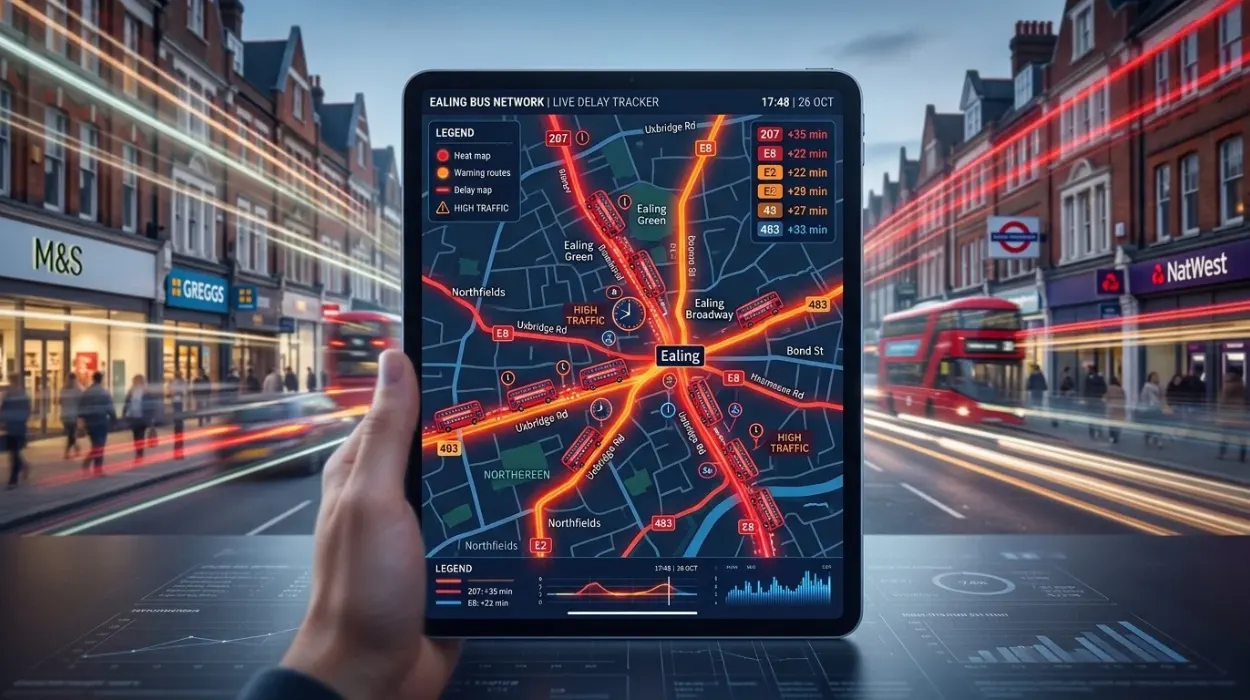
Ealing is well connected by bus, but travelling across the borough during weekday peak hours can be less predictable than the timetable suggests. Morning commuters, school traffic, roadworks, traffic signals, parked vehicles and congestion around major junctions can all increase journey times. For people travelling to work, school, appointments or transport interchanges, knowing which routes are more exposed to delays can make a noticeable difference.
There is no single permanent ranking of the “most delayed” Ealing bus routes because TfL bus performance changes with traffic conditions, diversions, roadworks and incidents. A route that runs reliably one week can experience significant disruption the next. However, some Ealing routes and corridors are naturally more vulnerable because they operate through busy roads and major interchange points.
Routes serving Ealing Broadway, Acton, Southall, Hanwell, Greenford, Northolt and neighbouring West London areas can all encounter peak-period congestion. The most useful way to assess reliability is therefore to understand the roads and locations where delays are most likely to develop.
Why Ealing Buses Are More Likely To Slow During Peak Hours
Peak-hour bus delays are rarely caused by the bus itself. Most delays are a consequence of the road environment around it.
Between roughly 7am and 9.30am, commuter traffic increases across West London. In the afternoon, congestion generally builds again from around 4pm, with school pick-ups, commuters returning home, deliveries and shopping traffic adding pressure.
Buses are particularly affected because they operate on public roads. Even when a route has bus lanes or priority measures, part of its journey may still take place in general traffic.
A five-minute delay early in a journey can also become a larger problem later. If a bus arrives late at a busy interchange, passengers may board at the same time as people from another service, increasing dwell time at stops. This can create a cycle in which buses become increasingly unevenly spaced.
Which Ealing Bus Corridors Are Most Delay-Prone?
Rather than identifying one route as permanently “the worst”, it is more useful to look at the major corridors used by several routes.
The Uxbridge Road corridor is particularly important. It connects several Ealing neighbourhoods and carries substantial traffic between areas including Ealing Broadway, West Ealing, Hanwell, Southall and beyond. Routes using busy sections of this corridor can be affected by congestion, junction delays and stop activity.
The Uxbridge Road and Ealing Broadway area is especially important because Ealing Broadway is a major transport interchange. Buses interact with Underground, Elizabeth line and National Rail passengers, while local traffic and pedestrians create additional pressure.
The A40 corridor and roads around Greenford and Perivale can experience different types of disruption. Traffic entering or leaving major roads can affect buses, particularly where congestion backs up into local streets.
Meanwhile, routes operating through Acton can be affected by congestion around busy junctions and connections with other transport services.
Ealing Broadway Is A Major Delay Point
Ealing Broadway is one of the most important locations to consider when assessing bus reliability in the borough.
It is not simply a bus stop. It is a major transport hub where bus passengers connect with the Elizabeth line, Central line and other services. The surrounding town centre also generates pedestrian, delivery and general traffic movements.
A commuter travelling from Southall towards Ealing Broadway during the morning peak may therefore experience delays caused by conditions several kilometres away from their final destination.
The same applies in the evening. A bus leaving Ealing Broadway may initially appear to be running normally but encounter congestion further along the Uxbridge Road.
For passengers with a train connection, this means a timetable should not be treated as a guarantee. Allowing a buffer is particularly sensible when a bus is being used to catch a specific train.
Routes Serving Southall Can Face Heavy Peak Traffic
Southall is another important area for understanding Ealing bus delays.
The neighbourhood has busy commercial streets, residential traffic and major public transport connections. Southall station is also an important Elizabeth line interchange, meaning bus movements can be influenced by passenger demand around the station and surrounding roads.
During peak periods, buses travelling through Southall may spend longer at stops because passenger numbers increase. A busy stop can therefore contribute to delay even when the road itself is moving reasonably well.
For passengers travelling from Southall towards Ealing Broadway, Acton or other parts of West London, it can be useful to check live TfL information shortly before leaving rather than relying entirely on the scheduled journey time.
Acton Bus Routes Can Be Affected By Junction Congestion
Acton has a particularly complicated road environment because several major routes and transport modes meet in the area.
Bus passengers can encounter delays around major junctions, town-centre streets and roads connecting Acton with Ealing, Shepherd’s Bush and central London.
Routes serving Acton can also experience different reliability patterns depending on direction. A bus may be relatively quick in one direction during the morning but slower in the opposite direction during the evening peak.
This is why asking whether an entire route is “delayed” can sometimes be misleading. Delay can be highly directional.
Someone commuting towards central London in the morning may experience a different journey from someone travelling west towards Ealing or Southall at the same time.
Greenford And Perivale Have Different Congestion Patterns
Bus services around Greenford and Perivale can be affected by traffic approaching major roads, shopping areas, industrial locations and residential neighbourhoods.
The A40 is particularly important because it carries substantial traffic across West London. Local bus routes that connect with roads near the A40 can be affected when congestion spills onto adjoining streets.
For passengers travelling between Greenford and Ealing, this can mean that the scheduled journey time becomes less reliable during busy periods.
A journey that takes 25 minutes outside the peak could take considerably longer when traffic conditions deteriorate.
The practical lesson is that residents should compare live journey conditions with scheduled arrival times rather than assuming the same delay occurs every weekday.
School Traffic Can Make Local Routes Unpredictable
Not all Ealing bus delays are caused by commuters.
School traffic can create significant short-term congestion, especially during morning drop-off and afternoon collection periods. This can affect roads near schools and residential streets that might otherwise move relatively smoothly.
A route can therefore experience a noticeable delay around 8am or 3pm without having the same problem later in the evening.
Parents travelling with children should account for this when planning journeys. A bus journey that normally feels comfortably long enough may become more difficult when traffic is heavier around school opening and closing times.
This is particularly relevant for routes connecting residential areas with schools, town centres and transport hubs.
Roadworks And Temporary Restrictions Can Change Everything
One of the biggest problems with identifying the “most delayed” Ealing bus routes is that road conditions are constantly changing.
Roadworks can reduce traffic lanes, alter junction movements or require buses to follow temporary diversions. Even a short-term restriction can have a significant effect if it occurs on a major corridor.
Temporary traffic lights are another common source of delay. When traffic is already heavy, a temporary signal can create queues that take several cycles to clear.
This means historical observations should be treated carefully. A route that had a poor reliability period during a particular roadworks project may perform normally once the work is completed.
How TfL Live Information Helps During Peak Hours
The most useful tool for an individual journey is usually live information rather than a general route ranking.
TfL provides real-time information about bus arrivals and service conditions. Checking the expected arrival of the next few buses can reveal whether a service is running normally or whether gaps are developing.
For example, imagine a passenger in Hanwell needs to reach Ealing Broadway by 8.30am. The timetable might show a bus every 10 minutes, but live information could reveal that the next bus is significantly late while two buses are expected close together afterwards.
That information changes the travel decision.
The passenger might choose an earlier bus, walk to another stop or consider an alternative transport connection rather than waiting for a service that is already delayed.
Why Bus Frequency Matters As Much As Delay
A route with frequent buses can sometimes be more practical than a theoretically faster route with infrequent services.
Suppose one service normally arrives every 7–10 minutes but is occasionally delayed. Another service may have a scheduled journey time five minutes shorter but run only every 20 minutes.
For the first service, missing one bus may not matter much. For the second, a small disruption can create a substantial wait.
This is why passengers should consider headway, journey time and reliability together.
A route with frequent services may provide more resilience because another bus is likely to arrive soon. A lower-frequency route can become problematic when traffic causes a service gap.
How To Reduce The Risk Of Being Late
Ealing passengers can take several practical steps to make peak-hour bus journeys more predictable.
First, check live departures before leaving home. This is particularly important when a journey involves a connection.
Second, allow additional time when travelling during the busiest periods. A journey that normally takes 30 minutes should not necessarily be planned with exactly 30 minutes between departure and an important appointment.
Third, identify alternative routes. Knowing that another bus, Underground station, Elizabeth line station or walking connection exists can be valuable when disruption occurs.
Fourth, consider the direction of travel. A route can perform differently depending on whether you are travelling towards or away from central London.
Finally, check for planned disruptions when you know you have an important journey coming up.
What Commuters Should Know About Ealing Bus Reliability
Regular commuters often develop their own understanding of which services are dependable at particular times.
One commuter might find that a particular bus is reliable at 7am but becomes inconsistent at 8am. Another might discover that the return journey is significantly slower between 5pm and 6.30pm.
Keeping a simple mental record of journey times can therefore be useful.
If a bus consistently takes longer on a particular section, passengers can build that into their routine rather than being surprised every day.
For people who have flexible working arrangements, shifting a journey by even 20 or 30 minutes can sometimes make a significant difference to congestion exposure.
Are Some Bus Routes In Ealing More Reliable Than Others?
Yes, but reliability can change over time and by direction, so it would be misleading to label one route permanently as the least reliable.
Routes using major congested corridors, busy town centres and transport interchanges are generally more exposed to delays than routes operating predominantly through quieter residential streets.
The most important factors include road congestion, bus-stop demand, traffic signals, roadworks, collisions, weather conditions and passenger boarding levels.
This also explains why residents’ experiences can differ. Someone travelling at 6.45am may have an excellent experience on a route that another passenger considers unreliable at 8.15am.
What Should Tourists Know About Ealing Buses?
Visitors to Ealing should remember that peak-hour bus travel can be slower than expected, especially on weekdays.
Tourists travelling to Ealing Broadway, Walpole Park, Southall or other local destinations should check their journey close to departure time.
If a visitor has a timed train, theatre booking, airport connection or other important appointment, it is sensible to allow extra time.
Visitors unfamiliar with West London may also underestimate the effect of road congestion. A journey that looks short on a map can take considerably longer by bus when several busy junctions are involved.
Using live information and allowing a reasonable buffer can make the journey less stressful.
How To Think About Ealing Bus Delays
The most useful conclusion is that there is no permanent league table of Ealing’s worst bus routes.
Instead, delay risk is strongly connected to the corridor, time of day, direction and current road conditions.
The Uxbridge Road, Ealing Broadway, Southall, Acton, Greenford and roads around the A40 are particularly important areas to watch because they combine significant traffic, transport interchanges and passenger demand.
For everyday travel, live TfL information is more useful than an old ranking of routes. A route that experienced problems last month may be running normally today, while a previously reliable route can suddenly be affected by roadworks or an incident.
Ealing bus delays during peak hours are influenced by much more than the timetable. Congestion on major corridors, busy town centres, school traffic, roadworks, passenger demand and connections with rail and Underground services can all affect journey times.
Routes operating around Ealing Broadway, Uxbridge Road, Southall, Acton, Greenford and Perivale can be particularly exposed because of the busy roads and transport connections they serve. However, delay patterns can change quickly, so passengers should avoid treating any route as permanently unreliable.
For commuters and residents, checking live departures, allowing extra time and knowing alternative routes are among the most effective ways to manage peak-hour uncertainty. For visitors, the same approach can prevent a relatively short Ealing journey from becoming an unexpected source of delay.
Frequently Asked Questions About Ealing Bus Delays
Which Ealing bus routes are most delayed during peak hours?
There is no permanent ranking because bus reliability changes with traffic, roadworks and incidents. Routes using busy corridors such as Uxbridge Road and areas around Ealing Broadway, Southall and Acton can be more exposed to congestion.
What time do Ealing buses experience the most delays?
Weekday morning congestion is generally strongest around the commuter peak, while another busy period occurs during the afternoon and early evening. School traffic can also create shorter periods of local congestion.
Why are buses around Ealing Broadway often delayed?
Ealing Broadway is a major transport and shopping centre. High traffic volumes, pedestrian activity, bus movements and connections with rail and Underground services can all contribute to slower journeys.
Are Ealing buses reliable during rush hour?
Many services operate normally, but reliability can vary considerably by route, direction and time. Live TfL information gives a more accurate picture of current conditions than a general assumption about a route.
Does the Uxbridge Road affect Ealing bus journey times?
Yes. Uxbridge Road is an important West London corridor carrying significant traffic and multiple bus services. Congestion, junctions and passenger activity can affect buses using different sections of the road.
How can I check whether my Ealing bus is delayed?
Passengers can check live TfL bus arrival and service information shortly before travelling. This can show whether buses are running close to schedule or whether longer gaps are developing.
Should I leave earlier when travelling by bus in Ealing?
If you have a work start time, appointment or transport connection, allowing additional time during peak hours is sensible. Delays caused by traffic or incidents can make actual journey times longer than scheduled times.